So here we are again, busy preparing for the festive season as another year draws to a close. Amid the frantic preparations, each December I delve into how people celebrated during the Middle Ages, back when Christmas was a joyful spiritual occasion with meaning rather than the over-hyped commercial fest it is now. Then in a family tradition we’ve made our own we try out a medieval custom or two, something that opens a portal to those tantalising times of Christmas past.

Time to play…
This year, I’ve been looking into one essential component that we still have in common with our distant ancestors: games. Medieval Christmases were full of them, from big group participation affairs to a spot of riotous gambling, or just some simple board games. Our quest led us to some greatly entertaining evenings involving brain-bending strategy, frozen fingers and some traditional family squabbles! So why not pour yourself a glass of your favourite winter tipple and join me for a peek into some of the festive fun of yore.
Fox and Geese
The first stop on our medieval gaming tour was a few rounds of Fox and Geese, the very game I bought on our visit to Barley Hall in York earlier this year. A popular medieval pastime, there are records of Edward IV (d.1483) ordering two sets of pieces of ‘silver over-gilt’ for his own pleasure, while the earliest evidence in Britain dates from the fourteenth century from a board carved into a stone bench in Gloucester Cathedral. It’s highly probable that the game dates back much further, and it continued to be played well beyond the Middle Ages, with adjustments to the rules and number of pieces used. Even Queen Victoria and Prince Albert were said to enjoy the game. Of course, we tried the medieval version and thoroughly enjoyed it.
Fox and Geese is a two-player game of capture that pitches a fox against a team of thirteen geese. Alternate turns move one square at a time on the cross-shaped board along either the straight or diagonal lines.
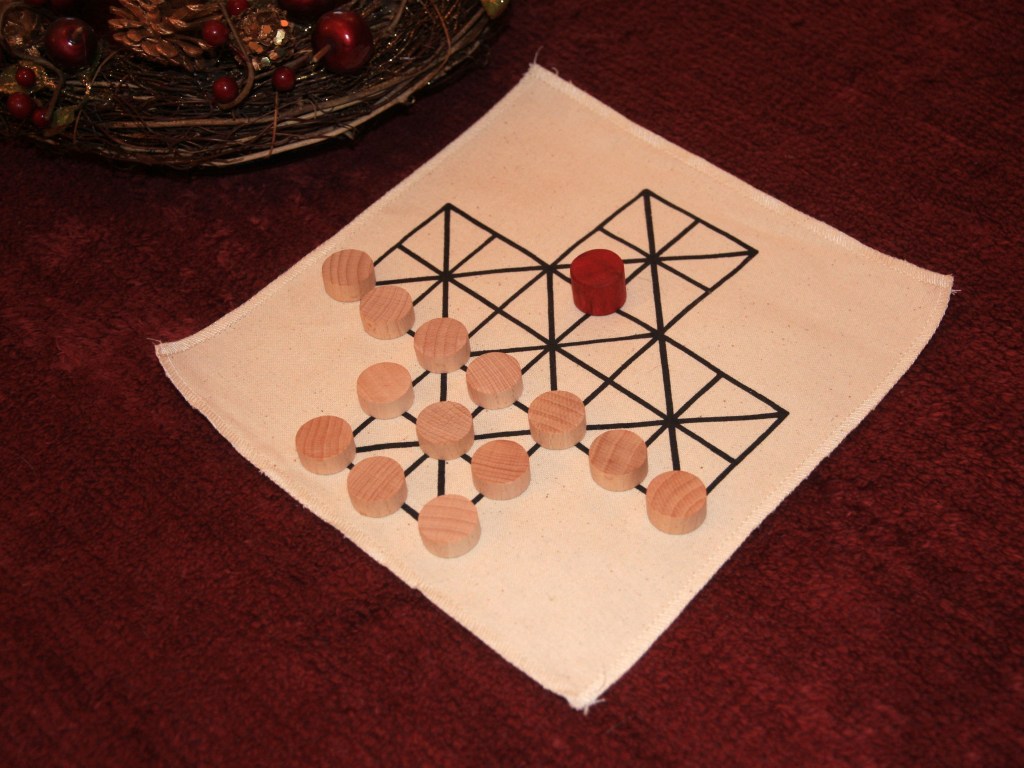
Set up and ready to play… the popular medieval game of Fox and Geese.
For the geese to win they need to hem in the fox so he cannot escape, while the Fox wins by taking enough of the geese to make their blockade impossible. Should the fox find itself adjacent to a goose with a free space on the other side he can jump it, drafts-style, and take the goose. Likewise, it can continue to jump as many such vulnerable geese in one go, changing direction if required, whereas the geese cannot take the fox. Straightforward enough, we thought, so we set up the board and gave it a whirl. But we soon discovered that Fox and Geese isn’t quite what it seems; the rules are simple, but playing it isn’t!
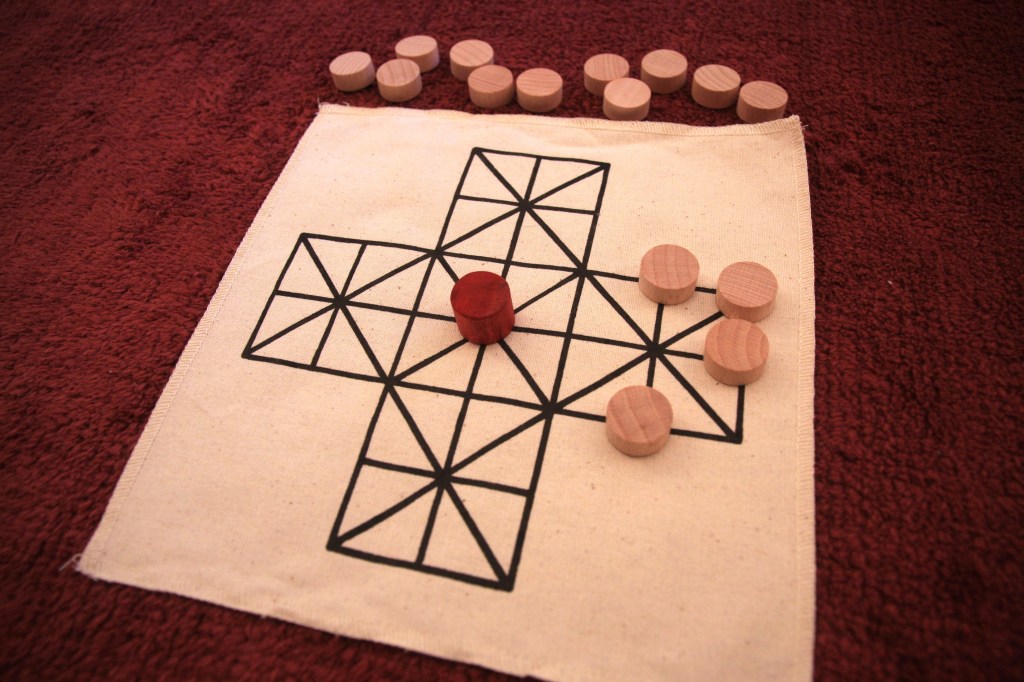
A hard won victory for the fox, but it’s not as easy as it seems!
In our first attempt (me vs Stuart), my geese won hands down, backing the fox into a corner without losing a single bird. It was great fun, but we couldn’t help thinking that the design of the game meant the geese would always win. However, we couldn’t have been more wrong. In the next round (Stuart vs Maddie), the opposite seemed true. Despite a valiant effort, Maddie was soon reduced to 8 geese, and a swift four-jump finish saw the fox triumphant. It was now we realised that, in fact, Fox and Geese requires a lot of thought. The final two rounds saw my fox pitted against Maddie’s, and then Stuart’s geese, and although I won in the end it was a much harder fight, and at times things could easily have gone the avian way.
Our verdict: Fox and Geese is now a firm favourite in the Templeton household, and we’ll be playing it a lot more over the festive season.
Hnefatafl
Similar to Fox and Geese but far more complex is Hnefatafl, a Viking game popular during the so-called Dark Ages in Northern Europe. Emerging from the mists of time, most of what we know about Hnefatafl (or King’s Table) has been learned from archaeological evidence, and we know the Vikings took their game with them wherever they went. Playing fragments have been found in York dating to around 950-1025, and further pieces come from sites as far apart as Ireland and Ukraine. The game’s popularity went into decline from the 11th century with the arrival of Chess, but it survived into the Early Modern era, with the last recorded play in Britain dating to 1597 in our home nation of Wales! But now we can change that record to 2025, and beyond…

Hnefatafl, the Viking Game.
Similar in nature to Fox and Geese, Hnefatafl involves a king, who sits in the centre of the board surrounded by his army, attempting to leg it to the safety of a corner fortress without being captured by the attackers. All pieces move as rooks in Chess, and opposition pieces can be captured by flanking them in a sandwich formation. If the king can reach one of the four corners safely, he wins. But he’s got to evade capture first. Again, we played several rounds with each of us winning, and we all agreed that the intrigue and strategy involved adds to the game’s appeal.

With men lost on both sides, the king makes it to a corner sanctuary without being captured, and wins the day.
Our verdict: another highly entertaining game, but the brain-straining tactics required is on another level, more akin to Chess. So, although we’ll certainly adopt Hnefatafl into our gaming repertoire, it may not be one to launch into if you’ve been on the festive booze!
Nine Men’s Morris
The last board game we tried, Nine Men’s Morris has been enjoyed since Roman times. Its popularity peaked in the Middle Ages when it was widely played across Europe, often on boards scratched into the earth, or on the stone floors of churches, castles or cathedrals with pebbles used as counters.

Nine Men’s Morris was widely played across Europe in the Middle Ages.
Nine Men’s Morris, or merels from the Latin merellus for ‘counter’ or ‘token’ is a three-in-a-row game that’s essentially a posh version of Noughts and Crosses. The board is set out on a grid of concentric squares interconnected by 24 ‘points’. To start, each player has nine counters, which they place alternately on one of the points with the aim of making a row of three, while the opponent tries to prevent them. Like Noughts and Crosses, this is usually achieved by blocking the third space. If you can make a row, however, you can remove one of the other player’s pieces.
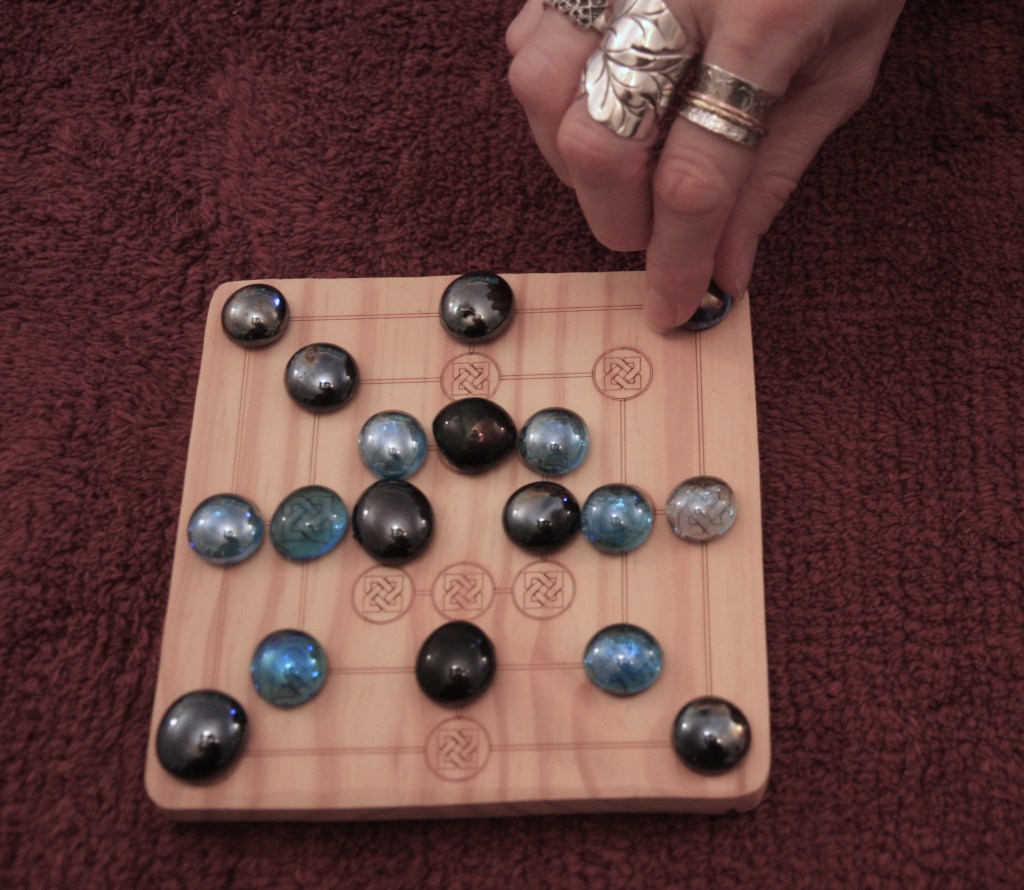
The game starts with each player placing a counter alternately on the board and trying to make a row of three.
Once all counters are on the board, each player in turn moves a counter to an adjacent free space, with the same row-and-removal goal, and whoever reduces their opponent’s number to only two is the winner. As a boost to the losing side, the player who gets down to three counters may start to ‘fly’ or ‘spring’ across the board, landing a piece on any free spot to give him a sporting chance of fightback.
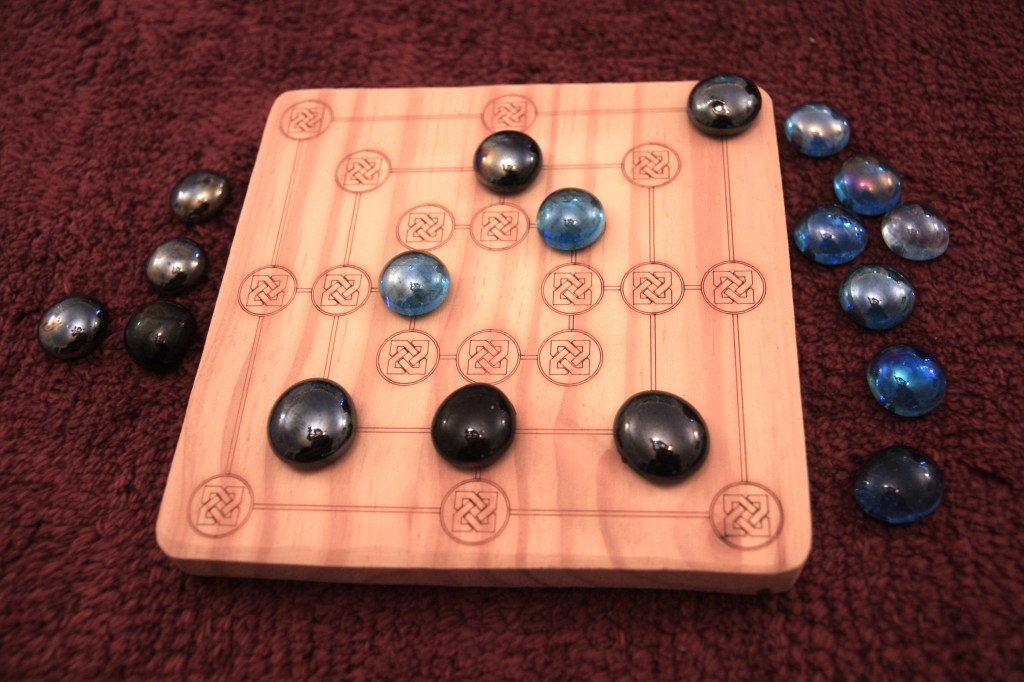
The game ends when one player is reduced to two counters. Here, I lost to Stuart’s cunning plan!
Again, we played several rounds of Nine Men’s Morris, and amid much mirth and a slight mead-induced haze we decided this game is all about out-witting your opponent. Each round was very different, leading to a fairly even score, with Stuart the overall winner.
Our Verdict: a highly amusing game, and one you can attempt even after the Christmas indulgence!
Hazard
One of the most popular pastimes during the Middle Ages was gambling with dice. Several games were in circulation, but the most popular was the delightfully disreputable Hazard.
Mainly a male occupation, these games of chance could prove addictive and therefore get folk into quite a pickle. Often fuelled by drink and high spirits, a player could gamble away not just his money, but any other possessions and even the shirt off his back! The twelfth century poet Wace writes in his Arthurian Chronicles that ‘The man who sat down to play clothed, might arise naked at the close of play’.
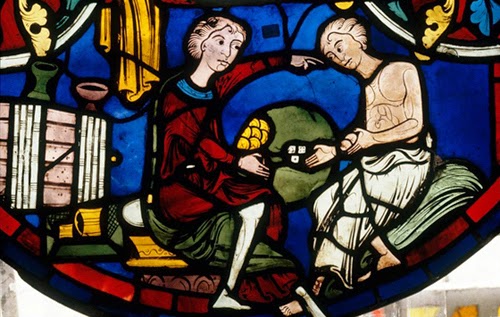
Two people playing at dice, depicted in a window of Bourges Cathedral in France. Notice the man on the right is without a shirt!
Often played in taverns, Hazard could involve cheating, unruly behaviour and even bloodshed. Nevertheless, dicing was hugely popular right across medieval society, from nobility and clergy to wealthy townsmen and the lower classes. But it was also frowned upon, earning the scorn of many influential figures, including John of Salisbury, a twelfth century bishop of Chartres, who called it ‘a damnable art’, and the celebrated fourteenth century writer Geoffrey Chaucer. In the Pardoner’s Tale, we read of a band of renegade youths:
Once there dwelt in Flanders a company
of young folk, who followed after folly
as riot, hazard, stywes (brothels) and taverns
…
They danced and played at dice day and night,
And ate and drunk inordinately.
Thus they did service to the Devil
in cursed fashion within the Devil’s temples
By abominable superfluity.
Sounds like fun, so we decided to try a bit of Hazard ourselves. Any number of people can play, and all you need is two dice, a surface to throw them on, and if you’re brave, something to gamble with. In our case, this was chocolate coins.
At first, the rules seem a little complicated as lots of numbers are involved, although once you’ve got your head around them it’s perfectly straightforward. For simplicity’s sake, though, I’ll outline them thus: the player rolling the dice at any one time is called the ‘caster’, while another is the ‘setter’ or banker, who takes the bets and deals out the winnings.

Here goes…
The caster picks a number between 5 and 9 inclusive, which is called the ‘main’, and places his bet. He/she then throws the two dice. If the main is matched by the combined number, the caster automatically wins (or ‘nicks’) and collects his winnings. To up the ante at this early stage, a selection of other set numbers, depending on the chosen main, will mean either success or failure. A result outside these becomes the ‘chance’.
The caster then rolls the dice again, but this time if the main comes up, he loses (or ‘throws out’), while the chance wins. If it’s neither, he keeps going until he rolls one or the other. Once the caster has lost three times in a row, the dice are past on to the next player who starts the process again. So, in best medieval style, we poured another glass of mead and argued over who was to go first…
The big surprise of the night was that Maddie, who won the toss to start, turned out to be a natural Hazard player, scooping most of our coins in a lengthy first innings. By the time she’d lost three times in succession and was forced to pass the dice on to me, we’d all gone off her and accused her of weighting the dice, while Stuart had been forced to bet one of his slippers! At least the balance was to some extent redressed after we’d all had a turn, but in the end we all lost out because we kept eating our winnings…

Look at that innocent face… but she’s a dab hand at Hazard!
Our verdict: it’s true, Hazard is a riot of a game and it deserves its reputation as ‘a damnable art’. But it’s also terrific fun, and we can all see why it was so popular. The dice will absolutely be featuring in our festivities, this year and next.
Snap-dragon
Our final venture was an insane game called Snap -dragon. The original version, which nobody should try at home, involved placing a large amount of dried fruit into a bowl, covering it with brandy and setting fire to it. Then, all other lights in the room were extinguished and players had to snatch a piece of fruit from the burning bowl and eat it as fast as possible, resulting in lots of scorched fingers and burnt tongues. Luckily, my source for Snap-dragon suggested a slightly less lethal re-creation of the game, so instead we went for the opposite effect, filling a bowl with heavily iced water and mixing in some cherries, raisins, sultanas and dates.
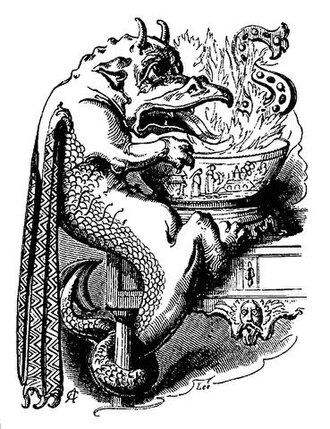
The insane original version of Snap-dragon.
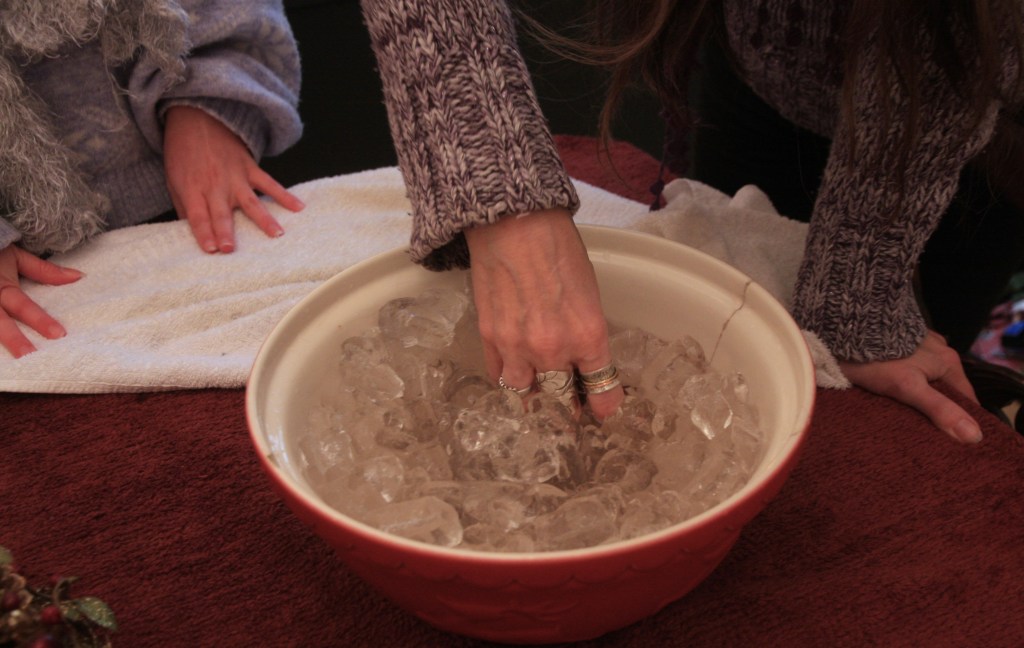
Using ice is pretty uncomfortable too!
At first it was very cold but not too bad as we all picked off the surface fruits, but this lulled us into a false sense of security. As the ice got to work, we had to plunge our hands deeper and deeper into the depths of the bowl and fish around to find a catch. That’s when the ice dragon began to bite, and soon we had a towel at hand to ease the freeze. In what was a brief and ridiculous bit of sport, we snatched as much fruit as we could before our fingers completely numbed!
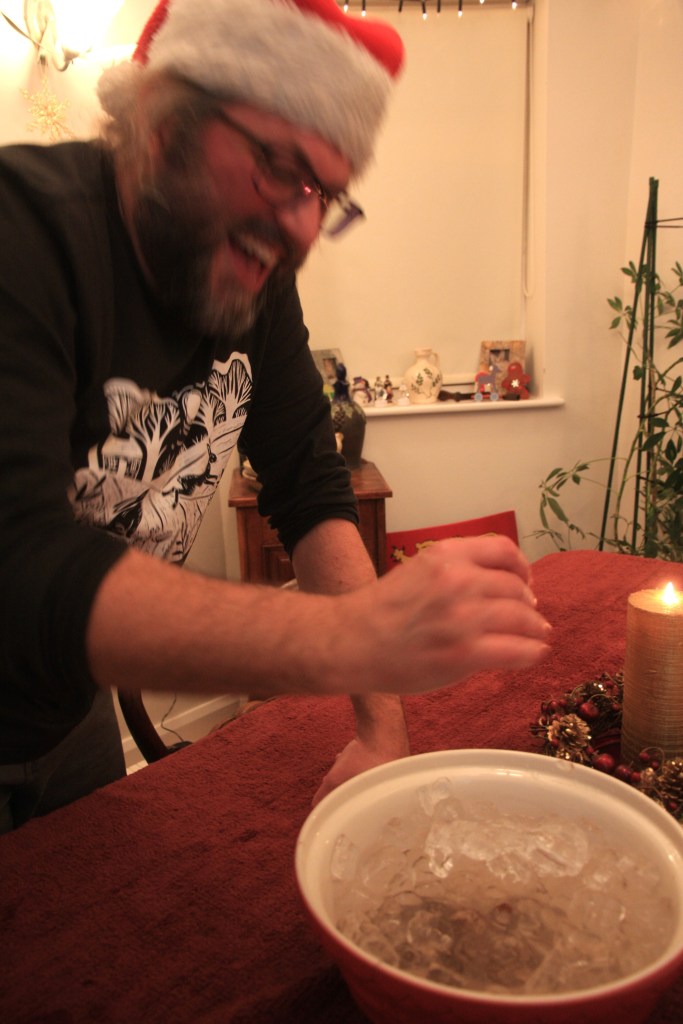
Numb fingers and freezing mouths!
Our verdict: bonkers, but (mostly) harmless fun. Snap-dragon is a painful but hilarious game, and to my surprise Maddie and Stuart said they would play it again. Perhaps just not that often!
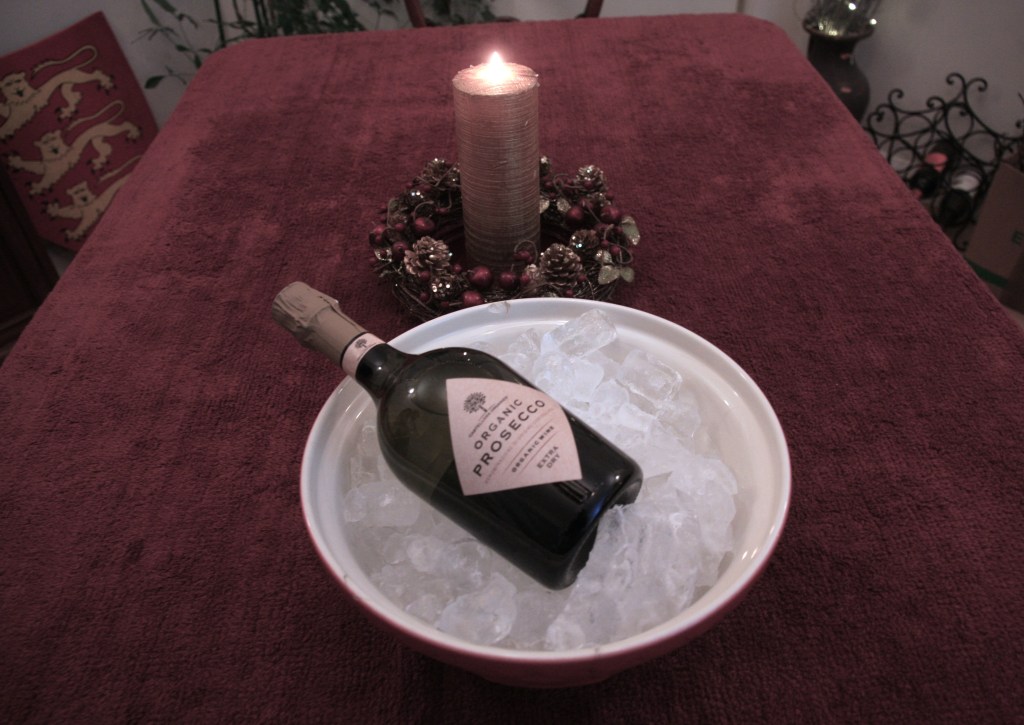
In the end we found a better use for the ice!
Like most ancient games, the rule sets of everything we played were subject to variations and changes over time, but we thoroughly enjoyed trying out the medieval versions and connecting with all those merrymakers of the past.
So which was our overall favourite? Well, for the festive period, when overindulgence means we’re not always firing on all intellectual cylinders, I think we’ll be playing a lot of Fox and Geese, with the odd game of Hazard for some rowdy amusement. But all of these games will come out time and again for years to come, except perhaps for Snap-dragon, which will likely remain an occasional folly, and is probably best left to the foolhardy medieval revellers…
Whatever games you play during this festive season, may they bring you much joy and laughter, and I wish you all a very Merry Christmas, and a happy and prosperous new year.

Merry Christmas!
 medievalwanderings.com
I’d play some of these games. I love a 2000 year old Chinese game, “Go.”
LikeLiked by 1 person
Wow, 2000 years – that’s a really old game! Go is a new one on me though. I’ll have to have a look into it. In the meantime, I can recommend the medieval ones, especially with a glass of mead! 🙂 Merry Christmas, Martha. x
LikeLiked by 1 person
Merry Christmas, Alli!!!! 🎄
LikeLiked by 1 person
🎄xx 😀
LikeLiked by 1 person
That was a great read! They sound a lot of fun – don’t fancy the Snapdragon one though (but I do have Reynauds so have to keep my hands warm). By the way, lose that wrapped-around oakleaf ring!
LikeLike
Glad you enjoyed the games, Carol. They were great fun, every one, and we’ll be playing them all many times more. Poor you having Reynauds though, so definitely no Snap-dragon for you.
My oakleaf ring )silver) came from Chester Christmas market last year. I fell in love with it when I tried it on and it fitted perfectly, So Stuart bought it for me for Christmas and I’ve worn it every day since! 🙂
LikeLiked by 1 person
I hope I see a ring like it one day as it’s lovely – just the kind of thing I like wearing… I don’t really suffer much with my Reynauds and it seems a lot better now I exercise much more and have got better circulation. But I do have to be careful and often even end up wearing gloves in summer on the fells.
LikeLike
Well I have to say I thoroughly enjoyed helping you research this post my love – what an absolute blast we had, even if Maddie was obviously cheating at Hazard!
I’m really looking forward to playing some more over Christmas, with lots more drunken merriment thrown in, and if we can find some more chocolate coins, perhaps I can win back my slipper- my foot is cold! 😀
LikeLiked by 1 person
Great fun, wasn’t it? Here’s to many more rematches over the twelve days of Christmas. 🙂 As for your slipper, well you don’t get it back that easily, because guess what? There’s another game they played in the Middle Ages that we haven’t tried out yet – it’s called ‘Hunt the Slipper’! 😉
LikeLiked by 1 person
😀 Ah but that shouldn’t be a problem – as you know I’m a master at finding lost things… except my marbles 😀
I’m looking forward to a lot more festive fun this Christmas!
LikeLiked by 1 person
Your marbles indeed… and flat caps, remember? That seems like a challenge to me – so Hunt the Slipper is on! 😉
On with the festive fun then.! 😀
LikeLiked by 1 person
I’m beginning to think the Naughty Elves stole my flat cap – it’s on a Snowman somewhere in the North Pole!
LikeLiked by 1 person
Who knows, but at least you’ve got another – nicely purple! – one now to replace it. Just don’t let the rascals get hold of it next year! 😉
LikeLiked by 1 person
That’s grand. Hope you have a great Christmas and a wonderful year of medieval wanderings.
LikeLiked by 1 person
Thanks John, glad you enjoyed our seasonal games. All good wishes to you and yours for Christmas and for 2026.
LikeLiked by 1 person
Have a grand time.
LikeLiked by 1 person
Most of these sound like fun, and I was interested to read about Hazard as I know it was also played in Regency times, in the gentlemen’s clubs and gambling dens.
LikeLiked by 1 person
Thanks, Sarah, yes they were all great fun in their own ways. 🙂 Like Hazard, many of them – including Snapdragon, amazingly, continued on through the centuries. But can you imagine the health and safety implications of the original rules now? As for Hazard itself, I believe it was the forerunner to the modern game of Craps. We’ve never played at dice before though, but it was huge fun and we’ll definitely be playing it more!
Have a great Christmas, Sarah, and all the very best for 2026. 🙂
LikeLiked by 1 person
Merry Christmas Alli, and all the best to you and your family for 2026 🎄
LikeLiked by 1 person
🎄🌟🍾
LikeLiked by 1 person
Wow, what an educational and entertaining post, Alli. Love the smiles and action shots -a nd these games are so interesting – especially the danger in some – like the snap dragon. And enjoyed seeing how you all explored Hazard and how that game is is ‘a damnable art’.
Happy new year and cheers to many wonderful things in store for 2026!!
LikeLiked by 1 person
Thanks Yvette, glad you enjoyed the festive games! It was great fun trying them out, and carried on enjoying them over Christmas (except Snap-dragon!). Maddie is still smashing us at Hazard, although we’re sure she’s got some trick up her sleeve!
Happy new year to you too, and all the best for 2026!
LikeLiked by 1 person
well I liked the “ice” option for that snap dragon one – and cheers to Maddie – and it does make me wonder how some folks have a sweet spot with games. We play yahtzee when folks visit and my cousin seems to roll the dice in ways that keeps him winning – needs five of a kind – he gets it. needs a full house, gets it. hmmm
LikeLiked by 1 person
Hmmm indeed! There’s got to be something going on! 😉
The ice ‘Snap-dragon’ is fun, and considerably less lethal! 🙂
LikeLiked by 1 person
🙂🙂
LikeLiked by 1 person
I’ve never seen games like these, cool!
LikeLiked by 1 person
Thanks John! They were all great fun, and it was a nice change from modern screen games – they got us talking and giggling, that’s for sure! 😀
LikeLiked by 1 person
That’s great! I remember the days before the internet and video games. People actually spoke to each other. Kids in the future will be born with necks that tilt forward from too much screen time. 😂
LikeLiked by 1 person
…and over-sized thumbs too from so much time playing on consoles! Yes that was one of the best things about these games. It was back to real face-to-face human interaction. 🙂
LikeLiked by 1 person
I’ve never heard of oversized thumbs from gaming but that would not surprise me! 😂
LikeLiked by 1 person
Who knows, the way the human race is going! 🙂
LikeLiked by 1 person
I’m 65 and have see a lot of you know what and I don’t like what I see coming for our countries and the world.
LikeLike