My last post came from our recent holiday in Northumberland, and the first image shows a place with which we have deep connection: the Sycamore Gap on Hadrian’s Wall. Just a couple of months ago we spent many cherished hours here, but now we are grieving. We’re all struggling to process this week’s devastating news that the noble tree we loved so much has been cruelly felled. The senseless destruction of this national icon and beacon of natural beauty has plunged the county into mourning. Its untimely and violent end sent a shock wave across Northumberland, the UK and around the globe, affecting everyone who knew and loved the most photographed tree in Europe.
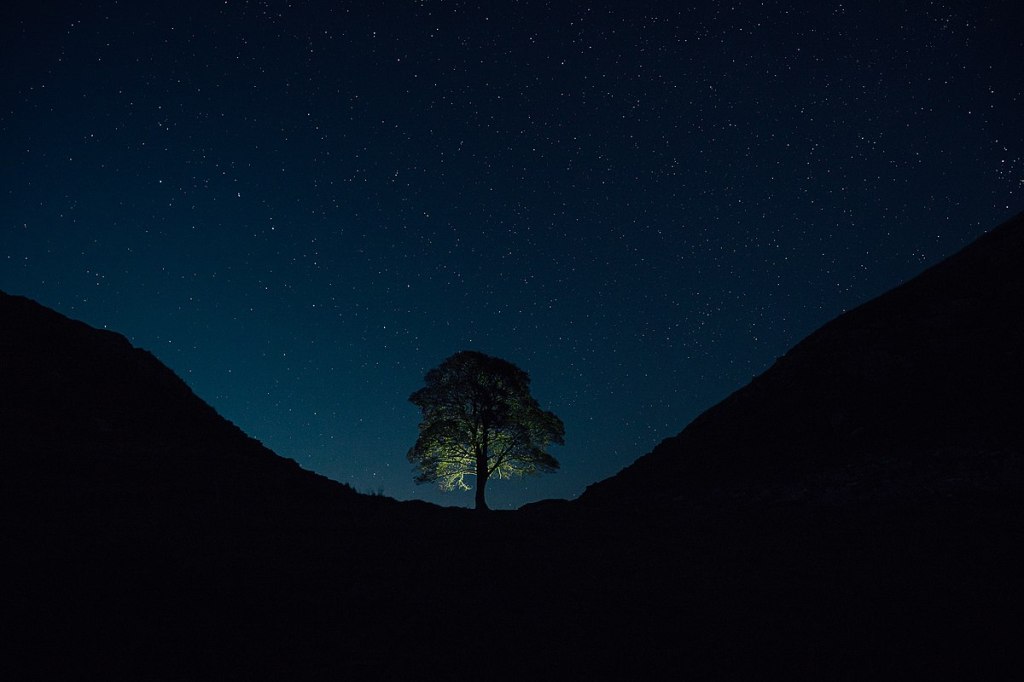
The celebrity tree occupied a prime spot on the Whin Sill, a natural system of dykes and raised ledges of dolerite rock formed around 295 million years ago, and spanning some 4,500km2 of Northumberland, Teesdale and Weardale. Little wonder then, that in the year AD 122 the Roman Emperor Hadrian chose this ready-made barrier on which to build a wall securing the Empire’s northern border in the province of Britain. The Sycamore was planted in its scenic position around 150 years ago, and as it matured and thrived the location became a focal point where history, geology and nature met to showcase Britain at its glorious best. The exquisite view of the tree framed within a dramatic dip in the wall inspired artists, writers, photographers and film makers, and it’s impossible to go into any gift shop in Northumberland without seeing its striking image.
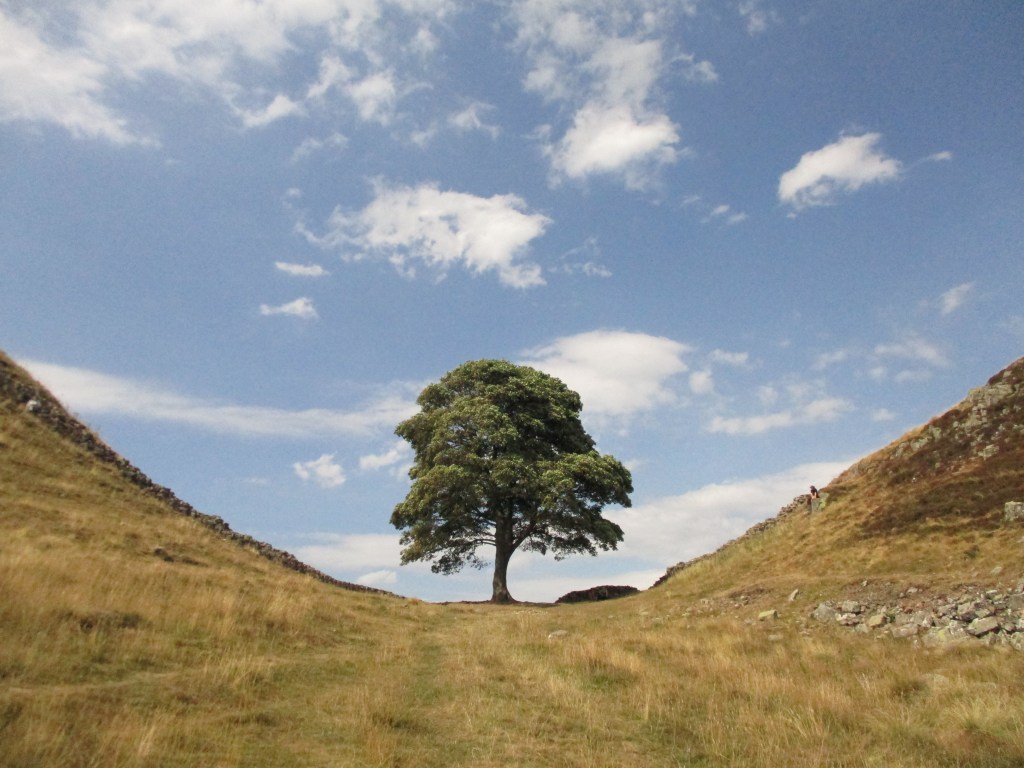
The unique beauty and tranquility of the Sycamore Gap drew visitors from all over the world and from all walks of life. Walkers trekking across the Wall would pause there to rest and record the famous stop on their journey, friends would wander along the hills to the shade of the tree on a summer’s evening, and couples embraced as proposals were made under its vibrant branches. Some people chose this idyllic spot as their final resting place, where their ashes, along with their memories, would suffuse the unsullied ground and find eternal peace in this little paradise. People would meet there, talk there, sit and chill there, reflect and remember, and always photograph the famous tree. But whatever was going on and whoever was around, the Sycamore Gap was always a place of peace and respect.


Our time at the Sycamore Gap was always treasured. It was a place of solace and celebration. When my degree award came through while we were in Northumberland in 2021, we chose this spot to mark my success with an evening picnic and a bottle of wine. A group of walkers passed us as we raised a glass, and they smiled in greeting while one of them said to her party ‘why didn’t we think of that?’. We visited the tree in all weathers, taking refuge under its verdant, shimmering canopy from both heat and rain. We explored the wall beside it, and collected fallen twigs from the ground around its roots as natural souvenirs, each one encapsulating its own cherished memory.
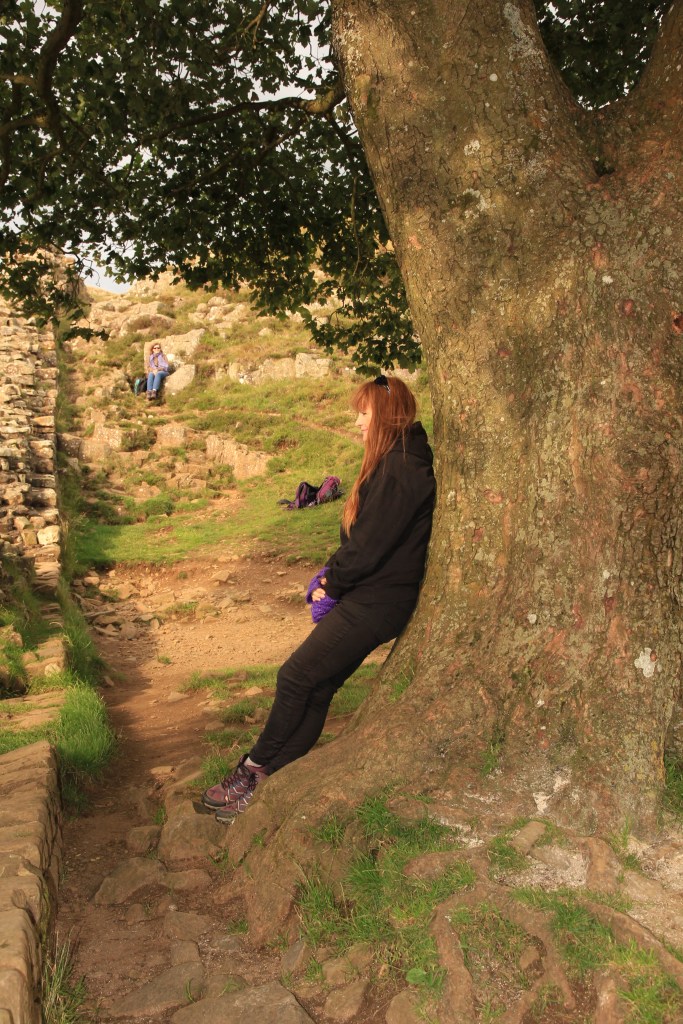

We collected fallen twigs from the Sycamore; now they’re even more precious keepsakes

For those who sadly never made it to the Sycamore Gap, it’s hard to describe the feelings the place evoked. Even though more than fifteen hundred years has passed since the Romans left, there remains a palpable sense of a frontier land. I would sit on the tree’s muscular roots with my feet up on Hadrian’s Wall and stare out at the wilderness beyond, to a land the great Empire failed to bring to heel, to a place, and its people, that were ‘other’. But it’s much more than that. The Sycamore Gap wasn’t just a site where two earthly realms collided. The tree by the wall seemed to bridge a barrier between this world and the next. It was almost a sacred space, a point at the thinnest edge of the physical world where the spirits were only a whisper away. And while the tree lived, they were.

The Sycamore touched so many lives, and resonated with so many people. And now it’s gone, brutally ripped from the heart of the Whin Sill, and we’re all reeling in shock and disgust. News reports show its noble form lying pitifully across the wall like a murder victim, the cherished spot now a taped-off crime scene. In recent years there has been a great deal of research into the lives of trees, and it seems there is a vast amount more to them than we had realised. In fact, they may not be all that different from us. The leading forest ecologist and scientist, Professor Suzanne Simard, has discovered many human-like traits in trees, and her findings make for intriguing, even poignant, reading. Although trees don’t have brains as such, Simard has learned that ‘the network in the soil is a neural network and the chemicals that move through it are the same as our neural transmitters’. It’s now widely believed that trees can experience pain, that they are social creatures, that they have memories, and that they may even be capable of distinguishing us as humans. Think of that…
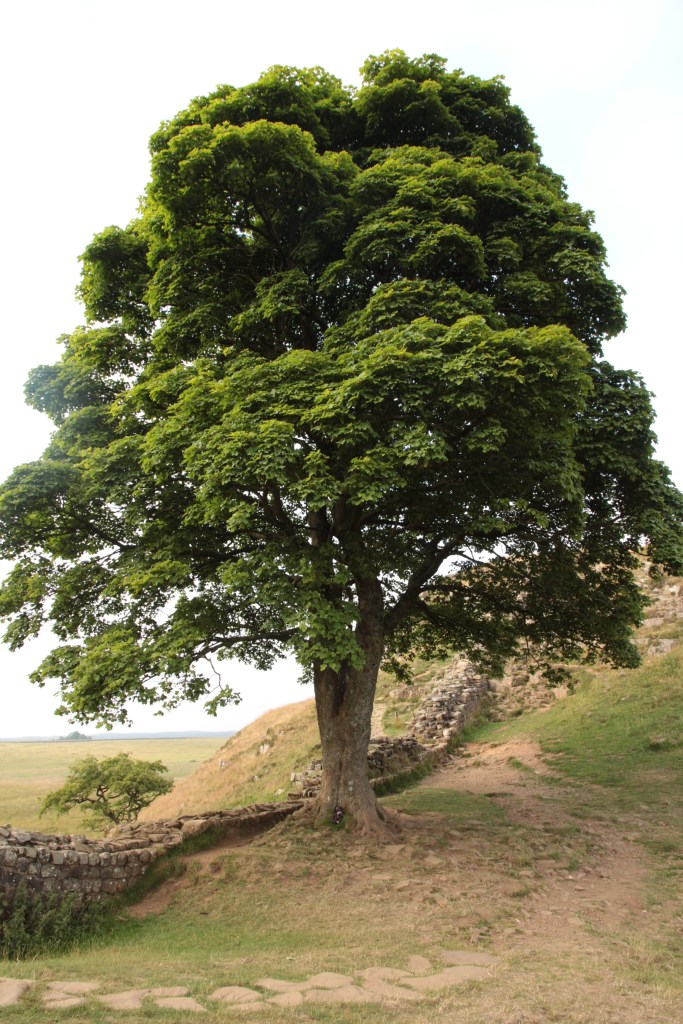
Our beloved place is no longer the Sycamore Gap. The dramatic dip in Hadirans Wall remains but, for us, it’s now a soulless gap, a void where there was once magic and life. There are plans to make this spot special again, to recreate a unique location where memories can be made and shared once more. But for many, and particularly for us, it will always be the sycamore void, the scene of happiness past before the heinous act of destruction.
As for the monsters who perpetrated this vile act, these inhuman beings, I hope the horror of what they have done haunts them for the rest of their miserable days. Not only have they killed the stunning Sycamore in the prime of its life, they have desecrated the precious memories of countless people, and robbed us – and thousands of others – of all the future joys that would have been experienced at this unique place.

I’d like to finish with a tribute to the Sycamore, an elegy in the form of a song. The lyrics were written by Rob Macfarlane, adapted from his poem written to accompany the enchanting illustrations of Jackie Morris, my daughter, Maddie’s favourite artist. Together, Macfarlane and Morris have produced two masterpiece books, The Lost Words and The Lost Spells, the latter of which we bought for Maddie, ironically, when we were in Northumberland this summer. Macfarlane’s poem, Heartwood, was set to music, along with several others from The Lost Words, to accompany a touring exhibition that, again ironically, began with an 11-month stay at The Sill, the discovery centre of the Northumberland National Park, located just a mile away from The Sycamore Gap.
Heartwood
Would you hew me to the heartwood, cutter?
Would you lay me low beneath your feet?
Listen to my sap mutter
Hear my heartwood beat.
Would you throw me on the log pile, cutter?
Would you toss me to the steel saw blade?
Listen to my leaves flutter
Hear my heartwood break.
Would you lean your back against me, cutter?
Would you rest your axe a while and sleep?
Listen to this song I utter
Hear my heartwood weep.
Hear my heartwood, heartwood
Hear my heartwood.
I drink the rain
I eat the sun
I gift the breath that fills your lungs
I hear the roaring engine thrum
But I cannot run…
Would you hew me to the heartwood, cutter?
Would you lay me low beneath your feet?
Listen to my sap mutter
Hear my heartwood beat.

Rest in peace, dear friend
Heartwood from ‘Spell Songs’: vocals by Karine Polwart, Lyrics by Rob Macfarlane, artwork by Jackie Morris.
 medievalwanderings.com
A Sycamore void it is indeed, its loss has left a huge void in our hearts and in the world – it’s was such a special place to so many people, the wound will take a long time to heal, if at all. As I said to you before, I’ve had a connection with this place for as long as I can remember, long before I even knew what the Sycamore gap was – I feel like I’ve had part of childhood stolen, and I’ve sure many feel the same…
…but that was a beautiful elegy my love, your words put voice to our feelings far better then mine ever could. XXX
LikeLiked by 1 person
Thank you. Now we know what we do about how complex trees really are this is even harder to take. I know you felt a connection with it from childhood so I can see how you’d feel robbed. But I’m glad you found it and that we got to spend such wonderful times there. It’s the thought of our future visits there being lost that hurts so much.
And now, like everyone else who loved the Sycamore Gap, all our memories there will now be tinged with sorrow. You’re right, it’ll take a long time to heal, if at all…
LikeLiked by 1 person
I do understand what it hurts so much, the lost times we could have had. I’m just so thankful I have you. XXX
LikeLiked by 1 person
Very sad indeed.
LikeLiked by 1 person
And a sad metaphor on the state of nature and humanity’s relationship with it.
LikeLiked by 2 people
Hi Alli, your well written and thoughtful article is the first I heard of this. Who did this awful thing to such an iconic and lovely tree and why? I have also read how trees share their roots and nutrients with their close friends who find themselves on less fertile ground. Our planet is closer to Avatar than we know. I hope you and family are keeping well. atb G
LikeLiked by 1 person
Gareth, so good to hear from you and thanks for adding your voice to the national chorus of disbelief. It really was a magical tree, and the poor thing will have suffered pain, shock and trauma, which makes the horrific news even harder to take. I’ve read a lot about the research done on trees, and I find them absolutely fascinating. It’s good to know that others like you are also becoming more aware that they’ve got a lot more in common with humans than we’d previously even dreamed of. And even then, in terms of learning about them we’ve only just scratched the surface. As you point out, truth can be even stranger than fiction. It’s a dark time for the world, that’s for sure, and that poor stump is a tragic metaphor for man’s abusive relationship with nature. Thanks again for getting in touch and for your lovely comments. I hope you are well too. All the best, A.
LikeLike
So sad
LikeLiked by 1 person
Thank you for the comment, Paul. Yes, it’s very sad indeed, and without any logic whatsoever. It’s affected so many people and the place will never be the same again.
LikeLike
A beautiful elegy to the lost sycamore. Like many, I was horrified when I heard what had happened, even though I’d only been to Sycamore Gap once on my many visits to the county.
LikeLiked by 1 person
Thanks Sarah. I wondered how well you would have known it. The Sycamore Gap meant a great deal to us and, as I know from reading about the research into trees, that the poor thing will have suffered at the hands of these mindless monsters it hurts even more. So many special memories for so many people. And we had plans for many, many more of our own. The world is all the poorer for the loss of the Sycamore.
LikeLiked by 1 person
A friend of mine shared this from a tree expert on Facebook. I have no idea if it’s true but it sounds encouraging:
‘A lot of people are understandably mortified by the vandalism of the Sycamore Gap tree, but I can guarantee, that tree isn’t dead or gone and will regrow vigorously from the stump. Ironically the little toerag who chopped it may have done it a favour and extended its life. Acers (European sycamores are Acer Pseudoplanatus) react very well to cutting and respond with strong regrowth. They used to be coppiced to stumps to regrow into fresh poles harvested on a 15 year cycle. In a few weeks it’ll be covered in shoots and new growth, next year it’ll be a thicket of branches, and in 5 years maybe 30 feet high. It’ll arise phoenix like from its ruin.’
LikeLiked by 2 people
Thanks for copying me in on this, Sarah. I hope it’s true, although opinion seems divided among the experts and scientists. Some say the shock will probably kill it, others like this person seem more optimistic. One thing’s for sure though, it’ll never be the same again. If it does survive it’ll be more like a bush than a tree, and we’ll never see it mature to anything like it was in our lifetime. I think that’s what hurts the most, that and knowing the tree would have suffered pain and trauma when it was felled. I’m grateful for at least a ray of hope for the future though, so thanks again. I appreciate that. 🙂
LikeLiked by 1 person
They just cut it down? It wasn’t because the tree was sickly? That’s horrible. I’m so sorry. It’s like losing a beloved family member.
LikeLiked by 2 people
Unbelievable, isn’t it? The tree wasn’t sickly at all, in fact it was thriving in it’s prime. This was a cruel and senseless attack on one of the few perfect places left in the world, all for no reason. You’re right, it is like losing a beloved family member. That tree meant so much to us, and now it’s effectively been murdered.
Thanks for your kind words, Marilyn. It means a lot.
LikeLiked by 1 person
I owe my life to a tree. I totally get this, Alli, and I’m very sorry. My heart goes out to you. 💔
LikeLiked by 1 person
Thank you for the kind words, Martha. I thought you’d understand. 😢 💔
…And I’m intrigued by how you owe your life to a tree. If you feel like telling me about it one day I’d love to know the story. 💜
LikeLiked by 1 person
…and I’m intrigued by how you owe your life to a tree. If you feel like telling me about it one day I’d love to know the story. 💜
LikeLiked by 1 person
Here’s the story, Alli! 💚 https://marthakennedy.wordpress.com/2018/09/30/mitigating%E2%80%8B-factors/
LikeLiked by 1 person
Oh that’s so lovely, Martha! Of course, I completely get it. And we can learn so much from trees, even life lessons for ourselves, just as you did. Wonderful. Thanks for this.💚
LikeLiked by 1 person
You’re very welcome!
LikeLiked by 1 person
We’re kindred spirits, you and I. 💜
LikeLiked by 1 person
I think so. 💚
LikeLiked by 1 person
😊
LikeLiked by 1 person
Alli, I hope you can see/hear this.
LikeLiked by 1 person
That’s mesmerising, Martha. I’d have loved to have been there at the station. The acoustics were incredible. If you close your eyes it sounds as though they’re in a cathedral! I’ve been watching some of their other videos and they’ve just got themselves a new fan! Thanks for sharing that, Martha. Wonderful. 🙂
LikeLiked by 1 person
I really think the culprits should be put in the nearest stocks in the area – or they should permit a lynching for what they’ve done!
I’m really sorry I never got to see the tree at ‘Sycamore Gap’ – of course, I was planning to and soon. I was shocked to the core when I saw the headline and read about its demise at the hands of some monster (or monsters).
I have to say that I always feel that trees and also mountains and other parts of nature are ‘entities’ rather than items. They just feel that way to me.
Really well written Alli – a fitting elegy. The poem is really great too – they should stick it on the wall of their cell if they manage to get them a jail sentence (which I hope they will but rather doubt).
LikeLiked by 1 person
Thank you so much, Carol.
I agree they should be lynched (preferably from the nearest sycamore!) for what they’ve done. Or felled at the knees.
I’m so sorry you never got there. I don’t know why but I’d assumed you had, so you must feel really cheated now. You’d have loved it. We feel cheated of all the future times we were going to spend there. It’s affected so many people, and really deeply too. You only need to look at the massive outpouring of grief and anger on social media. We can’t even face going back to Northumberland next year now, as we can’t bear the thought of seeing that poor stump in its desecrated site.
As for trees and other elements of nature being ‘entities’, I’m sure your feeling is right. All the recent scientific discoveries about how much trees have in common with humans has shown us that there’s a vast amount more to nature than we’d had any clue about before. It’s truly eye-opening and it’ll make it harder for us to see the natural world in any detached way now. After all, whether we like it or not, we’re not above nature, we’re part of it. We’ve just forgotten that.
Glad you liked the elegy, and thanks again for the great comments.
LikeLiked by 1 person
I hate it when so many people have the attitude that we’re above nature and above other species – we’re just part of it all.
LikeLiked by 1 person
Absolutely, me too. And nature is beginning to put us in our place.
LikeLiked by 1 person
This senseless act of vandalism upset everyone who appreciates a scene like this including me, but I can see that it upset you more than most.
LikeLiked by 1 person
Thanks for the comment, Malc, although I’d have to challenge your assertion that I’m more upset than most. Nothing could be further from the truth. You only need to look at the sheer outpouring of grief and outrage on social media to see I am far from unique in feeling so bereft. All my family feel the same. But much more than that; all the staff at The Sill, the visitor centre just a mile away from the gap, were all in floods of tears when they learned what had happened to their constant companion on the Whin Sill, some of whom had grown up with the tree and known it for all their lives. The Hairy Biker, Si King was on television, visibly upset, and said ‘Well I hope whoever’s done that has a conscience because you’ve just murdered a sentinel of time and elemental spirit of Northumberland’.
The people who own the cottage we stay in up there are ‘absolutely devastated’, and just look at Carol’s comment – and she never even got there. Northumberland, along with everyone who knew and loved the Sycamore Gap, is deeply upset. The destruction of one of the wonders of Britain has affected a great many people, from artists to walkers and many, many more. So I think in expressing our grief at the deliberate destruction of this beautiful tree, I’m speaking for the majority of people who knew and loved it, and are now trying to come to terms with it’s loss. 😦
LikeLike
I sincerely hope that you don’t think that I was being insensitive to your post Alli because like you say, nothing could be further from the truth. Of course I know how everyone feels about the wanton destruction of such an iconic part of that wonderful landscape because I feel exactly the same.
I imagine that you expected me to say as such in my comment, but there’s a reason why I didn’t, and it has nothing to do with your post which summed it all up perfectly. The desecration of that tree, and nature in general, is just another example of how awful the world has become, and for someone as sensitive as me about the planet, I find it difficult to put into words how I feel.
Today, I made one of my few trips out as I haven’t been in the best of health for quite a while, but I forced myself to go up to London to visit St Paul’s Cathedral. I’ve written about it, but that was before photography was allowed inside. Even though I found it a struggle, I also wanted to walk down Ludgate Hill into Fleet Street, the home of British printing (which if you remember was the trade I was employed in throughout my working life). I don’t know if you’ve ever been in there, but we went in Ye Olde Cheshire Cheese for a pit stop. It’s on many tourist’s itinerary, due to its literary connections and was the haunt of authors like Charles Dickens, Arthur Conan Doyle and Mark Twain amongst others. Some say that the master of the English language, Dr Samuel Johnson also frequented the pub as he lived close by, but I didn’t even have the energy to go and see where he lived, which to me is a real shame as it’s also open to the public.
Samuel Johnson is famous for saying “When a man is tired of London, he is tired of life” – and Alli – I’m tired of London.
LikeLiked by 1 person
I’m so sorry to hear that, Malc; that’s not good. I have to admit I’m also despairing of the world now, and this vile act just highlights how much humanity has lost its way. I’m going to go now and write you an email. 💜
LikeLiked by 1 person
That’ll be good. Thanks Alli 💙
LikeLike
What a gorgeous poem. Thank you. ❤️
LikeLiked by 1 person
Thank you, glad you liked it. It struck me as very appropriate. 🙂
LikeLiked by 1 person
Hi Alli, hoping you’re well. Just sending you a link to the latest post from a blogging lady I think you’d like:
https://wordpress.com/read/feeds/136055837/posts/4995600233
LikeLiked by 1 person
Many thanks for thinking of me and for the link, Carol. What a great read, and an interesting take on who stole what from whom. Very thought-provoking! 🙂
LikeLike
I find all her posts really good.
LikeLike