Welcome to Medieval Moments, a new series of short and (hopefully) sweet snapshots of life in the Middle Ages. These posts are designed to be read and enjoyed in just a moment or two, and will enable us to take a quick peek through the historical keyhole into all corners of the medieval world.
Subjects in the spotlight might be anything, from an object or person to a place, or perhaps the story behind something familiar that has its origins in the period. We won’t be covering full histories here, just focusing on a single relic or event from the past. With a little context thrown in, we can gain some fascinating insights into the medieval world, or simply discover what’s out there to go and see. But whatever is being covered, I hope you enjoy a moment’s break from the madness of the modern world. In this first episode we’ll go for a short but scenic walk to explore the natural sandstone marvel known as St Cuthbert’s Cave near Belford in Northumberland.
More of an overhanging outcrop than a cave, we set out to find this historical gem nestling high up in the Kyloe Hills after visiting Lindisfarne this summer. What we found was an oasis of peace and natural beauty, and the spiritual legacy of the man they called the ‘Wonder-worker of England’.
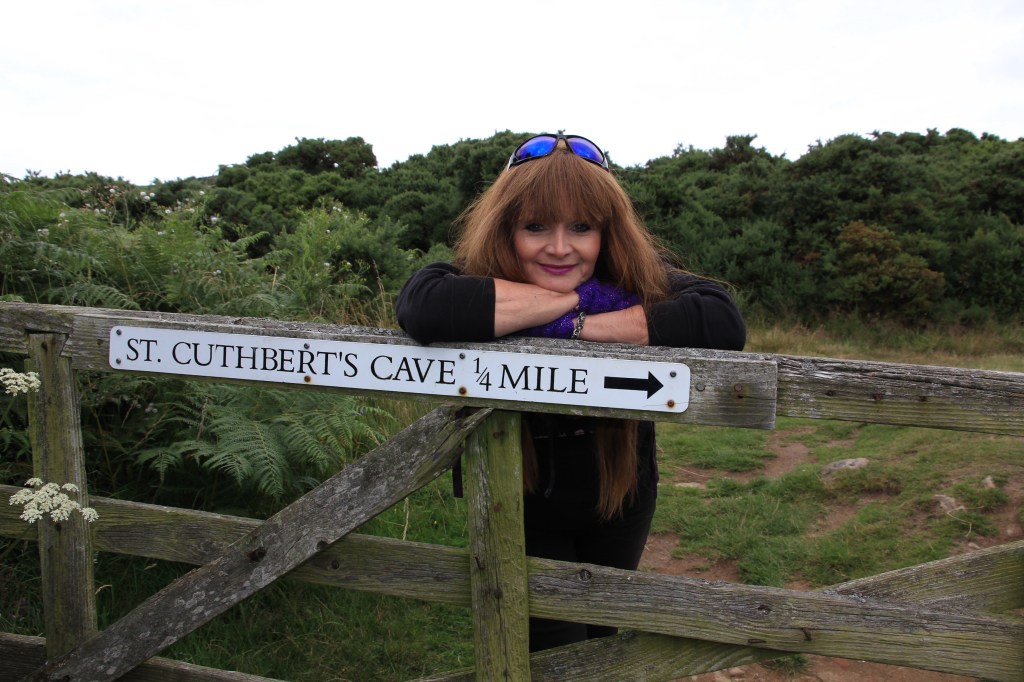
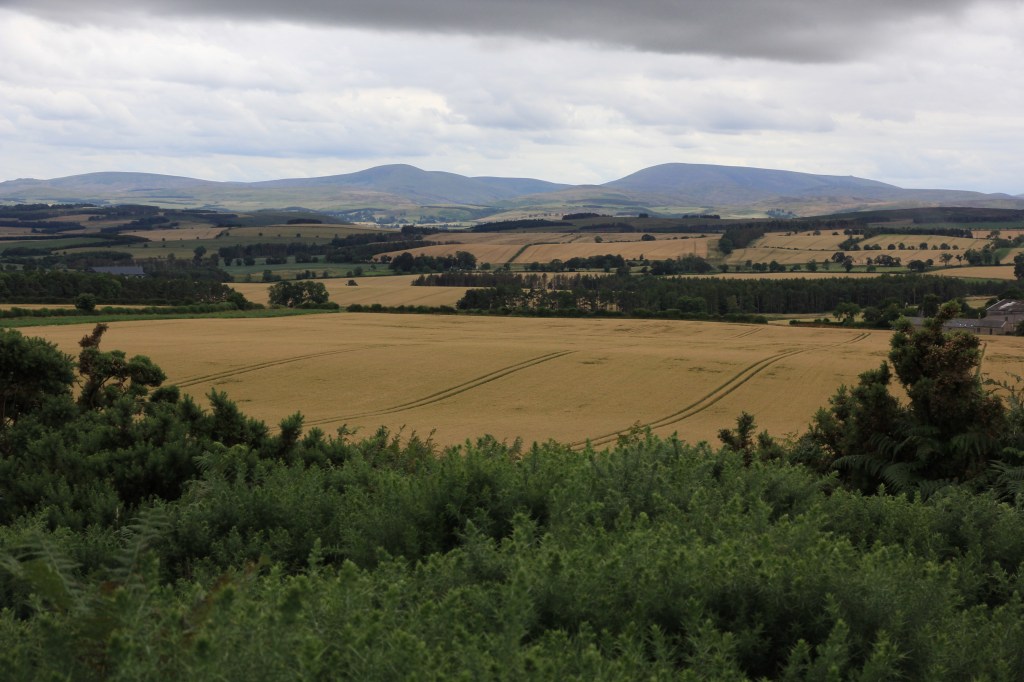
Beautiful views towards the Cheviot Hills on the walk to St Cuthbert’s Cave
Born around 634 AD, Cuthbert was, and still is, the star of the saintly show in the North, his reputation eclipsing all other leading churchmen of the age. His origins are veiled in mystery, but in 651, when he was only sixteen years old, he received a calling he couldn’t ignore. One star-spangled night as he was tending sheep on a hillside near Melrose, Cuthbert saw a vision of angels raising the soul of Aidan, Bishop of Lindisfarne, to heaven. This divine spectacle, it turned out, had coincided precisely with the time of Aidan’s death.

St Cuthbert, the ‘Wonder-worker of England’, as shown in a 12th Century wall painting in Durham Cathedral

Some beautiful woodland leads to our destination
Intensely moved by his vision, the young shepherd resolved to devote his life to the service of God. He joined the monasteries first at Melrose, and then Ripon before, at the age of 30, travelling to Lindisfarne Priory, where he lived as a monk, hermit and, for a time, the bishop. Described by Bede as ‘a very pleasant and affable man’, Cuthbert was an exemplary Christian. Widely revered for his values of humility, simplicity and tolerance, he was also famed for his love of wildlife and the natural world. He died in 687, but although his earthly days were at an end, his body was to take on a notable afterlife of its own.
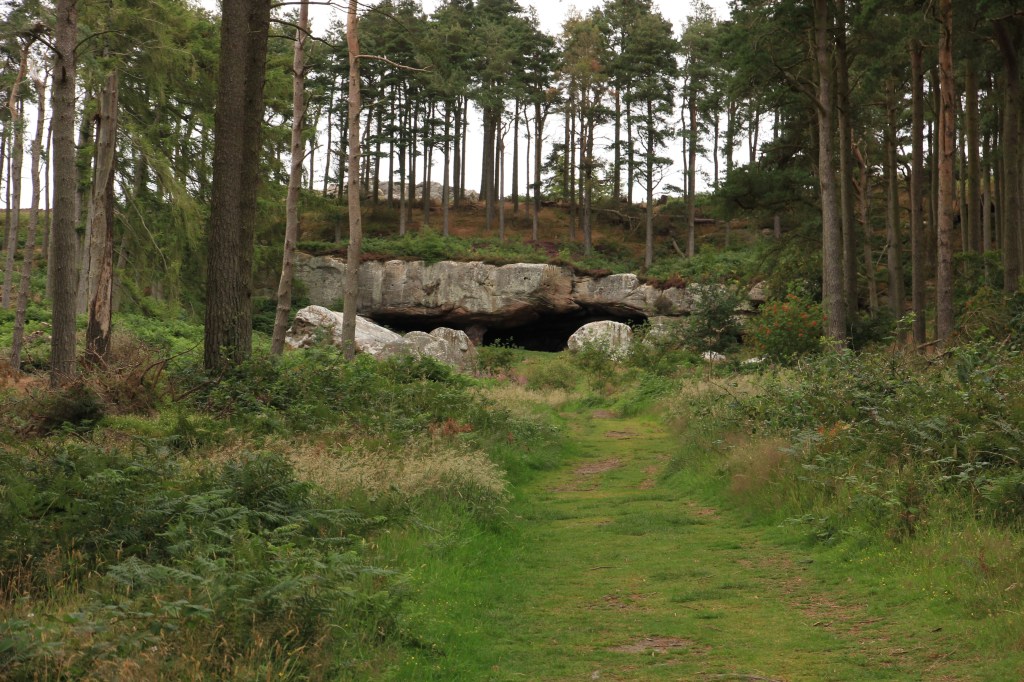
The first imposing sight of St Cuthbert’s Cave in it’s tranquil wooded surroundings
Cuthbert was buried in the Church of St Peter at Lindisfarne, but some eleven years later in 698 his body was transferred to a newly built tomb. When exhumed, his body was found to be as fully intact and preserved as it was on the day he died, a sure sign of Cuthbert’s sanctity. With numerous miracles reported at the new shrine, Holy Island became the foremost pilgrimage destination in Northumbria.
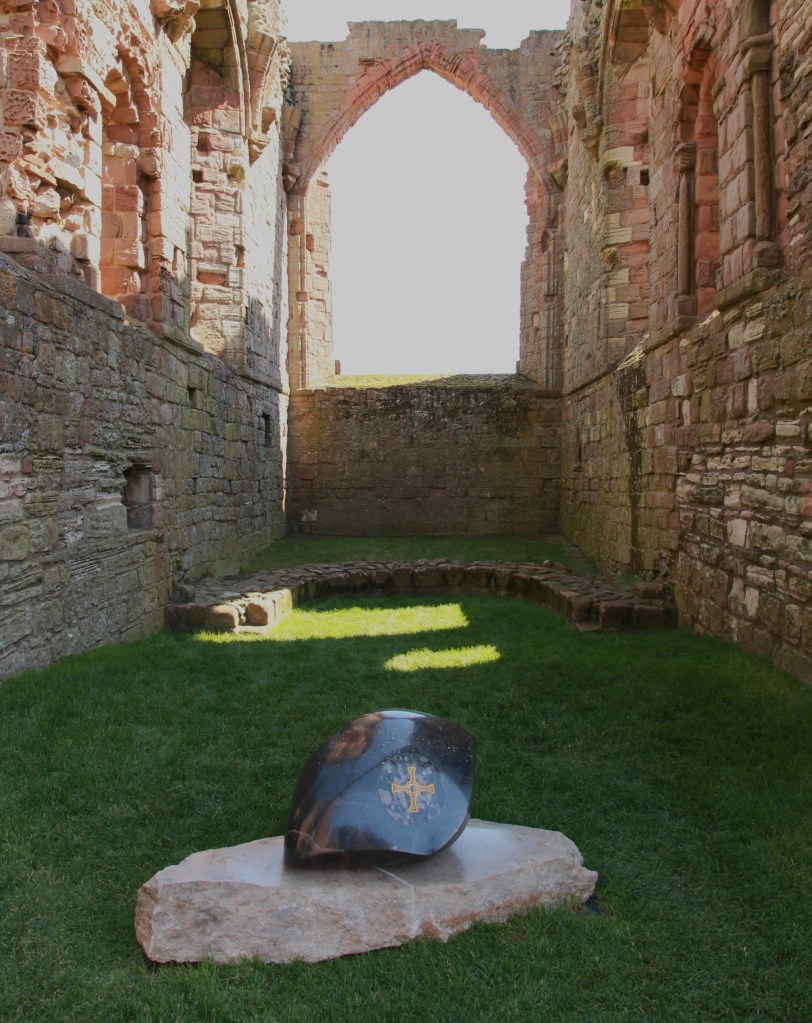
This commemorative stone, featuring St Cuthbert’s Cross and entitled ‘Feather Star Mantle’, was placed in the presbytery of the twelfth century Lindisfarne Priory in 2022. It marks the spot where Cuthbert’s original monument may have been located.
But in 793 the Vikings arrived to attack Lindisfarne, hailing a new age of peril for the priory. By 875 it was considered too risky for the monks to stay, so they fled, taking the relics of their beloved saint with them. The homeless monastic community took the show on the road, lugging Cuthbert’s coffin from place to place, with no fixed abode for eight years until 883 when they finally settled at their new home in Chester-le-Street. And that long and winding journey is where St Cuthbert’s Cave comes in, as this is believed to be one of the sites at which the monks and their precious cargo took shelter.

Supported by a natural stone pillar, the rocky overhanging outcrop is some 24m in width and 3m high, providing plenty of space for a roving band of monks and their saintly companion…

The interior of the cave is some 7m deep
The cave also boasts a second, more earthly connection with Cuthbert. It’s thought that he may have spent time here living as a hermit before moving to the Farne Islands, where even greater isolation allowed him to focus on prayer, and to commune with the wild creatures around him.

In 995, Cuthbert’s remains were finally enshrined at Durham, where he still lies in the grand Cathedral dedicated to his memory. I’m sure he would have been glad to end his posthumous travels and be allowed, at last, to rest in a sacred place for all eternity. But knowing his love for seclusion and the natural world, I think he’d have been just as happy to stay in the peaceful tranquility of the ancient cave that still bears his name.

 medievalwanderings.com
I enjoyed this so much! Thank you!
LikeLiked by 1 person
Well that was a moment worth taking – a really enjoyable post my love and a great idea for a series. I look forward to the next one.
I really enjoyed our walk up to the cave, such a beautiful part of the world and so peaceful. I can see why the Monks would have chosen it. I’m pretty sure that Cuthbert would have been more than happy to end his journey there – I know I would.
LikeLiked by 1 person
Thanks. It’s amazing to think that it had been there for millennia even before the monks arrived. Whether or not they really did shelter there, which, looking at it’s secluded position and proximity to Lindisfarne I reckon they may well have done, it’s a beautiful place, with wonderful wildlife too! 🙂 Looking forward to going back next time we’re up there. 🙂
LikeLiked by 1 person
I totally agree, and in fine Templeton tradition we should take some mead with us and drink a toast to Cuthbert
LikeLiked by 1 person
Now that’s a great idea! 🙂
LikeLiked by 1 person
I do have them occasionally 😀 And maybe a nice bit of medieval food to wash it down!
LikeLike
Well you’ve had two now! Perhaps some cheese and ‘compost’, followed by some medieval ‘gyngerbrede’… 🙂
LikeLiked by 1 person
mmmmm…. Now you’re talking! 😀
LikeLiked by 1 person
Here’s to Cuthbert! 🙂
LikeLiked by 1 person
Despite going to so many places with a link to Cuthbert, we still haven’t managed to get to thee famous cave – so thank you for the glimpse.
LikeLiked by 1 person
You’re welcome, John, I’m glad you enjoyed it. It’s a special place. It’s one of the points on St Cuthbert’s Way, which I hope to do at some point. I hope you can get there one day too. I’m sure you’d appreciate it.
LikeLiked by 1 person
I never knew anything about this cave Alli, but I can certainly see why you decided to seek it out. It ticks all the right boxes for you doesn’t it? A nice walk in a lovely peaceful location and with all that history to go with it. How true it is about Cuthbert’s connections with this rocky outcrop might be debateable, but sometimes it’s just nice to think that it could well be true, and that’s good enough for me.
I like the idea of your ‘Medieval Moments’. It’ll be a great way of adding some blogs when there’s not enough time for a more lengthy one, and it’ll break things up a bit too won’t it? 😊
LikeLiked by 1 person
Nice to know I’ve introduced you to a new piece of history, Malc, and yes it does tick all the boxes for us, and some extra boxes that weren’t even on the list! 🙂
We’ll never really know whether the connections with Cuthbert are true, but it’s only about 5 miles from Lindisfarne as the crow flies (closer to 10 on the ground, but still not that far), so I don’t think it’s beyond the bounds of possibility that they may have sheltered in this remote cave – it wouldn’t be a bad place to take refuge in for a bit. But either way, it’s a lovely place with quite a spiritual feel.
Glad you like the idea of Medieval Moments. You had all the same thoughts about it as I did. 🙂
LikeLike
I like spiritual places as you know Alli and I look forward to more of your Medieval Moments.
LikeLiked by 1 person
Thanks Malc, there’s a wide variety of different subjects to come, so I hope you enjoy them. 🙂
LikeLiked by 1 person
I like the idea of ‘Mediaeval Moments’ too
LikeLiked by 1 person
Thanks, Carol. Hope you enjoy them – there’s all kinds of things to come. 🙂
LikeLike
In that last photo, the topstone looks like it’s supported by a clawed foot and leg!
A bit of Christmas story to his beginnings there…
That looks a really great cave to visit – I must try to get to see it. Are you allowed to spend the night there do you think? It could be a great, atmospheric place to sleep for a night (leaving no traces of course).
LikeLiked by 1 person
That’s a very interesting question, Carol. I think the wood around the cave is looked after by the NT now, so not sure what the rules are. However, when we were in the cave there was clear black and charred evidence of someone having had a fire, so people do obviously stay there on occasion – and after all, the monks did! 😉 Besides, the place is pretty remote and quiet so who would know anyway? It’s really worth visiting, and I’m glad you enjoyed reading about it.
Funnily enough, I thought exactly the same as you about the pillar in the last photo – that’s why I included it! Great minds, eh? 🙂
I hadn’t made the connection with Christmas in Cuthbert’s early story though, but I can see it now you mention it. My Christmas post is also going to have a supernatural theme this year, admittedly of a different kind. 🙂
LikeLiked by 1 person
Sounds good! look forward to it
LikeLiked by 1 person
Thanks, Carol. 🙂
LikeLike
What a great idea for a series, and an excellent topic to start with. Cuthbert is a favourite of mine and my husband’s too, given our love of Lindisfarne. I knew his story well but have never heard of or visited this cave! Definitely somewhere we’ll seek out, so thank you for introducing me to it 😀
LikeLiked by 1 person
Thank you, Sarah! I’m a huge fan of Cuthbert too, and Lindisfarne is a very special place indeed. Glad to have introduced you to the cave though, which is well worth a visit, and it’s not far at all from Lindisfarne once you get back onto the mainland – only around 15 mins drive from Beal to the NT car park. It’s so atmospheric and peaceful, and the scenery is beautiful. So that’s good then – Medieval Moments has already done it’s job! Thanks again, Sarah. 🙂
LikeLiked by 1 person
We could use him back right now! Nothing else seems to have worked. Maybe a genuine official saint could get the world in gear?
LikeLiked by 1 person
Too right Marilyn, we certainly need a miracle or two!
LikeLike
An enjoyable read, Alli. I wandered over here from Malc’s blog and am glad I did. I had heard of the cave but never actually visited. It looks impressive and it’s good to make the connection with Lindisfarne. I’m more familiar with Durham but it’s a beautiful island.
LikeLiked by 1 person
Thank you, Jo! Glad you enjoyed discovering a little more about Cuthbert’s Cave. It’s an idyllic spot and well worth a visit. Funnily enough, I’m not that familiar with Durham, but I’m hoping to rectify that next year, particularly the cathedral, of course. Thanks for visiting. 🙂
LikeLike
It’s a lovely city, and I could never resist popping into the cathedral if I was there.
LikeLiked by 1 person
It’ll be our first stop in the city. 🙂
LikeLiked by 1 person