One of our favourite places in North Wales is a small tidal island on the south-western corner of Anglesey. The perfect place to escape, we love to wander along it’s winding paths and soak up the unspoiled beauty. While the tides heave and spray onto the ancient rocks, we watch seabirds ride the waves and waddle around the quiet coves digging their beaks into the sand. We’ve even seen dolphins play off the shore, their arching dorsal fins circling out of the water on their smooth backs, glinting in the sun. But today, we have another reason to celebrate this wonderful haven, as Llanddwyn Island is steeped in the legend of an early Welsh saint. For today, 25th January, is the feast day of St Dwynwen, Wales’s very own St Valentine.

St Dwynwen, the Welsh patron saint of lovers

Stretching out into the Irish Sea, Llanddwyn Island lies off the south-west of Anglesey, where the sprawling greenery of Newborough Forest opens out onto the shell-strewn sandy beach
To find St Dwynwen we must travel all the way back to the fifth century AD and the time of the early Welsh Kingdoms. According to legend, Dwynwen was the most beautiful daughter of King Brychan of Brycheiniog, now Breconshire. Many suitors set their caps at the girl, whose fair face was matched only by her flirtatious wit and intelligence, but none was good enough until she fell in love with Maelon, the son of the king of Gwynedd.

Llanddwyn (meaning the enclosure, or church, of St Dwynwen) Island is a stunning – and romantic – place to roam

A carved wooden gateway leads to one of the island’s tranquil coastal paths
During a royal visit to her father’s palace, Maelon found himself beguiled by Dwynwen’s charms, so the day before their departure he approached Brychan to ask for her hand in marriage. But to his horror the king refused, announcing that his daughter was already betrothed to another. That night, overcome with frustration and desire, Maelon broke into Dwynwen’s chambers and had his wicked way with her.
Fraught with shame and confusion, and fearing an outbreak of war should news of Maelon’s attack reach her father’s ears, Dwynwen fled into the forest. She prayed for divine intervention to erase the lustful prince from her mind – and the world – forever. Then, exhausted from her ordeal she fell asleep. When she awoke, she returned to the palace to discover that Maelon had been frozen in a block of ice. That night an angel appeared before her to announce that God had granted her three wishes, but also warned she should be careful what she wished for.

The view across the island. There’s an unmistakable ‘edge of the world’ feel to the place…

A Celtic cross stands near the ruins of Dwynwen’s chapel
Driven by guilt, Dwynwen’s first request was that Maelon be released from his icy prison and that he would live a good and honest life. For the remaining wishes, she asked that God watch over all true lovers, and finally that she should never marry.
God clearly approved because soon after Maelon was duly defrosted, making a full recovery. He got over his misdirected passion and went on to live a good and honest life, marrying and raising a family. As for Dwynwen herself, it could certainly be said that her other wishes also came true. She left her father’s court, travelled across Wales and built a chapel on this remote, wild spot spilling into the sea from the Island of Anglesey. And here she stayed, devoting the rest of her life to the service of God until her death in 465 AD. But despite being cut off from all she had known before, she must have been content with her chosen path, as she is famous for her saying:
‘Nothing wins hearts like cheerfulness’

The ruins of Dwynwen’s chapel
Although she never married, Dwynwen became associated with the plight of lovers everywhere. Young women would come to ask her if they had found true love, and she would direct them to a nearby well occupied by a sacred eel with the power of romantic prophecy. The hopeful enquirer would place a piece of bread on the surface of the water and cover it with her suitor’s handkerchief. If all remained calm the love was surely true, but if the eel devoured the bread in a fit of anger then the chap was nothing but a rogue and a cheat, and she’d be better off without him.
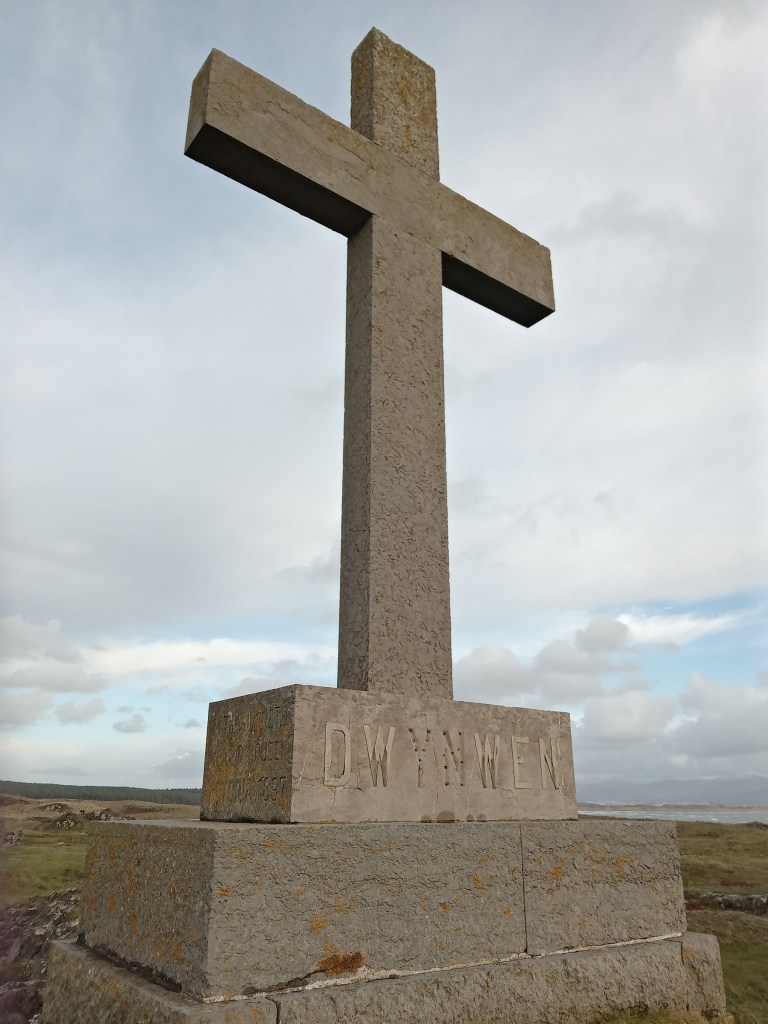
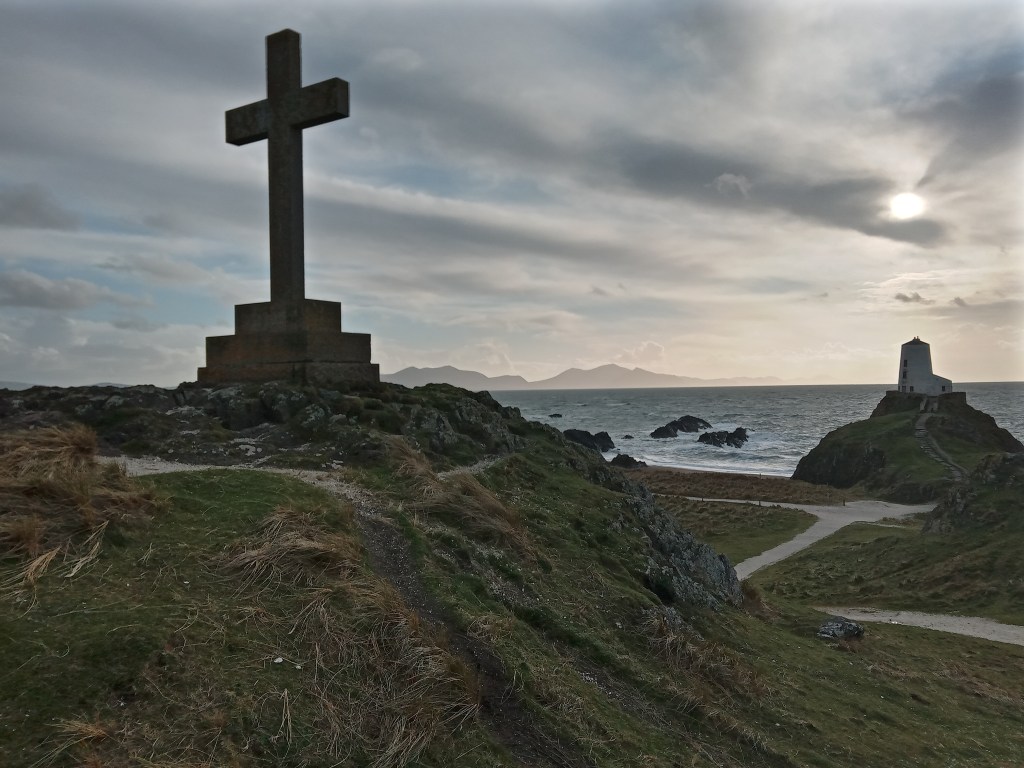
A second cross, commemorating the saint, stands on high ground behind the chapel

The inscription on the base reads: ‘In memory of St Dwynwen Jan 25 465’

A winding path passes the cross and leads to an old lighthouse looking out to sea
When Dwynwen died she was buried within her chapel, and pilgrims flocked to her shrine. Her remarkable story earned her the title of the patron saint of lovers, and the folk of Wales celebrate her every year on 25th January. The remains of her chapel, together with a memorial cross erected in 1897, can still be seen on Llanddwyn Island, the tranquil, haunting place that bears her name. Even today, lovers often leave small votive offerings to St Dwynwen – either sea-smoothed pebbles, shells chosen from the beach or sometimes single red roses – tucked into the ragged walls of her chapel.

Visiting lovers leave votive offerings to St Dwynwen in the ruins of her chapel, seen here on the right
I wish them all a very Happy St Dwynwen’s Day, and hope all their wishes come true.
 medievalwanderings.com
And a very Happy St Dwynwen’s Day to you too my love, I couldn’t think of anyone better to spend it with ❤ ❤ ❤
I love Llanddwyn Island, it's such a magical place – it's about time we went back there and took some lunch and our books there – we just need to remember check the tide times next time!
LikeLiked by 1 person
Ah yes, the tide table. Wellies don’t really cut it at high tide do they? Still, I wouldn’t mind being stuck on the island with a bottle of wine and some binoculars one day! 😀
Happy Dwynwen’s Day to you too. ❤ ❤ ❤
LikeLiked by 1 person
As long as I’m stuck there with you, I wouldn’t mind that at all ❤ ❤ ❤
LikeLiked by 1 person
Aww, thanks. 🙂 A comment worthy of St Dwynwen herself. Me too. ❤ ❤ ❤
LikeLiked by 1 person
Ah all those Welsh saint! Such a lot of them. Borrow mentions a few in Wild Wales.
LikeLiked by 1 person
Good grief yes, John, you can’t seem to go anywhere in Wales without tripping over a saint! They don’t refer to the early medieval period here as the Dark Ages, they call it the Age of Saints. I’m currently reading Rob MacFarlane’s masterpiece, ‘The Old Ways’, and he’s also full of praise for Borrow. I thought of you when I read that part, so I’m going to have to read some of the great man’s work this year. As for the Welsh saints, I’m planning to delve into that subject in a big way later this year. Should be interesting!
LikeLiked by 1 person
Rob’s book is very good. I think only Cornwall matches the saintcount of Wales.
LikeLiked by 1 person
Yes, I’m really enjoying Rob’s book.
I can imagine Cornwall’s saintly quota is also pretty high. It’s not a corner of the UK I know very well, but I’d like to.
LikeLiked by 1 person
On paths Jack Cornish has a new book out in April called The Lost Paths. Looks good.
LikeLiked by 1 person
Thanks for that, John, check it out.
LikeLiked by 1 person
That looks a terrific spot Alli, even without the legend of the Welsh St Valentine. Whether people believe in these stories or not, they make this beautiful location even more atmospheric – and I have to say that your pictures (or Stuart’s) of Llanddwyn Island are fabulous.
LikeLiked by 1 person
It really is an idyllic place, Malc. It’s like our own little Lindisfarne. 🙂 And it has a very special atmosphere. As for Dwynwen herself, being so far back in the very early middle ages, the saint’s legend is, of course, just a legend, although with the precise date of her death given as 465 AD, it’s quite possible that she did exist, and there’s probably a grain of truth in her story. These things just get embellished over time. Still, it’s a good story, and when you’re on her island you do feel, if only for a moment, that she was really there. 🙂
LikeLiked by 1 person
I can see why you think of it as your own Lindisfarne Alli 🙂
LikeLiked by 1 person
Small, but perfectly formed. 🙂
LikeLiked by 1 person
…oh and I meant to say, the photos are mine, for a change! Glad you like them – coming from you that’s a real compliment! 😀
LikeLiked by 1 person
In that case you captured the magic of the island perfectly. There’s an art in conveying feelings in a photograph.
LikeLiked by 1 person
Thanks, Malc, you’re too kind. You convey feelings in a photograph really well, but in my case it was probably more luck than judgement! Or maybe the camera (my phone, believe it or not!) picked up on how much I love the place. 🙂
LikeLike
This is beautiful. I’m in love with Wales and it’s totally OK that Wales has never heard of me. I like this saint. Legends such as hers have a lovely, enduring universality. Thank you, Alli!
LikeLiked by 1 person
Thank you so much, Martha! Wales would love you too, I’m certain of it. ❤ Glad you like the look of Llanddwyn Island and Dwynwen’s story. You’re right about it’s enduring universality (like it!), as lovers keep coming and there are always offerings left in the chapel’s walls. Nice to be able to feature a lady saint too, and her island legacy is really rather magical. 🙂
LikeLiked by 1 person
I must admit to not having done more than a cursory visit to Anglesey but that little island looks well worth a visit. I love the photo of the cross on the hillock and the winding path around it. Amazing that people still leave offerings there – I’m assuming they must mostly be Welsh Folks who celebrate the legend as I’m not sure most others will have heard about it.
LikeLiked by 1 person
It’s true, Dwynwen and her story aren’t well known outside Wales, but there are always lots of offerings at her chapel. It may be that tourists and visiting couples go there once they’ve found out about it, and to be honest it’s a pretty romantic place to be.
Funnily enough, I didn’t think we’d be all that bothered about Anglesey either, but strangely it’s one of our favourite places to go. It has a different feel to it from the mainland, and there’s lots to see and do – including Beaumaris Castle of course! The coastline is particularly impressive, especially around South Stack (Holyhead) and Penmon lighthouses. And we get to see puffins over there in the summer! 🙂
LikeLike
I’d love to see a puffin. My mother’s favourite bird and I’ve never seen even one!
It wasn’t that I wasn’t bothered about Anglesey – just the main mountains weren’t there and I’m just generally too obsessed with my mountains to get to the other areas – beautiful as they probably are.
LikeLiked by 1 person
Fair enough, I can understand that. Mind you, if you fancied a different type of hike the coastal path around Anglesey is gorgeous, and there is one mountain on Holyhead. 🙂
Before last summer I had only caught a brief glimpse of a puffin in flight, but I’ve now seen them at South Stack and Puffin Island off Penmon Point, and they’re one of my top favourite birds too. They’re so desperately cute! 🙂
LikeLiked by 1 person
I like coastal walking – I find it more strenuous than the hills though in many areas – especially Dorset! I must go and do the Holyhead mountain sometime. I really hope I get down to Wales this next year.
LikeLiked by 1 person
I haven’t done any coastal walking in Dorset, but from what I’ve read I can imagine it can be a challenge in places. Just got back from South Stack and Holyhead, and I think you’d like it there. 🙂
LikeLike
The Dorset coastline goes very steeply up for a long way… and then immediately goes very steeply back down again. It then immediately goes up again and so on. It is very beautiful though…
LikeLiked by 1 person
Sounds it, but I think I’ll stick to the North Wales coastal paths! 😉
LikeLike
I can see immediately why you love this spot and I know I would too – such a beautiful but somewhat bleak landscape is just the sort of coastal environment I love to visit and photograph! Add in those ruins and the story attached to them, and it becomes pretty much perfect!
LikeLiked by 1 person
Thanks Sarah, I’m glad I’ve managed to convey some of the beauty, remoteness and magic of the island. Honestly, it’s a photographer’s gift. You’d have a field day there, and I know you’d capture it far better than me. You’re right too, Llanddwyn Island is about as close to perfection as it’s possible to get. To me, it’s like Wales’s very own little Lindisfarne. Glad you liked it. 🙂
LikeLiked by 1 person