From our home in Conwy County we can easily nip back across the border to England, so in terms of castles and medieval history we have the best of both worlds. In Wales we’re surrounded by the Edward I’s magnificent ‘Iron Ring’ of fortresses and their more modest Welsh counterparts, and yet we’re also not far from the beautiful medieval city of Chester. Some ten miles to the south east of Chester, occupying a prime location in the Cheshire countryside, stands Beeston Castle, and this was our destination for a recent jaunt back to England. Although not the most historically significant of castles it boasts some very impressive ruins, visible for miles around. What’s more, human occupation of the site itself stretches way back into prehistory, when it was an important place. And with spectacular views from the castle’s inner ward, an enchanting woodland and a medieval legend into the bargain, it’s little wonder that Beeston has quickly become one of our favourite haunts.
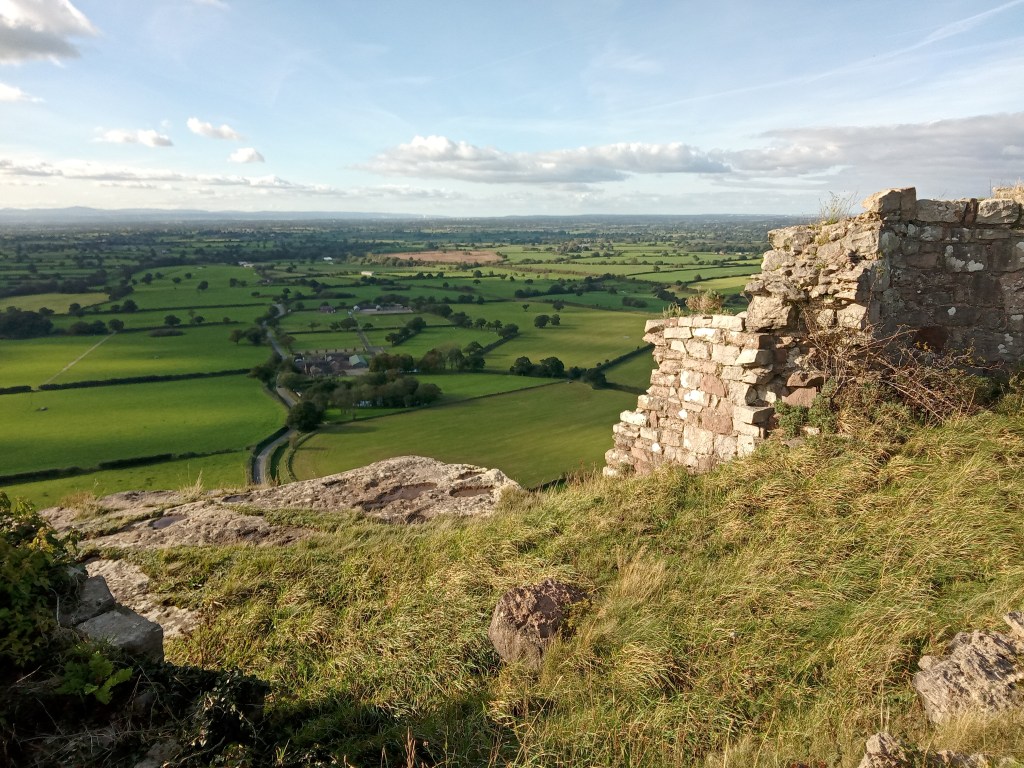
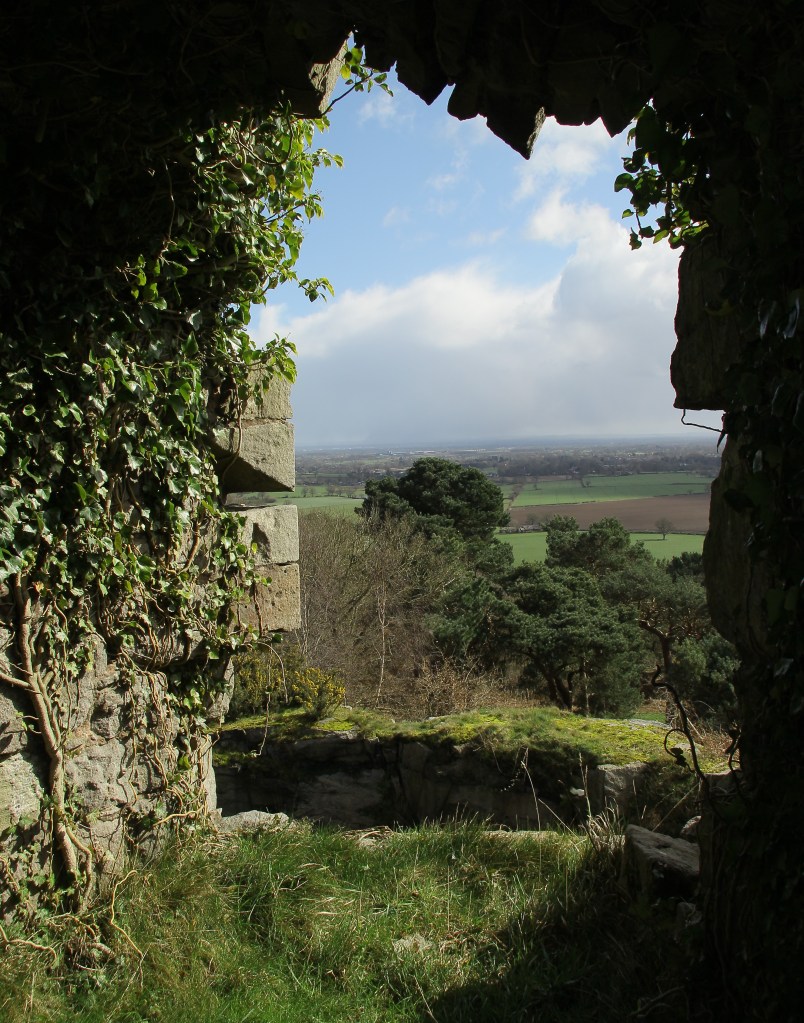
The spectacular views from the inner ward of Beeston Castle stretch from the Welsh hills, seen here on the horizon, to the Pennines.
Crowning the top of a high rocky crag above the Cheshire plain, Beeston has to be one of the most dramatically positioned castles I’ve ever visited. Presiding over the surrounding landscape, it’s easy to see why, for thousands of years, communities and leaders chose this imposing spot to announce their presence and status to all around.
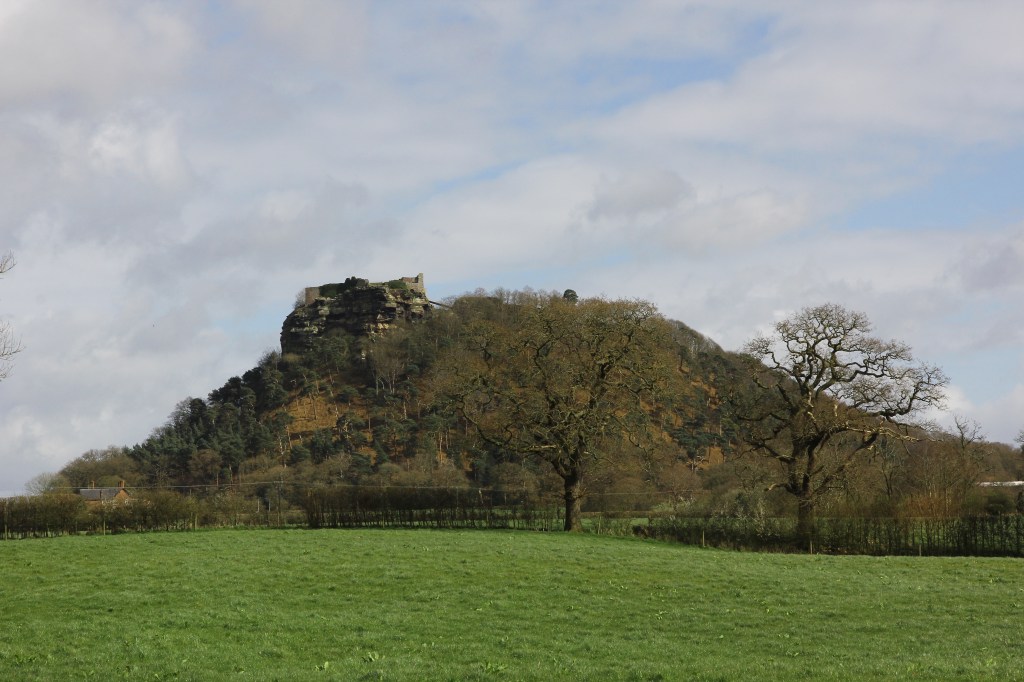
The ruins of Beeston on its dramatic crag can be seen for miles around.
Neolithic flint tools have been found on the hill, but it was during the Bronze Age that Beeston’s crag seems to have soared to prominence. Archaeological evidence of burial mounds has been recovered from the lower slopes, while occupation by the living is shown by an earthwork bank where the medieval curtain wall now stands. Metal deposits within the crag would have made the site an attractive prospect to Bronze Age craftsmen, and the discovery of copper-alloy axe heads together with moulds and crucibles for smelting indicates that Beeston was a major metalworking centre. Remarkably, two of the highly prized axe heads appeared to have been intentionally buried beneath the earthwork bank, perhaps highlighting the importance of the crag to the people who worked there. But lucrative craft production aside, for me what’s most interesting is that this was also a settlement, a place where people built their homes and went about their daily lives.
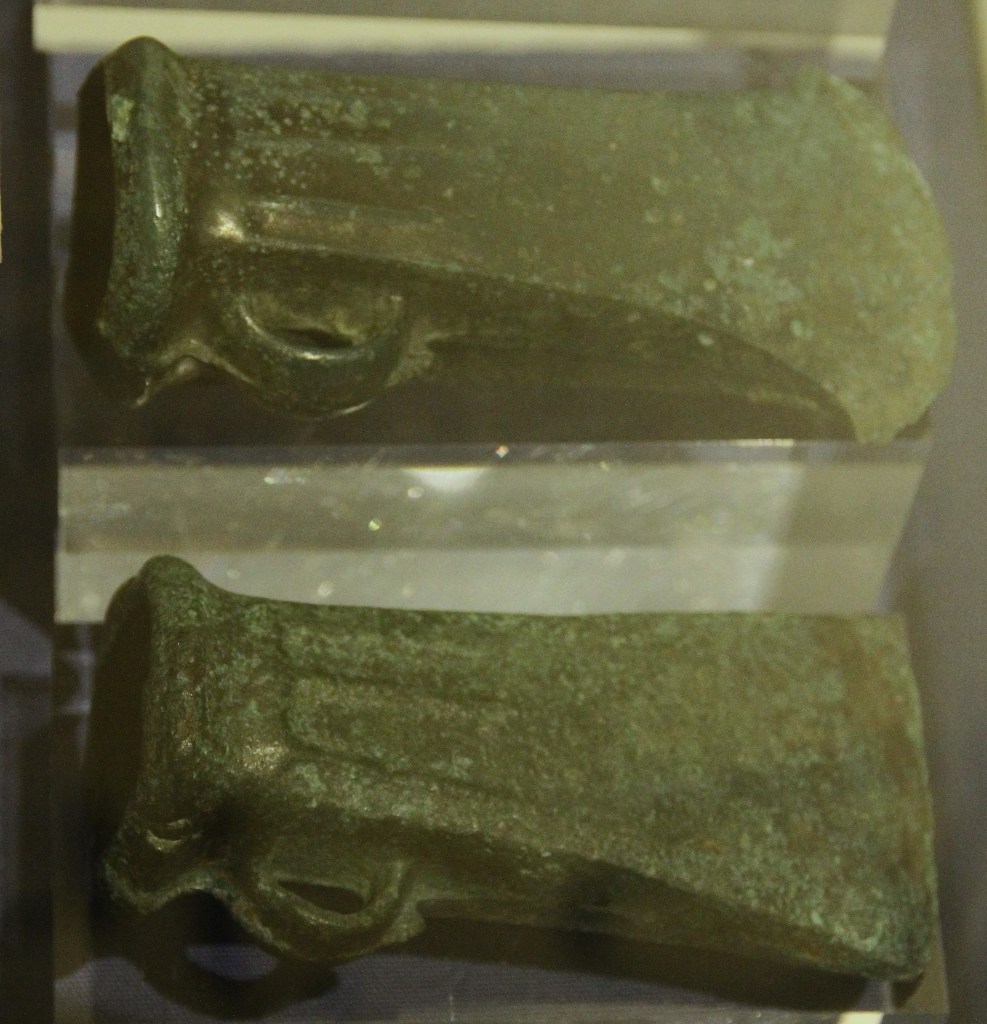
These axe heads that had been deliberately buried beneath the Bronze Age rampart are just two of the artefacts on display in a fascinating exhibition at Beeston Castle’s visitor centre.
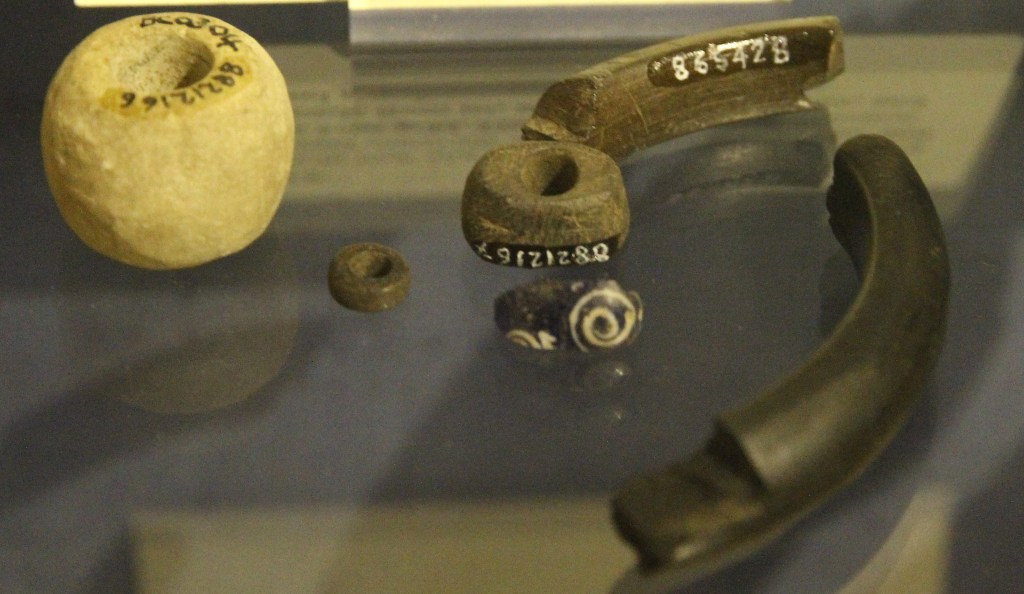
Archaeologists also unearthed items of jewellery, such as this collection of beads and bracelet fragments. Made from a range of materials including amber, jet, glass and stone, these items give a more personal insight to prehistoric Beeston, and show the sophisticated tastes of the Bronze Age residents.
Excavations carried out at Beeston in the 1970s and 80s found a collection of Bronze Age roundhouses, and in 2019 an eight-month experimental archaeology project resulted in the recreation of one of these houses within the wooded area of the castle’s outer ward. Using tools and materials available to our prehistoric forebears, a group of dedicated volunteers built a replica residence – probably of one of those metalworkers – for visitors to explore and get a taste of Bronze Age life. It’s an impressive structure, with a good-sized interior, doors to the front and rear, and a tall conical roof. And I have to admit that on the chilly day of our visit, with the weather shut out and a cosy fire burning in the central hearth, the house felt really rather homely.
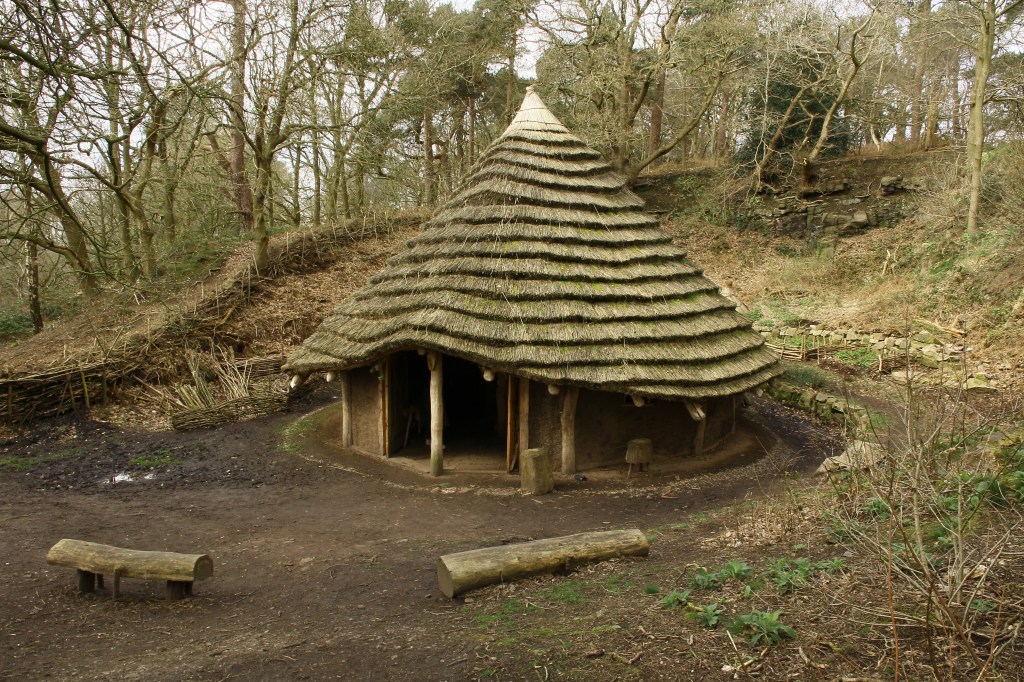
The reconstructed Bronze Age round house from around 800 BC was constructed using the evidence from archaeological excavations at Beeston.
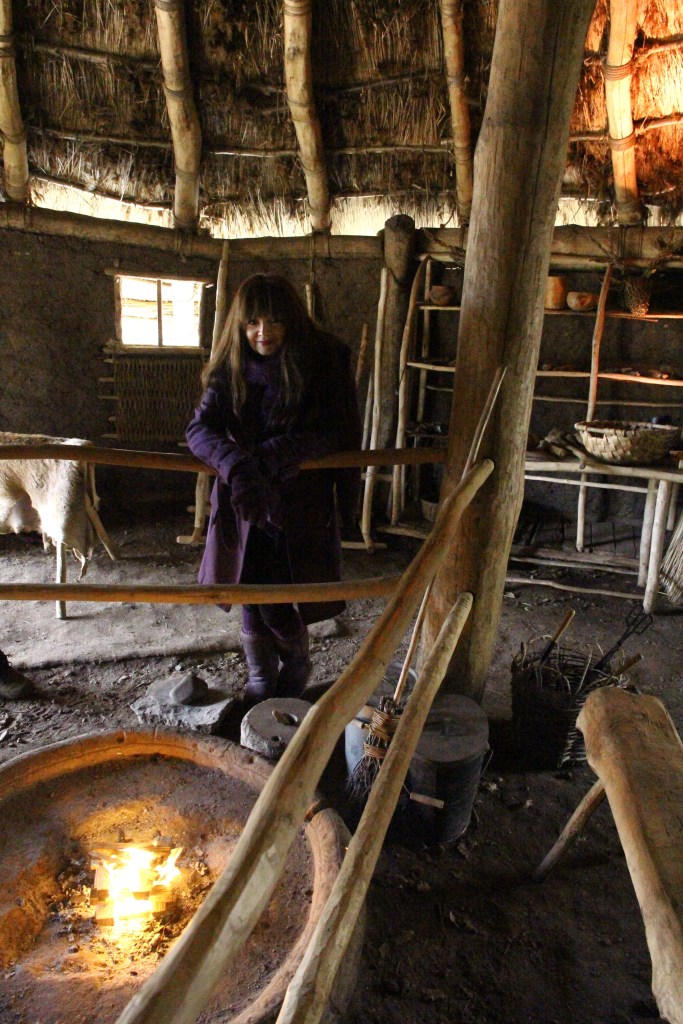
Keeping warm by the fire inside the roundhouse.
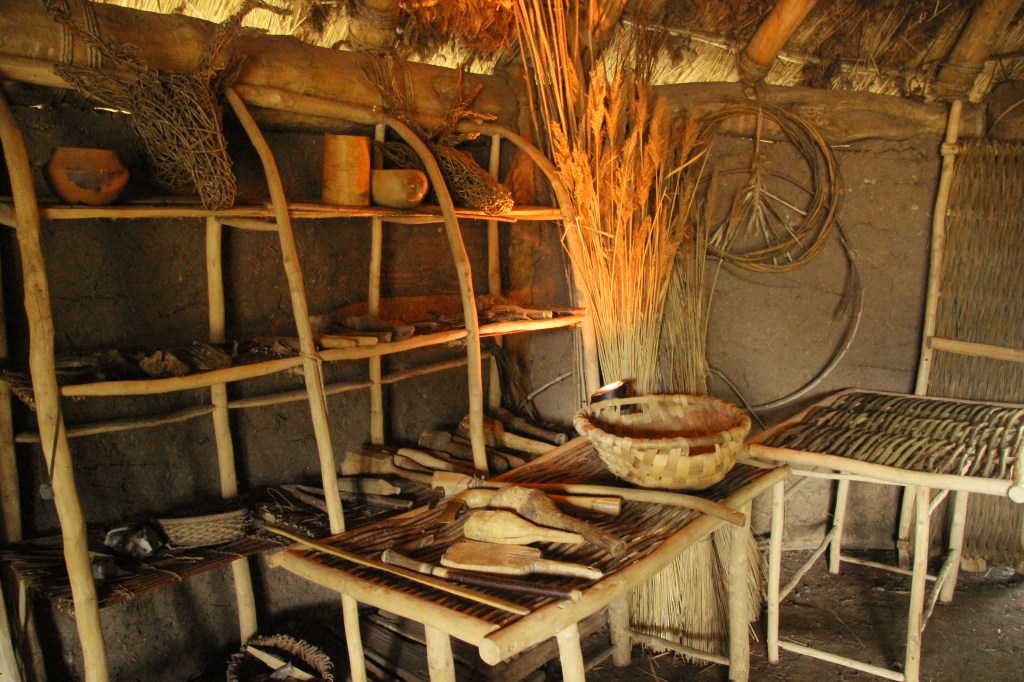
Domestic items and construction tools on display in the house interior.
Beeston’s crag held its importance into the Iron Age when it developed into a Hillfort. The earthworks were substantially expanded, with a main entrance sited where the medieval outer gatehouse stands today. Evidence of crop processing and storage has been found as well as fragments of pottery used for the storage and transportation of salt. Cheshire was a prominent area for salt production in prehistoric Britain, and the archaeology suggests that Iron Age Beeston had been both an important site for the protection of surplus crops and a part of a wider regional trading network. But nothing lasts forever, and as the Iron Age gave way to the invasion from Rome the good times were over at Beeston Crag, at least for a while.
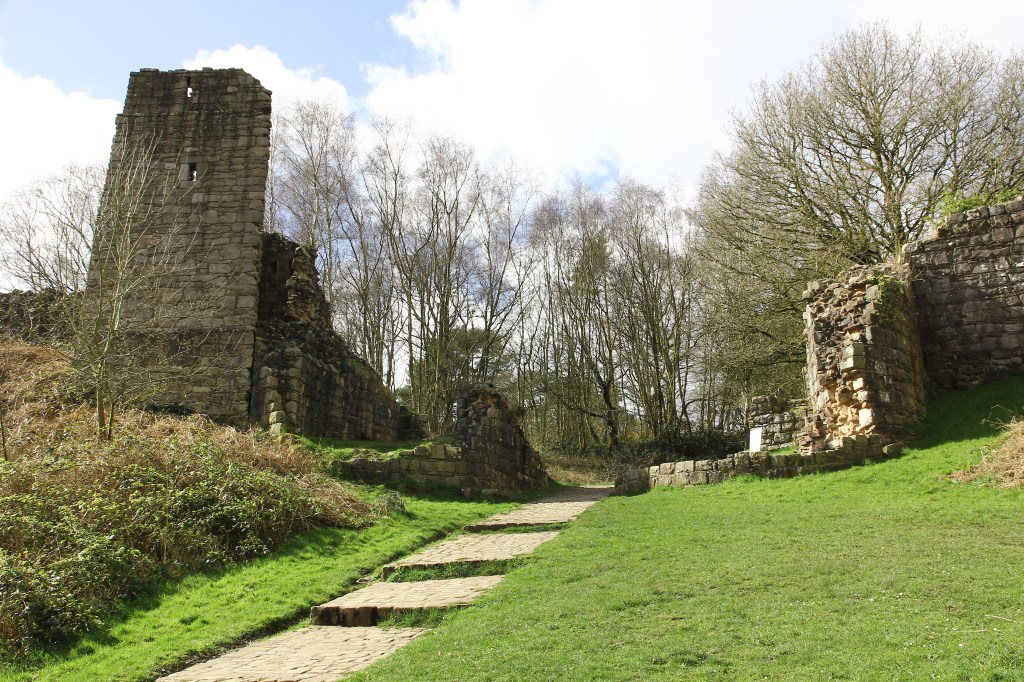
The remains of the medieval outer gatehouse that stands on the site of the Iron Age entrance.
Perhaps the Romans couldn’t be bothered to trudge all the way up the steep, rocky hill to make use of the former hillfort, as the only pottery they left behind has been found around the base. They may have been in the vicinity, but they weren’t on the crag. Neither, it seems, were the Anglo-Saxons taken with the place because they shunned it too. So the lofty site remained quiet until the 13th-century, when along came Ranulf, sixth earl of Chester (1170-1232), who decided to drag Beeston out of the Dark Ages and build a spanking new castle on the top.
A native of Cheshire, a military hero, and one of England’s foremost medieval barons, Ranulf was a steadfast supporter of King John (r.1199 – 1216). He did well out of his loyalty, receiving large tracts of land, titles and castles in reward. But these were times of turmoil, and the end of John’s reign saw England mired in civil war. The reviled king was pitted against his bitterly disaffected barons, who had invited the French prince Louis to invade England, oust John and take the throne instead.
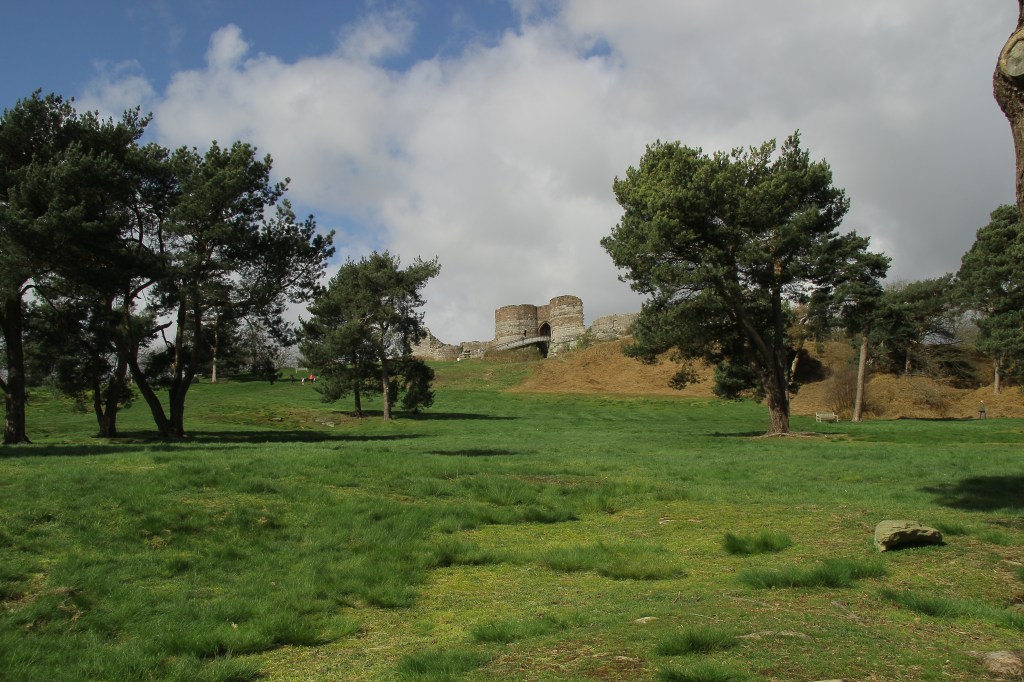
Looking across the castle’s huge outer ward to the great gatehouse to the inner ward.
However, in 1216 the situation was abruptly resolved when John did the decent thing and kicked the bucket, and was succeeded by his son, the nine-year old Henry III (r.1216-1272). The politically adroit Ranulf successfully navigated the change, helping to defeat the French forces at the Battle of Lincoln before negotiating their departure from England’s shores. With the French gone and new, albeit young blood on the throne, the rebel barons calmed down and peace finally reigned. For his sterling work, Ranulf was handed yet another honour, the earldom of Lincoln and now he was one of the most powerful barons in the land. In fact, during his lifetime, he managed to make the earldom of Chester autonomous from royal power, and so great was his authority that a monk in the city described him as a ‘prince’. Thus, in the early 1220s, after returning to his Cheshire powerbase from the fifth crusade, Ranulf began work on his new castle at Beeston, or ‘the castle of the rock’ as it was known, to make a great show of his wealth and status.
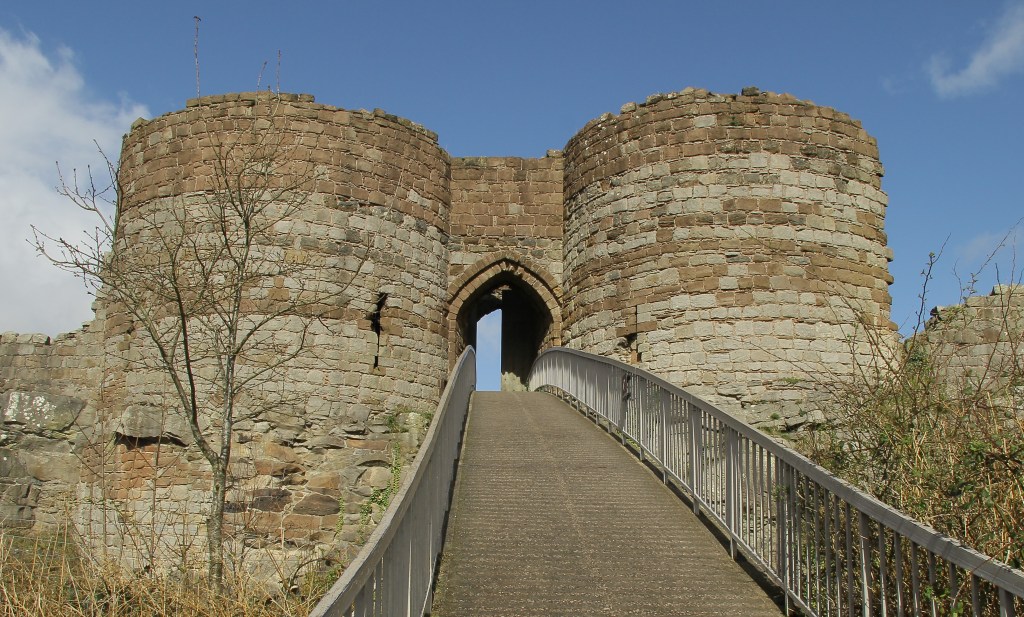
Ranulf’s great gatehouses show his wish to impress. The gatehouse to the inner ward was the most important building, and is reached today by a modern, and steep(!) bridge spanning the dry moat below.
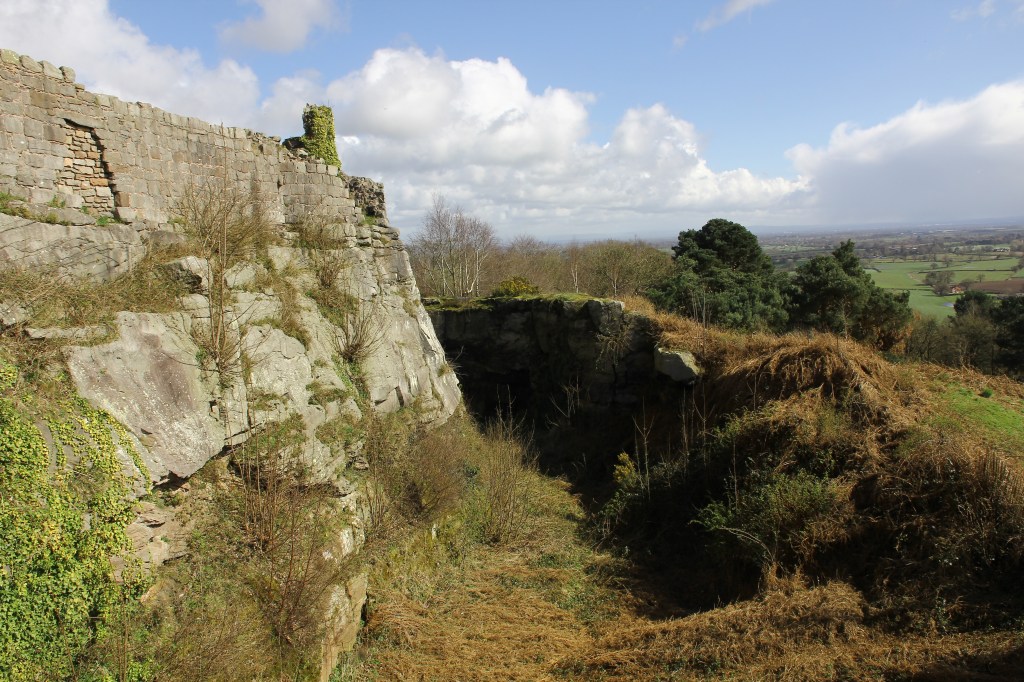
Ranulf’s ‘castle of the rock’ also had an imposing rock-cut ditch, the stone from which was used as building material.
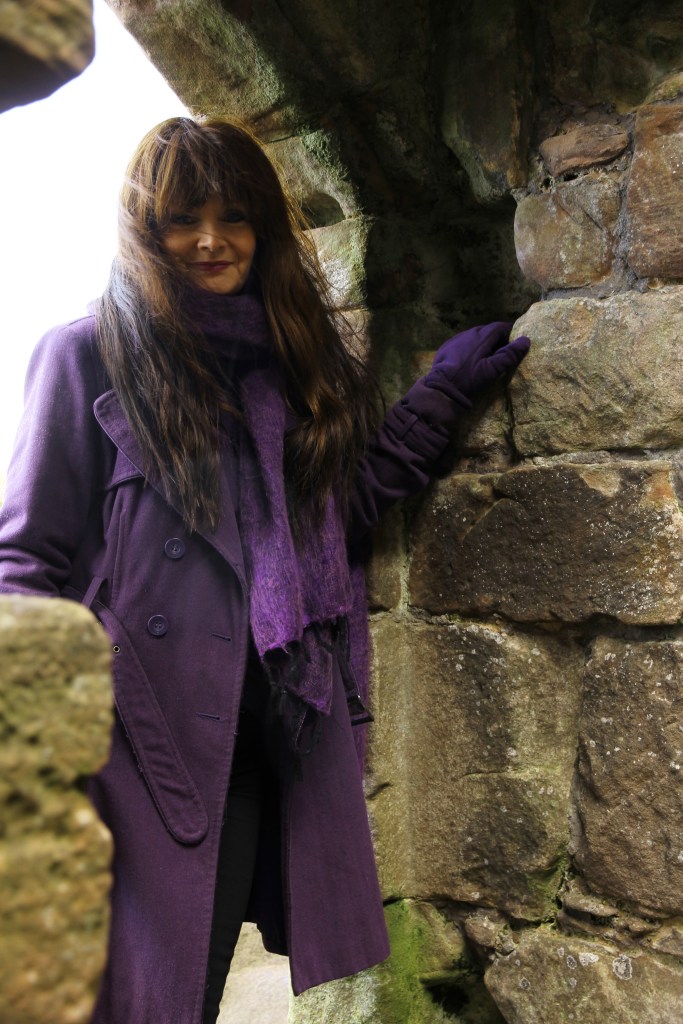
In the western tower of the inner gatehouse
It’s unclear exactly how far work had progressed by the time of Ranulf’s death in 1232, but it seems the domestic buildings were incomplete. With no son to succeed him, the earl’s estates passed briefly to his nephew, John le Scot, until his death in 1237 when Beeston, along with all Ranulf’s lands were claimed by the Crown. Henry III installed a custodian at the castle and in the 1240s a major programme of building works was undertaken in preparation for a royal campaign against the Welsh. Relations with Wales didn’t improve under the next king, Edward I, and as he prepared to march across the border to war in 1277, Edward based himself in Chester while Beeston was garrisoned and used as a supply base for the troops. Further work was carried out to strengthen the inner ward in the early 14th-century, but perhaps owing to the erratic pace of construction the castle was never completed as a noble residence. But despite the lack of lavish accommodation, Beeston still had a good story to tell, and one that would embed itself in local legend.
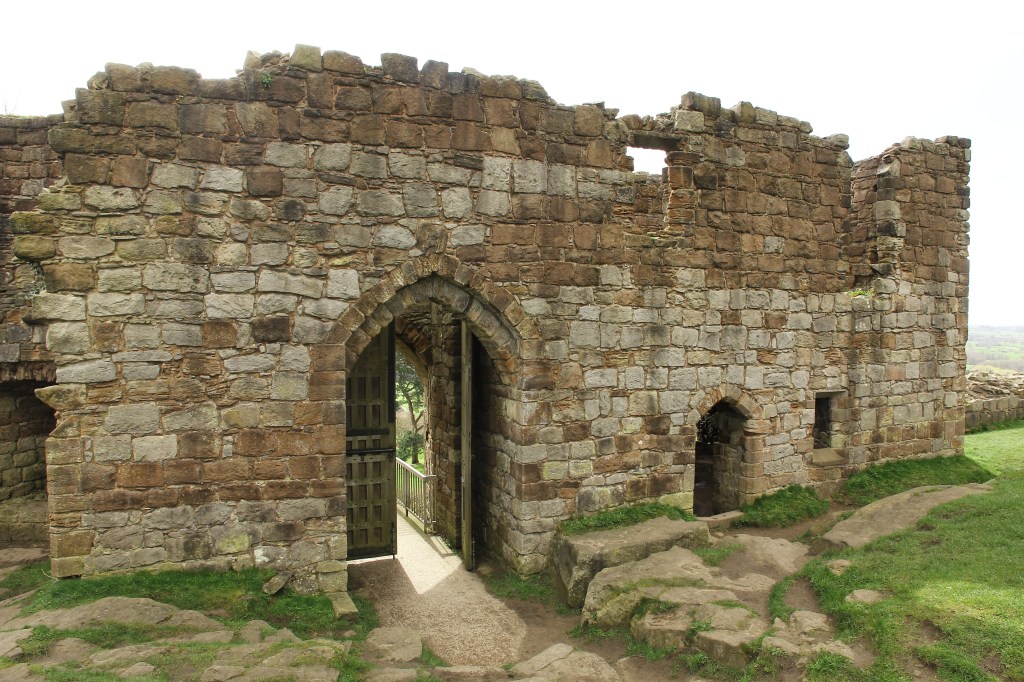
The rear of the gatehouse to the inner ward.
In 1399, King Richard II (r.1377-99) stayed in Chester before embarking on a military expedition to Ireland. All was not going well for the king, who had managed to alienate many of his barons with his autocratic rule, financial mismanagement and his clique of sycophantic favourites. Trouble had been brewing for some time, and on the king’s return from Ireland he was captured at Flint Castle by an army of rebel nobles led by his cousin, Henry Bolingbroke, the future King Henry IV (r.1399-1413). Richard was deposed, and later murdered, while Henry took the crown for himself. However, according to tradition, before Richard left for Ireland he took precautions against the growing threat from his adversaries, and secreted part of the royal treasure somewhere at Beeston Castle.
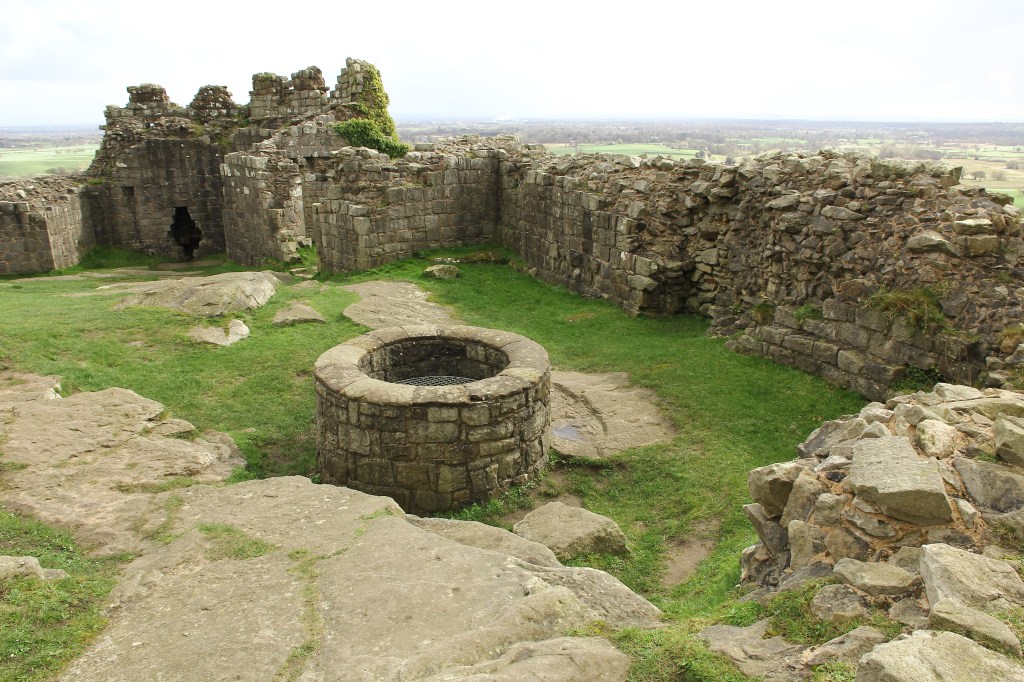
The uneven rocky inner ward. This is the well that’s believed to have hidden some of Richard II’s treasure.
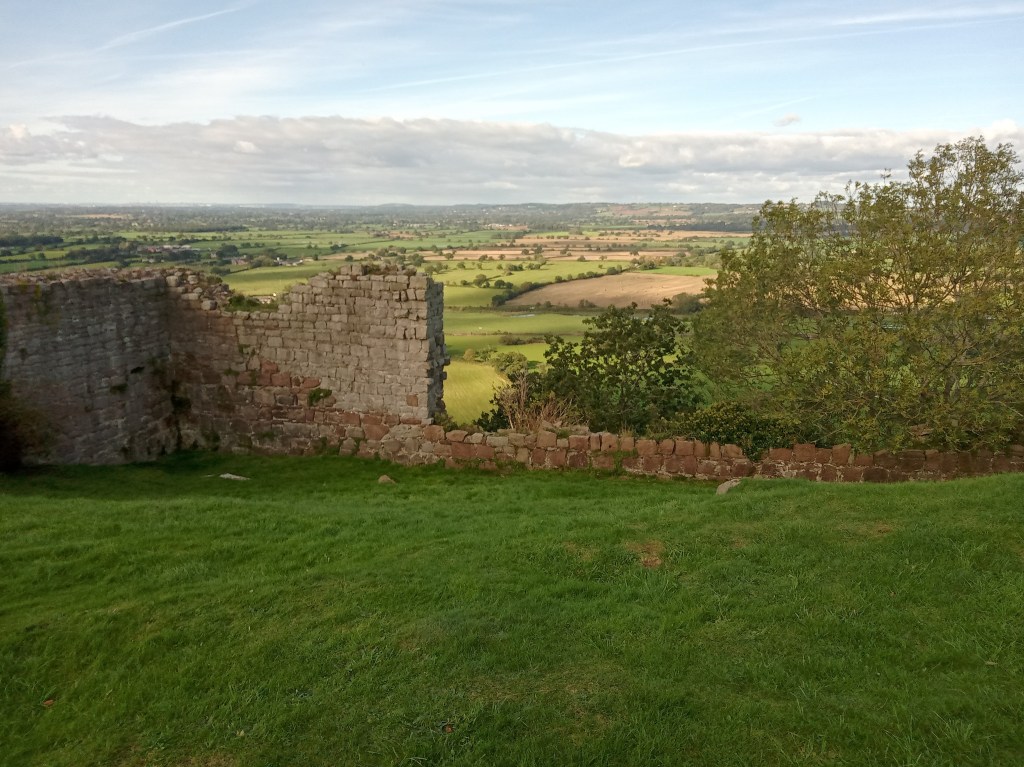
The view north from the back of the inner ward.
They say every legend contains a grain of truth, and it seems the tale of Beeston’s medieval treasure may well have one foot in reality. A contemporary monastic chronicle from Yorkshire informs us that after Richard was captured, ‘vessels and many other goods [were] found in water cisterns’ and that more valuables were recovered from ‘other secret places’. Furthermore, another chronicle from neighbouring Staffordshire states that Henry IV seized treasure and other riches that had been buried. These accounts probably inspired two investigations of the well in the castle’s inner ward, in 1794 and 1842, but although three intriguing openings were discovered off the well shaft, no gleaming hoard was ever found. If the story is true, it seems that Henry IV got there first, scooping up all Richard’s dispersed riches from their various hiding places long before anyone else got a chance to bag any.
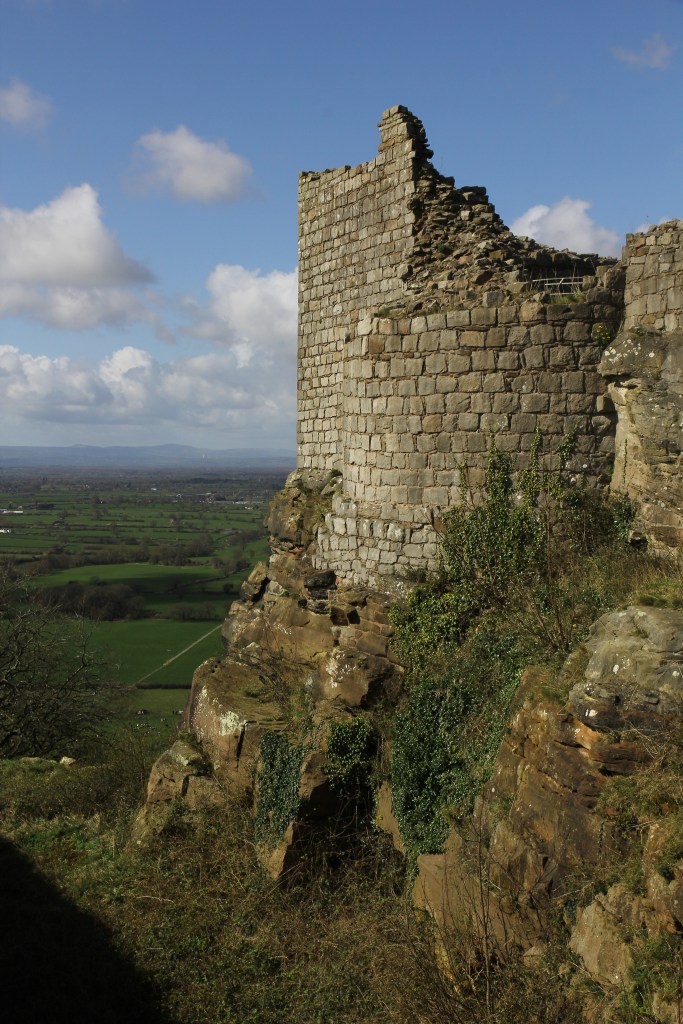
The view from the bridge across the South West tower.
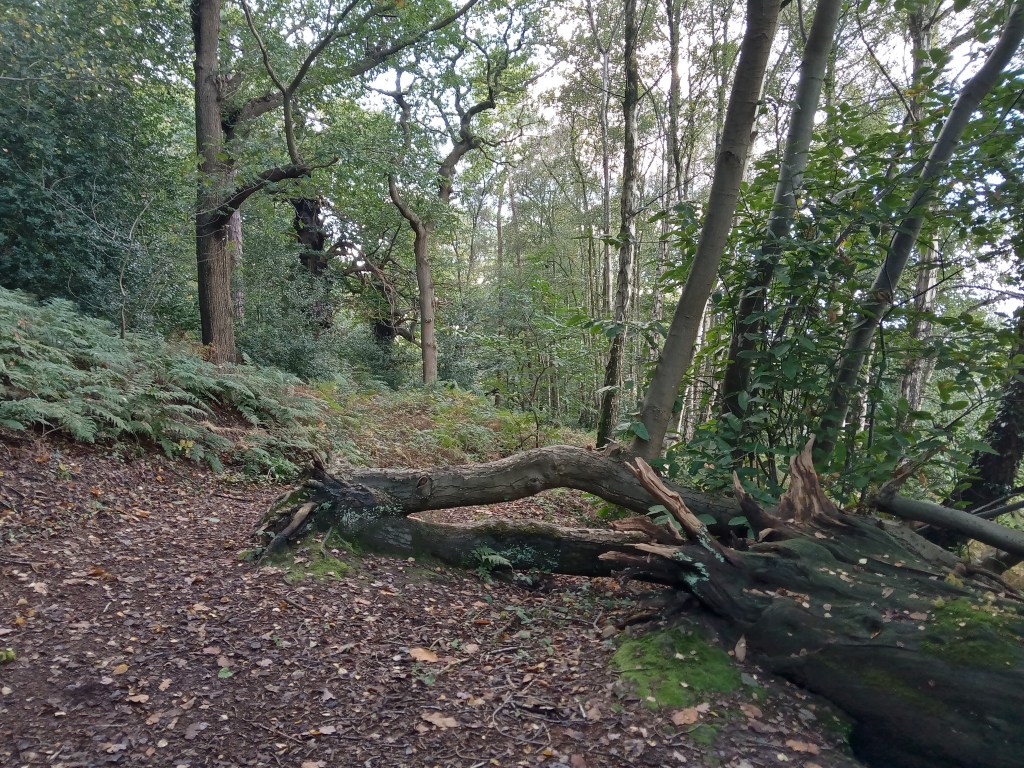
After exploring the castle’s inner and outer wards, there’s just enough time to enjoy a wander through Beeston’s beautiful woodland. The path meanders around the lower slopes of the crag and leads back to the visitor centre.
Even though it’s highly unlikely that any of Richard’s treasure still lingers within these walls, what is left is the castle’s rich history stretching back across four millennia. Instead of gold and jewels, we have a priceless collection of tangible links to the hill’s ancient past, each buried by time and unearthed for us all to see and learn from today. And what’s more, when the cold weather bites we can even warm up in a Bronze Age home. For me, that still makes Beeston Castle, in its striking setting upon this rugged outcrop in rural Cheshire, a real gem of a find.
 medievalwanderings.com
Another fabulous post my love ❤ ❤ ❤
I love our visits to Beeston, it’s a brilliant little jaunt back across the boarder and it has such a wonderful atmosphere that you can feel the wealth of history going back through the ages. And I adore that Roundhouse, I could have quite happily spent the rest of the day there with you, in front of the fire, with a good book and a decent glass or three of Mead.
LikeLiked by 1 person
Glad it was worth waiting for! 🙂
I know, it’s hard to tear yourself away from the roundhouse, but then again there’s so much else to see and do. I wouldn’t mind indulging in a nice glass of mead while drinking in those amazing views from the inner ward either! Here’s to many more visits to Beeston, and to all those who lived and stayed there through the millennia! 🙂
LikeLiked by 1 person
Agreed! I’m sold on the idea of making EH an offer on the castle and turning the gatehouse back into a house – the views would be amazing!
LikeLiked by 1 person
Ohhh yes, if only! I’d jump at that chance! 🙂
LikeLiked by 1 person
I’d drink a glass of mead to that! 😀
LikeLiked by 1 person
What a fascinating tale.
LikeLiked by 1 person
Thank you John.
LikeLike
This really is a gem Alli, both the castle, and your description of it. Until now, I was only vaguely aware of Beeston Castle and knew virtually nothing about it. The views alone are worth making the effort to go there, let alone the impressive remains. Its back story and tale about the treasure makes this a most enjoyable post – and all told in a way that only you can 😊
LikeLiked by 1 person
Ahh, thanks so much, Malc. 🙂 Glad you enjoyed Beeston and its long story. It’s a lovely place to spend time, and as it’s less than an hour away we’ll definitely be popping back there regularly. And you’re right, the views alone are worth the uphill wander to the top. Glad the post has filled out your knowledge of the place. A few more threads in England’s rich historical tapestry, eh? 🙂
LikeLiked by 1 person
Absolutely, and I always check the locations on Google Earth.
LikeLiked by 1 person
Good idea. 🙂
LikeLike
I’ve never been but will add to the list. Fascinating long history over thousands of years –
LikeLiked by 1 person
Glad you enjoyed Beeston, John. It’s well worth a visit if you’re in the area. There’s a bit of an uphill trek to the inner ward at the top, but I’m sure you’d be fine with it, and it’s worth it for the views alone. Not only that, you can drop into the roundhouse half way up, and the woodland is lovely too. By the way, the roundhouse isn’t always open as it’s staffed by volunteers, so it may be worth checking before you go. You can still walk around the outside and look in through the windows, even when it’s not open, but the exhibition is always available in the visitor centre. Either way, it’s great to spend time back in the Bronze Age. Life really wasn’t bad back then.
LikeLiked by 1 person
That’s a really dramatic setting for a castle (I love your last image of the view!) and so many layers of history to uncover. It’s great to see that reconstruction of the Bronze Age house too. Interestingly it has much in common with the very basic homes I’ve seen in some other parts of the world.
LikeLiked by 1 person
I can believe that, Sarah. It may have been basic, but it really did feel cosy and homely, and I could quite happily while away a few hours inside. It’s nice that it’s made from all natural materials, too.
The first time we saw the castle in the distance as we drove towards it, we were all blown away by it’s amazing setting, and that’s just one of the reasons we keep going back. Glad you enjoyed reading about Beeston and it’s rich past. 🙂
LikeLiked by 2 people
That looks quite the castle to visit – what a superb and grandiose location! The reconstructed roundhouse looks really interesting too (and warm) – I love the roof.
It’s good that people in the past were such show-offs with their wealth otherwise we wouldn’t have all these great monuments to visit!
LikeLiked by 2 people
Grandiose indeed, Carol! 🙂 Very good point about the show-offs of history. Our land would be all the poorer without these great legacies. 🙂
The roundhouse is pretty impressive, and it’s cosy and surprisingly homely inside. I’m with you on the roof aspect too. From inside it’s quite the work of art. It’s really tall, and the genius design means the smoke from the fire diffuses through the structure leaving the air clear in the living area. Anyway, glad you found Beeston and it’s story interesting. 🙂
LikeLiked by 1 person
ah so that’s why the roof is so tall – pretty ingenious!
LikeLike
I love the fresh and friendly way you write. What a beautiful location and a fascinating story.
LikeLiked by 1 person
Thanks, Martha, that’s a lovely thing to say! 🙂 It is a pretty stunning location, and I’m glad you enjoyed Beeston’s long story. 🙂
LikeLiked by 1 person
What a pity we have not written records from the iron and bronze ages. I think that world may have had a lot to offer, maybe more than did the medieval world. It was rich land, healthy people — and mostly, not nearly as much war. We don’t know who ruled or even if there WERE rulers or religion. I’m guessing based on absolutely nothing but speculation that there was really a lot going on. We just don’t know what it was.
Have you read any of Jodi Taylor’s “St. Mary” chronicles in which they travel to historic places and were responsible for burying Rich III so that it would be later found? It’s great time travel stuff, mostly in England but occasionally other areas. They are also funny, sometimes hilariously. When you mentioned Rich II it reminded me of how the historians (time travelers in the book) were there for his last battle and when he fell, buried him in a place where later people were SURE to find hm … and we did.
I hope you don’t mind if I reblog this. I find it fascinating. I hope some of my followers also find it interesting. A lot of them are actually on your side of the pond anyway, so they can go and check out your locations.
LikeLiked by 1 person
Hi Marilyn, thanks for the great and interesting comments. Of course I’m happy for you to reblog the post, do feel free. 🙂
You say you’re guessing about our prehistoric ancestors, but I think you’ll find you’re more accurate than you think. I don’t know whether you ever saw ‘Time Team’, a brilliant archaeology series (it was stupidly cancelled by Channel 4 years ago now, but they now have a very successful Youtube Channel too with some superb fresh material and programme), but there’s a Bronze Age expert called Francis Pryor who managed many of their digs, and he’s also created an Archaeology Park with reconstructed buildings. It’s called Flag Fen near Peterborough, and it’s on the site of a real Bronze Age settlement. Pryor says that life in the Bronze Age was really rather good, as you also thought, with plentiful food, no overcrowding and mostly peaceful and convivial communities. So , in very many ways, it was better than it is even today! 🙂
Thanks also for the steer to the St Mary’s Chronicles. It sounds right up my street so will look those up straight away. 🙂
Hope all’s going well with you and your recovery, and thanks again for the insightful comments. 🙂
LikeLike