A few weeks ago we spent a very pleasant few days exploring Herefordshire and Shropshire, an area rich in castles and medieval history. In Ludlow, I dropped into the imposing Church of St Laurence, and in the ornate chancel I met some remarkable 15th century wood carvings. As I was to learn, these intriguing relics, all created between 1425 and 1447, bear evidence of the contemporary political turmoil that was about to plunge England into thirty years of brutal civil war.

Reached via a narrow alleyway from Ludlow’s charming High Street, St Laurence’s Church has been a house of worship for over 800 years.
A medieval tradition, misericords, or ‘mercy seats’, were carved ledges on the underside of folding choir stall seats so that weary clergymen – forced to stand for lengthy services – had something to rest upon. A feature of cathedrals and churches across Europe, many were destroyed during the Reformation but many also survived, and St Laurence’s can boast one of the largest collections in any parish church.

The ornate chancel, showing the oak choir stalls

A line of choir stalls, their raised seats revealing the beautifully carved misericords underneath.

A drunken tapster takes his place in the choir stalls. This is a moral message about a servant who abuses his master’s trust by raiding the boozy stores he’s supposed to be looking after.
Misericords first appeared in plain form around the eleventh century. Over time the supporting brackets became more and more elaborately decorated, allowing the carver to showcase his talent and let loose a little creativity, sometimes even indulging in a little satire or humour. The range of designs was very diverse, including religious and moralistic images, fantastical beasts, animals taken from medieval bestiaries and foliate decoration. Even the mundane featured, with scenes depicting everyday medieval life. But the sharp-eyed observer at St Laurence’s will see that among the oaken people, plants and beasts there are other carvings carrying a more political message.

An owl stares out from under it’s ledge. A far cry from today’s image of a wise old bird, during the Middle Ages owls were seen as dark and ignorant creatures, shunning God’s divine light. This one is being mobbed by two, presumably more virtuous, birds.

Apparently this is the ideal of medieval womanhood. Not sure that side buns and a wimple would suit me…
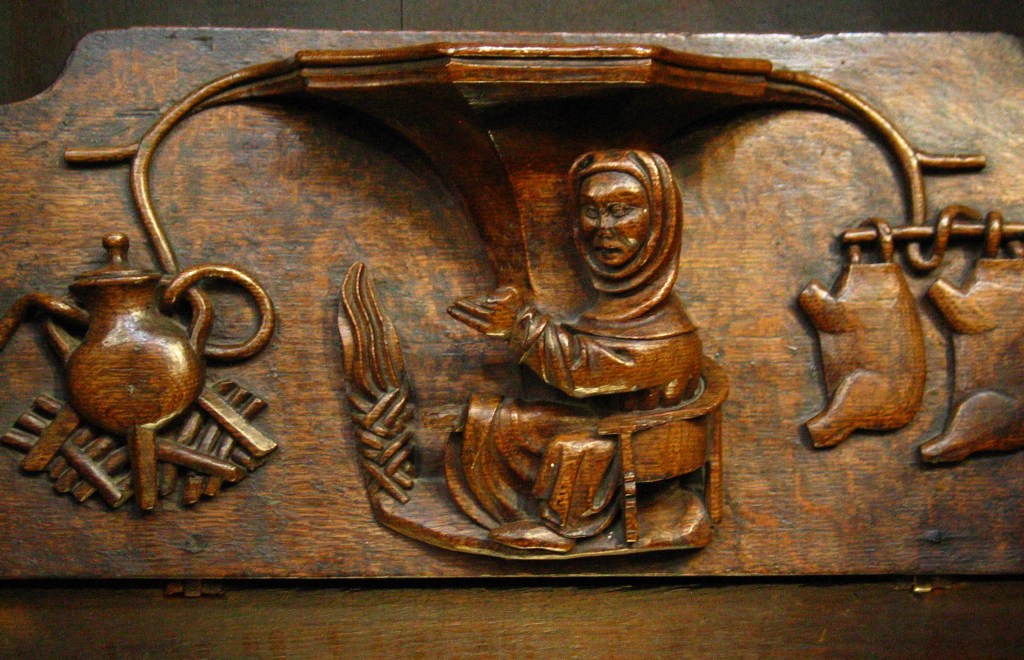
A secular seasonal scene: a man warms himself by the fire with his winter stocks and pots around him.

A purely decorative foliage design given movement and form by the 15th century woodcarver.
Ludlow was one of the main strongholds of Richard, duke of York (1411-1460), father to the future Edward IV and Richard III, and his ancestors had worshipped at St Laurence’s for centuries. In 1450, soon after the misericords had been completed, many English nobles were growing increasingly frustrated with the feckless and militarily inert Lancastrian king, Henry VI, and none more so than Richard, duke of York.
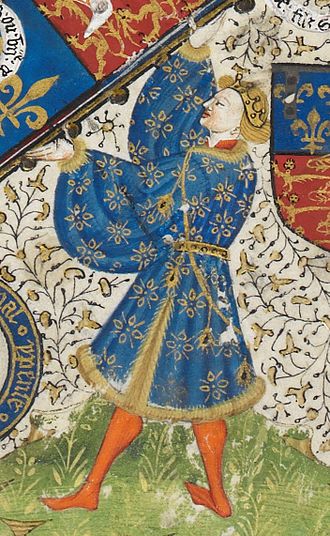
Richard Plantagenet, duke of York, the man who would be king.
England was becoming destabilised amid the growing insecurity and discontent, and when the king began to succumb to bouts of madness, Richard made plans to advance his own (and, many agree, more legitimate) claim to the throne. To highlight his regal credentials, he adopted the Plantagenet name, becoming the first of his dynasty to use the soubriquet originally given to his ancestor Geoffrey of Anjou (d.1151), father of Henry II. And so it was that on 22 May 1455, Richard Plantagenet led an army of supporting magnates to St Albans to fight the first battle of the Wars of the Roses, resulting in a Yorkist victory and a decidedly shaky and ill-fated truce.

The Falcon and Fetterlock: this was the personal badge of Richard Plantagenet, duke of York. The use of the Falcon motif can be traced all the way back to King Edward III (r.1327-1377), from whom the two warring houses of York and Lancaster were descended, so the badge links Richard directly with the ancestral crown.

The White Hart at Rest, the personal badge of King Richard II, the king who the first Lancastrians had deposed in 1399, over twenty five years before the Ludlow misericords were begun. The Yorkists regarded Richard II as the last legitimate king of England, so this is a pointed reminder that the crown had been usurped by the first Lancastrian king, Henry IV.
As it turned out, the only crown Richard ever wore was a paper one, mockingly placed on his lifeless head when he was killed at the Battle of Wakefield in 1460. Instead it was left to his son, Edward, to continue the Yorkist bid for the throne. The dashing young noble fought his way to victory the following year on the blood-soaked fields of Towton, and took the real crown for himself as King Edward IV.

An elegant and detailed carving of the white rose, the symbol the Yorkist armies fought under during the Wars of the Roses.
The Ludlow misericords are superb examples of medieval craftsmanship. They draw us into the vivid imaginations of their creators and shine a light on the culture of late medieval England. But they also give us tangible evidence of the lofty ambitions of Richard Plantagenet, duke of York at a critical time in history, when his powerbase of Ludlow was about to be thrust into the increasingly fractious political limelight. I wonder if those weary churchmen, resting back then on their splendid new misericords, had any idea of the trouble that lay ahead…

Let battle commence…
 medievalwanderings.com
Personally, I think you’d look very nice in side buns and a wimple. You’re already the perfect wife so…
Fabulous workmanship on those carvings, those medieval craftsmen were amazing.
LikeLiked by 1 person
Hardly, unless ‘hopelessly flawed’ is your definition of perfection! 😉 Thanks anyway… 🙂
It’s always a treat to be able to see, touch and study objects from the middle ages, especially when they’re so well preserved. And I thought these were wonderful, such great craftsmanship and with so many stories to tell. It’s almost as though you’re chatting with the medieval carvers themselves. Oh, for one of Maddie’s time wormholes! 😀
LikeLiked by 1 person
Flaws? Flaws? I see no Flaws! ❤ ❤ ❤
I’d love to have one of Maddie’s Wormholes – think of all the wonderful places we go and visit in their heyday! Think of all the real mead we can drink!
LikeLiked by 1 person
Ludlow would be a good place to start! And plenty of taverns too for the mead… 😉
LikeLike
Some really beautiful carvings there – it must have been a really interesting church to visit.
By the way, what are ‘fetterlocks’?
And have you got the dreaded blackmailing WordPress banner foisted on your site yet? It takes up loads of the top of the screen (and therefore any post on your main blog page) and demands that you pay £3 per month to remove it! I’m really cross about it!
LikeLiked by 1 person
They’re amazing carvings, aren’t they? It’s a great church to visit as it’s so connected with the Yorkists and their nearby castle. A grand day out, you might say, especially when you throw in a great little cafe and a fantastic chocolate shop as well! 🙂
A fetterlock (good question) is a kind of shackle, like a padlock, commonly used in heraldry. It’s shown as the arch surrounding the falcon. They’re supposed to symbolise authority, and victory in battle with the taking of prisoners. Edward III used the falcon, and his son, Edmund of Langley, (Richard’s grandfather) was the first duke of York and it was he who added the fetterlock. It’s a very Plantagenet and Yorkist emblem, and with the falcon coming from the great King Edward III, it’s hardly surprising that Richard used it to promote his royal credentials. 🙂 They’re a fascinating set of woodcarvings to study, and they sit there silently with all their stories preserved in the wood grain. I could write an extended essay on the Ludlow misericords – there are 28 of them in total and so much to learn from them, so this post is only a snapshot, but hopefully enough to give a good idea of the meanings behind them, both secular and political. Glad you enjoyed it though. 🙂
As for the WordPress banner, that sounds like extortion! I haven’t had it imposed on my site yet, so I don’t know whether it’s because I keep resisting updating it, but if I do get it I reckon I’ll be voting with my feet. Have you been able to sort it out yet?
LikeLiked by 1 person
no – they just say we signed up for any ‘advertising’ – but a banner stopping you viewing your pages all the time isn’t advertising – it is extortion as you say! I definitely won’t be updating – I pay enough for my internet as it is and can’t afford to pay for things I use on it!
I’m wondering whether a few things could have triggered it. I’ve been getting a lot of hits to my site recently (but that’s fairly common for the holiday period as people are wanting to go and do stuff I’ve done and documented). Also, I’ve been running this blog for 13 years now and am only half way through my storage allocation as I shrink all my photos (or scan the film ones small) so my file sizes are around 300KB at the most instead of the 4 – 7 MB per photo of an uncompressed digi photo.
LikeLiked by 1 person
It’s truly awful. Have you tried contacting them about it? Doesn’t sound right at all, and you shouldn’t have to put up with unwanted banners that aren’t even proper advertising.
Must admit I haven’t thought about picture size. Maybe I should have a look and see how much space I’ve got left. Thirteen years of keeping a blog is quite some achievement, though, so bloomin’ well done! 🙂
LikeLiked by 1 person
I started a post on the Support forum – basically I’ve got like it or pay for it removing! And apparently we all signed up to ‘advertising’ as we have a free site – I agree we agreed to advertising but a permanent banner blocking a lot of my screen isn’t really what I’d term ‘advertising’!
LikeLiked by 1 person
Honestly, that sounds wrong on every level.
LikeLike
does to me too but I don’t think they’ll budge on it. Perhaps if they put one on everyone’s blog there’d be such an outcry they’d have to rethink!
LikeLike
There’s been a lot of discussion about it on the forum post I set up on the Support Forum but it looks like they’re not going to remove it!
LikeLiked by 1 person
Still seems to be pushing the legal boundaries a bit too far to me.
LikeLiked by 1 person
On the forum answers, they swore blind that absolutely everyone who has a free blog has that banner too. I said none of my friend-bloggers have a paid-for site and none of them have it! No answer to that yet (not sure there will be now) – I just hope they get fed up and remove it again one day! And I hope my readers don’t see it…
LikeLiked by 1 person
I doubt people would put up with extortion like this for long. WordPress aren’t the only blogging platform and people will eventually walk. I certainly would.
LikeLike
Some of the comments are saying other sites are worse and have lots of popups and suchlike.
LikeLiked by 1 person
Oh, great. Maybe that’s not so surprising, as a bad idea for customers that makes money is bound to catch on. Maybe just a normal website then and use it as a blog? 😦
LikeLike
I don’t think I’d really know how to set up a normal website as such – that’s why I chose WordPress as, at the time, it was really easy designing and starting off a blog. It just took me one evening and I was up and running and happy with how it looked.
LikeLiked by 1 person
I guess that’s how these companies attract folk like us and subsequently feel they can do whatever they want and we’ll take it, as the alternative is too daunting a prospect.
LikeLike
Definitely true. It’s a shame really as I spent as much time reading my blog as other people as it was nice to look back at some of the more daring days. Now I don’t bother as it irritates me
LikeLike
I actually visited Hereford Castle in 1979. I don’t imagine too much has changed since then, unlike me where everything has changed!
LikeLiked by 1 person
Everything changes, Marilyn, whether we like it or not. Still, some change is for the better I guess. 🙂 We went to Ludlow Castle while we were in the area as it’s one of our favourites, and dropped into the church to see the misericords while we were in the town, but I haven’t been to Hereford Castle. Apparently now there’s nothing left except the enclosed are which was once the outer bailey. I’d love to go to Hereford Cathedral though as that’s where the mappa mundi lives, and I’d love to see that. We didn’t have time this holiday, but it’s on the list for our next visit! 🙂 I’ve got more posts from this beautiful part of the world planned, so do let me know if you recognise anywhere else from your travels over here. 🙂
LikeLike
This is a fabulous post Alli, not least because I’m also familiar with these misericords. I’ve also got a number of photographs that are the same as you’ve got here, but what I haven’t got is the detailed knowledge that you have about them. I haven’t sorted out my photos yet (nothing new there) but when I do, I’ll now be able to understand what these carvings represent. You really are an expert in your field of knowledge Alli and I’m hoping to read some more about your visit to this lovely part of the country 😊
LikeLiked by 1 person
Thanks Malc, that’s music to my ears (or whatever the equivalent is for eyes, I suppose!). So glad you enjoyed reading about the Ludlow misericords and that you learned something useful. It makes it worthwhile writing a post if it throws some light on these beautiful objects for someone, and enables more understanding of what they’re about. There are 28 misericords in total, so of course this is only a snapshot. But if you want to know about any others when you’re sorting through your photos do just drop me a line and I’ll see what I can tell you. In the meantime, thanks so much for your kind and very welcome comments. It means a lot. 🙂
More posts will come from our visit, that’s for sure. It really is a lovely part of the country, and there’s a vast amount to see and do. We’re already adding things to the list for next time! 🙂
LikeLiked by 1 person
Ludlow is a great destination, and even the church could be overlooked let alone the misericords, but you’ve done a great job of making sure that they’re not overlooked now Alli, and I will get in touch with you about any photos that I would like to know more about. Hope all’s well at Templeton Towers 🙂
LikeLike
Thanks again, Malc. Yes, we’re very fond of Ludlow indeed, it’s a wonderfully medieval town. Used to love going to the Medieval Christmas Fayre at the castle, but sadly they don’t do it any more. Covid and Storm Beryl (I think it was called, in 2021?) put paid to it. But the castle is fantastic and, of course, St Laurence’s Church is well worth a visit. So I’m glad to have done my bit to put the misericords into the spotlight. 🙂
We’re all OK at Templeton Towers thanks. Too much going on as usual, but I live in hope that one day it’ll all settle down so we can all slow down. Hope all’s well with you too, and I’ll be in touch this week – on your site as well as over email. 🙂
LikeLiked by 1 person
I look forward to both Alli 😊
LikeLike
🙂
LikeLiked by 1 person
The craftsmanship in these misericords is amazing, and alongside your fascinating insights they make for a wonderful post 🙂 I just wish I knew about them before we stopped off in Ludlow for lunch a couple of years ago!
LikeLiked by 1 person
Aww, thanks Sarah! 🙂 Glad you enjoyed the Ludlow misericords, and apologies that I didn’t post this a couple of years ago! Oh well, at least you know for next time. 😀
LikeLiked by 1 person
We’re great fans of misericords – have you seen Mike Harding’s fun little book? Noce summary of the wars there. I am, of course, on the Yorkist side.
LikeLiked by 1 person
Thanks John. I thought you might like misericords too. The Ludlow ones are wonderful. Haven’t seen Mike Harding’s book though, and I didn’t know he’d written one. Do you know what it’s called? I’ll have to look out for it.
LikeLiked by 1 person
Think it’s just calle Misericords.
LikeLiked by 1 person
I’ll see if I can track it down. Thanks for the steer, John.
LikeLiked by 1 person
Thank you for explaining the meaning of the misericords. I read your blog as I looked at the misericords in St Lawrence’s on Thursday 18-9-25 and you helped me make sense of them.
LikeLiked by 1 person
Thank you for the kind and welcome comment, Andy. Glad you found it helpful. They’re very beautiful, aren’t they? As, of course, is Ludlow. Hope you enjoyed your visit.
LikeLike