We spend a lot of time in Llandudno these days, as it’s our nearest big town and the location of our son’s excellent special school. Described as the Queen of Welsh Resorts since the 19th century, Llandudno is an attractive place to wander around and admire the sweeping coastline, but for us the star attraction is Great Orme, the magnificent limestone headland that dominates the Victorian town.
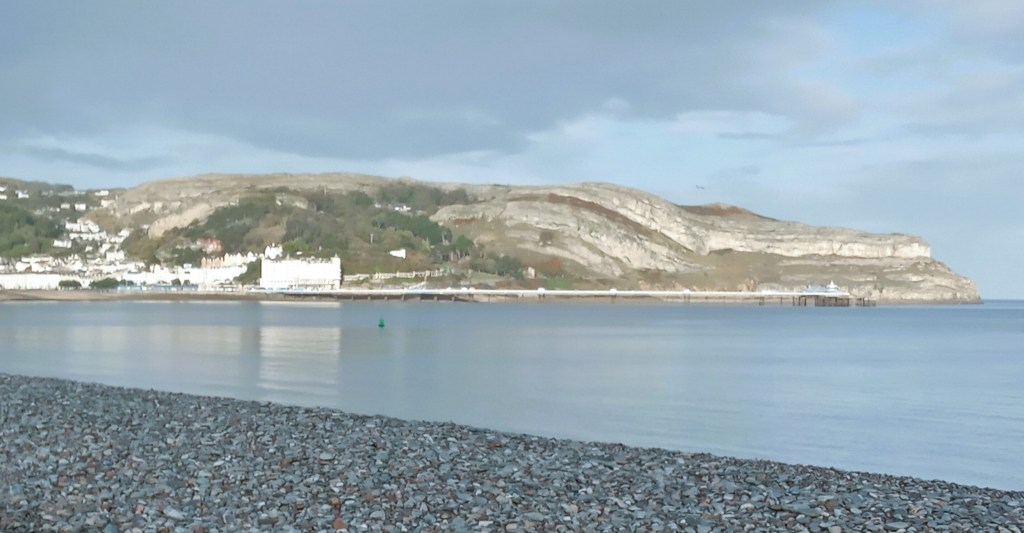
Viewed from Llandudno’s North Shore, Great Orme reminds me of a sleeping dragon looking out to sea.
Rich in wildlife and designated a Site of Special Scientific Interest, a Special Area of Conservation and Heritage Coast, Great Orme is managed as a nature reserve and country park, while it’s human story dates all the way back to the Stone Age, with over 400 sites of archaeological and historic importance. The most famous of these is the Bronze Age copper mine, the largest prehistoric mine workings ever found in the world. Extensive archaeological investigations have been carried out since its discovery in 1987, and today the mine is open to the public as a visitor attraction and is well worth a visit. But last week, with a couple of hours to spare before the school run, we decided to take a wander above ground on the Orme, and seek out its lesser-known medieval history.

The Bronze Age Copper Mines are well worth a visit
In fact, you don’t have to go that far to slip into the Middle Ages on Great Orme, as the name itself came from the Vikings. The fearless raiders and explorers weren’t so fearless when they sailed the coasts of Wales between the 8th and 11th centuries and came across this staggering curvilinear land form stretching out into the Irish sea. From their longships, the forboding protrusion looming up out of the mist resembled a fearsome beast, so they named it ‘horma heva’, meaning great dragon or sea serpent, before turning and fleeing as as fast as their little sails could carry them.
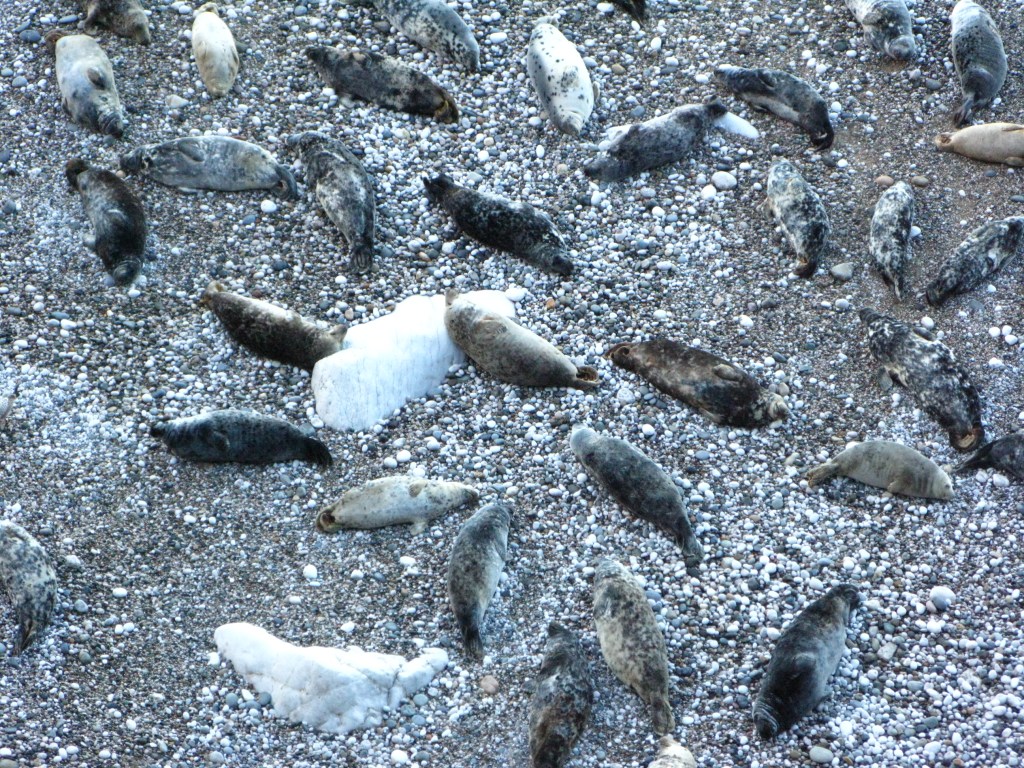
Far from fearful: Great Orme is now home to a large colony of Atlantic Grey Seals, just one of the wildlife wonders to be seen on this special nature reserve. At this time of year they can often be seen chilling out on the shore of Pigeon’s Cove.

Another welcome inhabitant is the famous feral Kashmir goats, of which there are around 200 roaming Great Orme, all descended from a pair acquired from the Windsor Royal Estate around 1880. The resulting herd was released on the headland twenty years later and they’ve been breeding successfully ever since.
The Vikings were right to be afraid though, because the hazardous seas around Great Orme have claimed many lives over the centuries, as countless ships either ran aground or came to grief on the rocks. One of the best-known is that of the Hornby, which met its doom on New Years Day in 1824 as it was attempting to round Great Orme’s head. Caught in a fierce north-westerly gale whilst en route from Liverpool to South America, the vessel was driven onto the rocky cliffs now known as Hornby Craggs. All hands were lost save for one man, John Williams, who was flung onto the land from the rigging, and managed to climb his way up to safety. The long tradition of maritime disasters stretches back at least to the Middle Ages, when even royalty suffered losses. In 1245, three military supply ships belonging to King Henry III (1207-72) were wrecked off Great Orme.
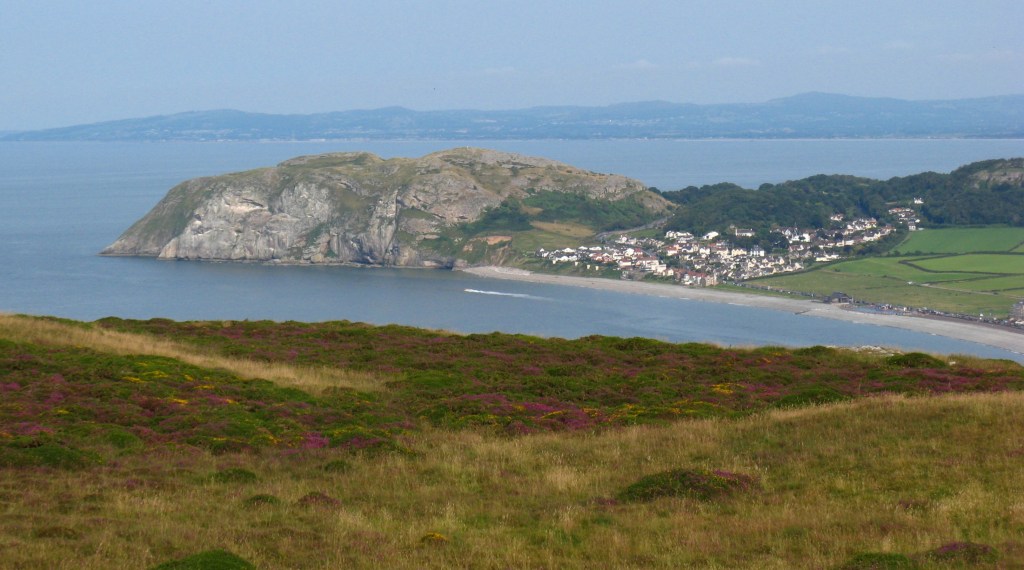
The view from Great Orme to it’s smaller cousin, Little Orme, that lies on the other side of Llandudno Bay.
It wasn’t just mariners who lost their lives on the rocks of the Orme. On 3rd July 1093 the powerful Norman lord Robert of Rhuddlan, who ruled much of North Wales, was enjoying a nice midday nap in his castle just along the coast at Deganwy, when he was roused with very unwelcome news.
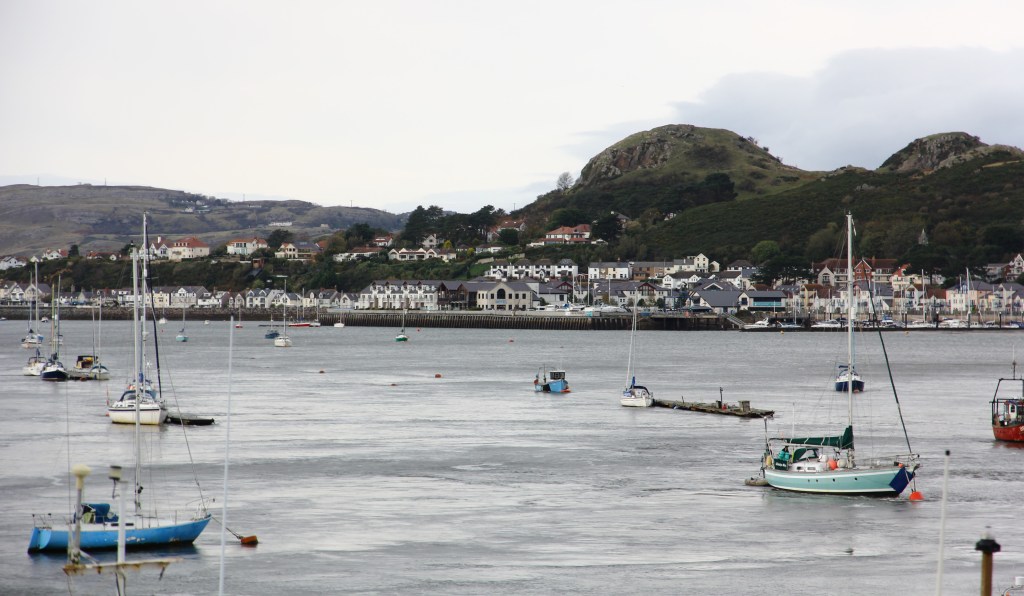
The two ‘camel hump’ hills on the right are the site of the now vanished Deganwy Castle, where Robert of Rhuddlan was snoozing. Great Orme is just along the coast, seen here rising on the left.
A group of Welsh and Viking raiders had beached three ships on Great Orme, pillaged his lands and were busy loading the loot. Robert sent messengers to gather his troops, then made straight for the Orme accompanied by only a single knight. When he got there, he saw to his horror that the raiders were soon to make their escape on the rising tide, so without thinking he charged down the steep mountain path in a rage, followed by his companion, to attack them. It was a fatally bad move. Robert was met by a volley of arrows and spears, and his enemies sailed away with all their plunder and a brand new figurehead on their leading ship, in the shape of Robert of Rhuddlan’s freshly spiked head.
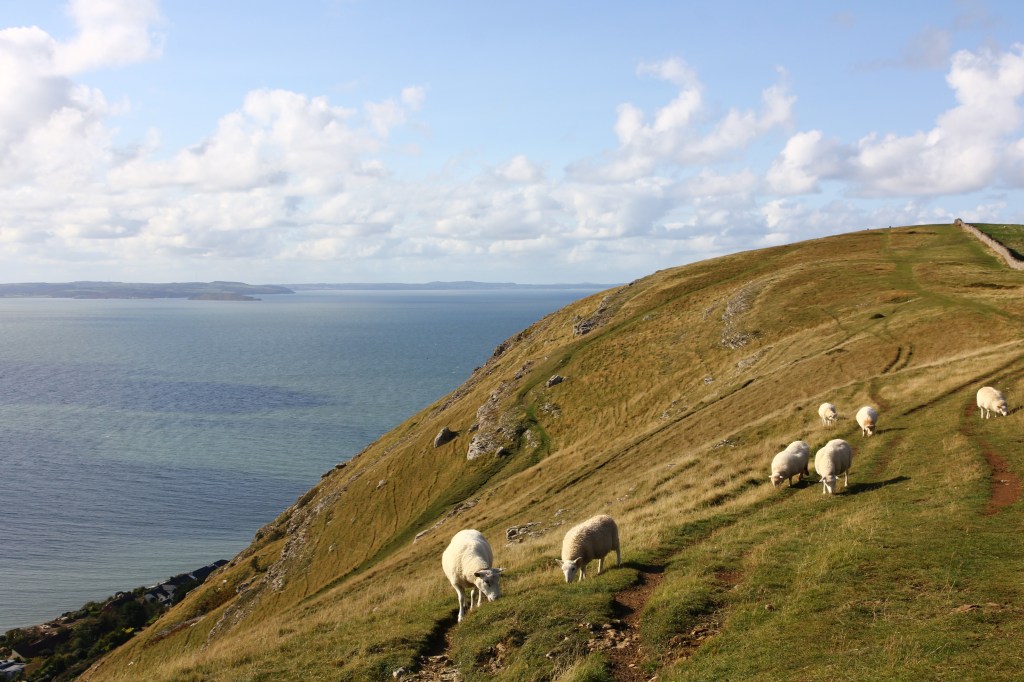
Sheep grazing on the slopes of the Orme, with Anglesey in the distance.

This triangulation point is right on the top of Great Orme’s summit, and the 360° views from here are spectacular.
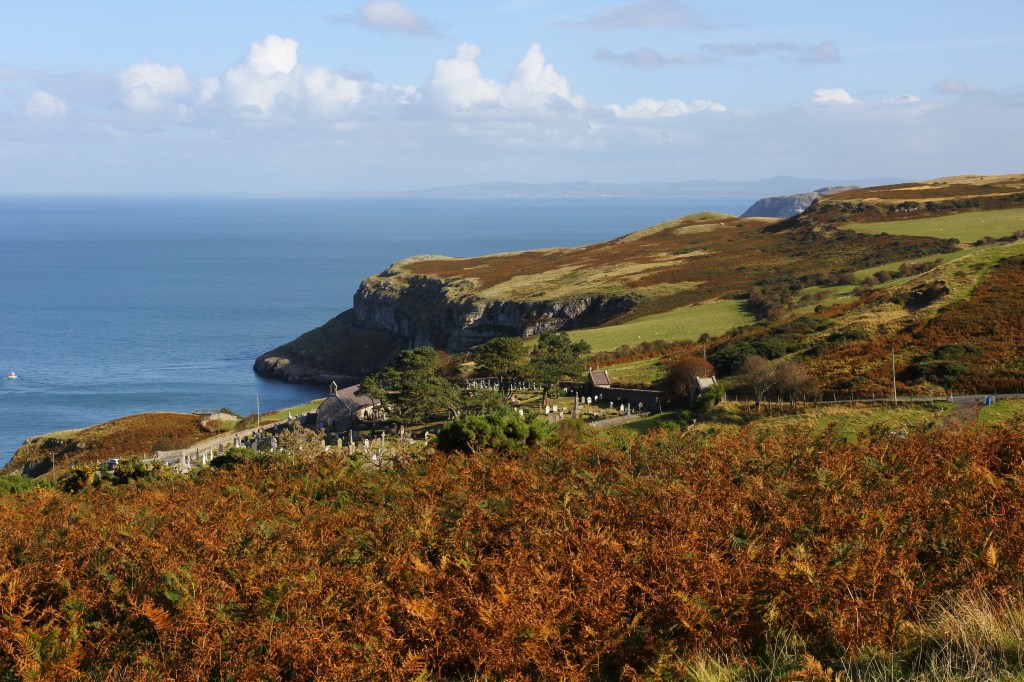
A view across the headland, with our next medieval destination below…

Llandudno, which during the Middle Ages was nothing but boggy marshland. The modern town is so near, and yet so far when you’re up on Great Orme. Our son’s school is the last building on the left of the town in this view.
The next stop on our medieval tour was St Tudno’s church, situated in a hollow on the north face of the Orme. Tudno was a sixth century Welsh Christian missionary of noble birth, who landed on Great Orme and took refuge in a small cave, Ogof Llech, from which he began to spread the word of Christ to the pagan locals. Presumably at some point Tudno was able to move to more suitable accommodation, because he went on to build his cell in a hollow further up the Orme, on the exact spot where this charming 12th century church now stands.

St Tudno’s Church, built in the twelfth century on the site of the saint’s 6th century cell.

The Church’s interior, which holds much interest for the medievalist.

Two c.14th century grave slabs found buried in the graveyard during church restorations. We don’t know whose they were, but from the intricate celtic carvings, they were clearly markers for high-status individuals.

This 12th century round-headed window is in the north wall of the church, which was unusual at the time. It faces out to sea, and there’s a legend that at night, a candle was placed in this window to act as a warning to sailors trying to navigate the tricky waters in the dark. At a time when there would have been no other lights around, this may have acted as one of the earliest lighthouses.
Tudno is purported to have owned a legendary whetstone, which he’s often depicted holding. Once noted as one of the thirteen treasures of Britain, the mystical stone is said to have sharpened the swords of the brave, but blunted those of cowards. It must have been an excellent judge of character…

St Tudno with his magical whetstone, as depicted in this rather beautiful picture inside the church.
Little more is known about Tudno, but he was clearly a very significant local figure because some thirteen centuries later he gave his name to the town at the foot of Great Orme; Llandudno literally means the Church, or enclosure of Tudno.
The 13th century saw a flurry of activity and occupation on Great Orme. In 1284, following his conquest of Wales, King Edward I awarded the manor of Gogarth (Great Orme) to one of his loyal supporters, Anian, Bishop of Bangor. At this time, of course, the town of Llandudno didn’t exist, and the land it now occupies was an uninhabitable marsh, so the medieval settlements were on higher ground. There were three townships on Great Orme, so Anian would likely have done very well from his new land. With Edward’s help he built himself a posh new residence, known today as Gogarth Abbey or Bishop’s Palace, the ivy-clad ruins of which now linger in some lucky person’s garden on the lower south-western cliffs of the Orme. The remains are scant, partly due to coastal erosion, but deliberate destruction also seems to have played a part in the building’s demise. Evidence has been found of a great fire on the site, leading historians to conclude that the palace was most likely burned down at the start of the 15th century by the Welsh rebel Owain Glyndŵr, and it was never rebuilt.
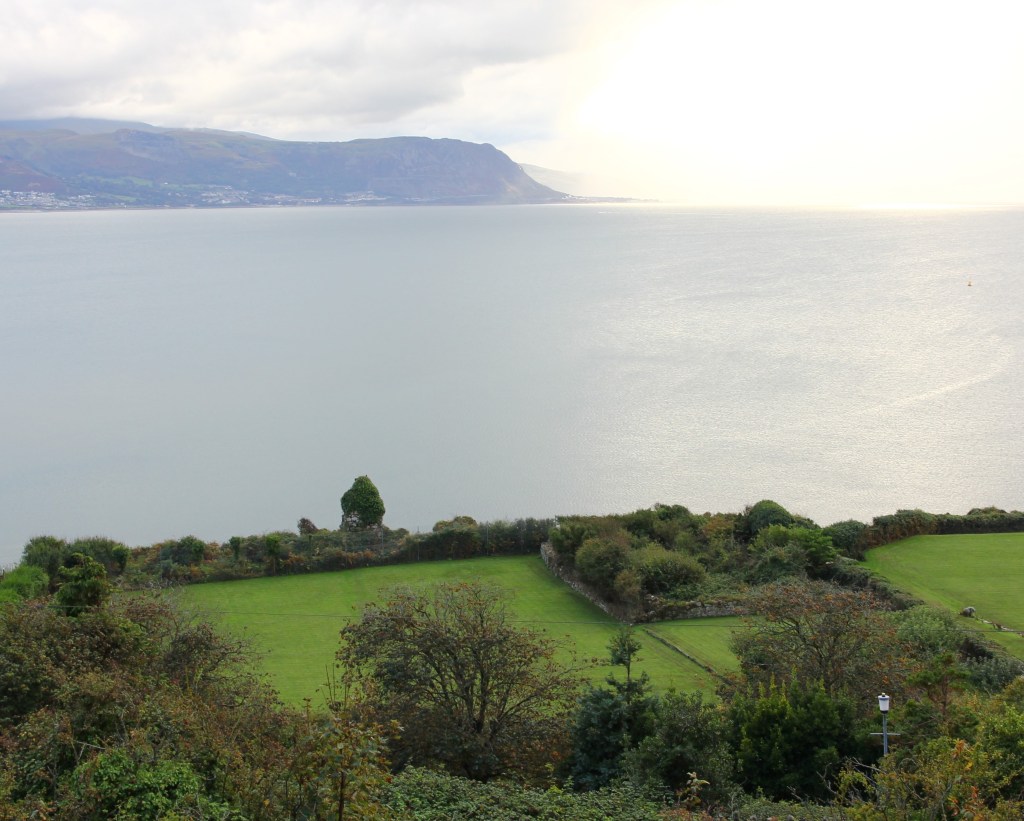
Cloaked in ivy and hedgerow, the ruins of Anian’s palace are now on private land on the lower cliffs of Great Orme, looking across the sea to the northern coast of the Snowdonian mountains.
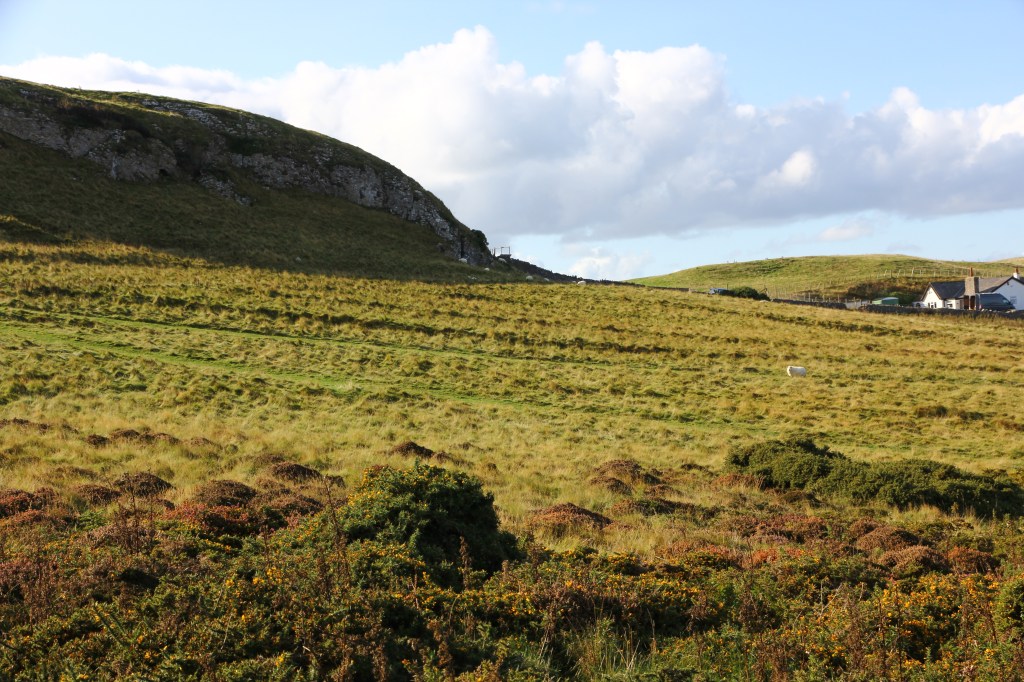
Relics from one of the three townships of medieval Great Orme: uphill from St Tudno’s, the remnants of ridge and furrow farming fields are discernible from left to right in the middle distance, land that is now grazed by sheep.
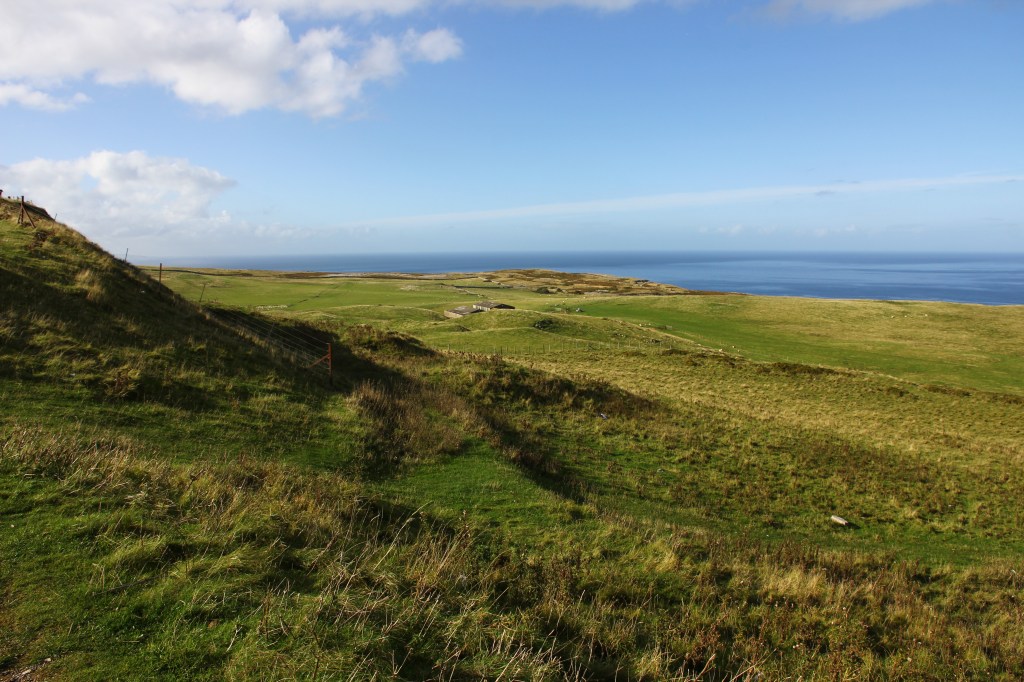
Wandering in the wilderness: up here, it’s hard to believe that we’re only five minutes’ drive from a bustling tourist town…
Behind the palace, rising dramatically along the edge of an alarmingly steep slope, is a footpath known as the Monk’s Path, so-called because of the surrounding lush greenery that’s said to have sprung up from the feet of the monks who trod the route long ago, and the holy water they spilled along the way. It’s a dizzying track that I’ve only ever done once, but it’s easy to imagine a trail of medieval men of God tramping down the Orme to visit the Bishop in his sensibly-sited low-level palace…
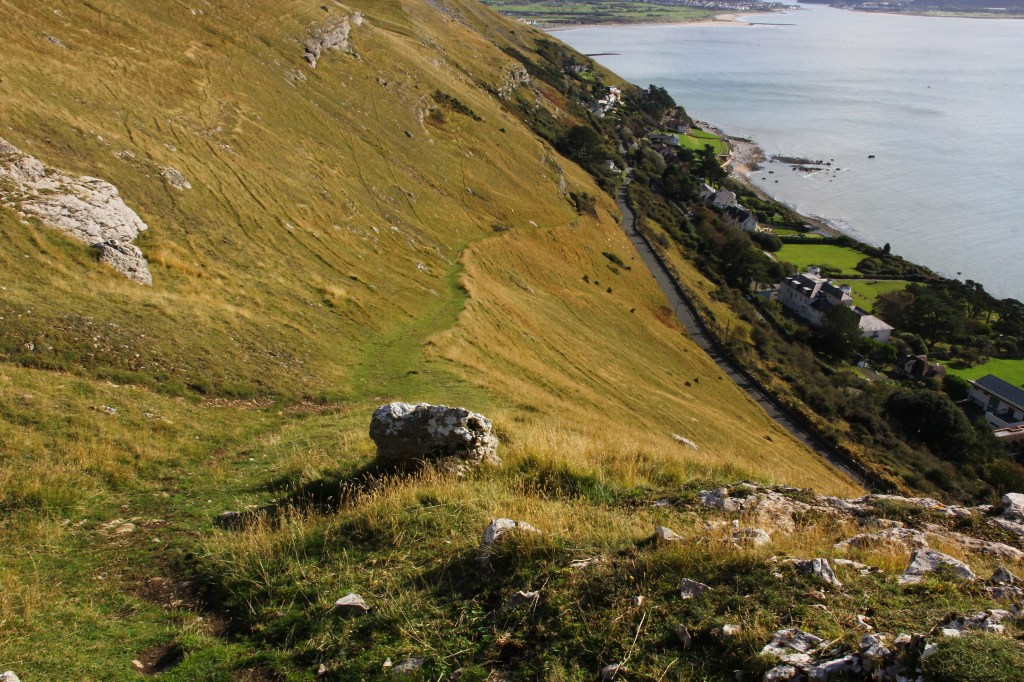
The verdant, but vertigo-inducing Monk’s Path. I’ve done it once, but never, ever again. Those holy men were braver than me! Bishop’s Palace is just visible on the right.
After a most enjoyable walk of discovery, a welcome cup of tea in a clifftop café and a good gaze at the abundant wildlife, it was time to make our way back down to the town, and to school. But it won’t be long before we’re back up on Great Orme to wander around its breathtaking landscapes, take in the spectacular views and learn more of its never-ending story. As with Tudno, this vast, wild headland has become a true refuge for us, a local sanctuary to escape to whenever we need a break from the increasingly maddening modern world, and we’re constantly mindful of how lucky we are to be able to spend time exploring this ancient and unique place.
 medievalwanderings.com
That wasn’t ‘holy water’ the monks were spilling, that was wine! Those monks were drunk! There’s certainly no way I’d go down that path again without some decent alcoholic fortification.
Another cracking post my love, I really enjoyed reading it. You don’t often get to hear about the Orme’s medieval past as you say, it’s far too over shadowed by it’s earlier and later history, which is a shame as it’s equally as fascinating. I do love the Orme though. it really does have a bit of everything.
Here’s to our next visit, and to those brave but tipsy monks and their superior sense of balance!
LikeLiked by 1 person
It really is an amazing place, and we’re so lucky to be able to nip up there any time we like. I still can’t believe it’s so close to the town, as it feels as though you’re in the middle of nowhere when you’re up on the Orme. What a wonderful haven!
As for the monks, surely booze would have made the path even more hazardous? I feel queasy even thinking about it! Still, I’ll happily drink a toast to them for their bravery in tottering down there without even the aid of walking boots! Quick, break open the mead! 😀
LikeLiked by 1 person
Are you sure? I’m pretty certain they must have been under the influence of something to get them up and down that path. If not drink then maybe Nuns? 😀
Either way, I’ll certainly crack open the Mead and drink a toast to them – I’ll go get some now.
We are truly blessed to have such a wonderful place on our doorstep.
LikeLike
Well, here’s to whatever influenced them, but they were still braver than me! 🙂
LikeLiked by 1 person
The park sounds amazing. Not only wildlife, but archeology and medieval ruins AND a grand view of the ocean? In my opinion, that’s as good as it could possibly get. I know we were in that area, but I don’t remember the park. Then again, we went so many places in England and Wales in those 6 weeks AND it was 55 years ago — wow, talk about time flying! — so maybe there has been more work done in the area since them. A lot of places we saw in Ireland have been complete “reconstructed” by which I mean rebuilt to sort of look like they looked, but lacking the oldness factor.
The longer I live, the more things I remember aren’t anything like what I remember. I’m never sure if rosiness has set in or it really HAS changed that much. Maybe both.
You have certainly found a splendid place to live and explore. We get seasons, but you have eternity hanging in your air.
LikeLiked by 2 people
Ah, thanks Marilyn, glad you enjoyed Great Orme! It’s a very special and unique place, and in terms of all it has to offer, you’re right, it doesn’t get better than this.
I think most of us have those kinds of memories, that are perhaps caught between rosiness and the haziness of time. We are hoping to get over to Ireland at some point as we can sail from Holy Island, just off Anglesey. I have heard about some places being reconstructed there though, one of them being Newgrange in County Meath, which was a prehistoric monument but it looks like a brand new building nowadays!
Thanks for the lovely comments, and I must just say I absolutely love your last sentence: ‘We get seasons, but you have eternity hanging in your air’. Wow, that’s so fitting for Great Orme, and it’s given me goosebumps! 🙂
LikeLike
I will reblog this tomorrow. When it is not longer new and after all your fans have signed in 🌈🌄🌅
LikeLiked by 1 person
Many thanks, Marilyn. That would be great, and much appreciated. 🙂
LikeLike
Wonderful! Thank you!
LikeLiked by 1 person
Thank you, Martha, glad you enjoyed Great Orme. 🙂 Hope you’re well. I’ve hardly been in the blogsphere over the past months – life is on overdrive just now. But as and when things finally slow down, Martin of Gfenn is next on my reading list and I can’t wait! 🙂
LikeLiked by 1 person
❤️
LikeLiked by 1 person
💜😊
LikeLiked by 1 person
Well! It may have been a long time in coming but it was more than worth the wait Alli. Great Orme is one of those places that I’ve always wanted to visit and never have. Your post has certainly given me a taste of what I’ve missed: The views alone are worth going up there for, not to mention the wildlife and history. That Bronze Age copper mine looks interesting as does St Tudno’s Church, but what on earth was Robert of Rhuddlan thinking of chasing after a bunch of marauding Vikings – and while I’m at it, what was a person who suffers from vertigo doing walking along that Monk’s Path? Great stuff Alli but please don’t leave it so long next time. 😊
LikeLiked by 1 person
Aww, thanks Malc! 🙂 Glad you enjoyed this taste of Great Orme and all it has to offer the nature and history lover. The views are stunning, and the Bronze Age mine is an education – we’ve been a couple of times and will definitely go again. As for Robert of Rhuddlan, well yes, I thought that too – what on Earth was he thinking? I suppose his anger clouded his judgement, but I bet he wished he’d stayed in bed as he breathed his last! When you think about it, this was a bit of a Darwin award, really.
We did the Monk’s Path upwards as part of a walk last year which we’d planned on the OS Map, but hadn’t realised how scary it would be! When you’re ascending, the path is narrow, the slope very steep with no safety barrier or fence, and you’re looking ahead at land that’s at least at a 45 degree angle! My poor brain kept trying to right what it thought was a horizon, and I had to keep stopping to turn away and face the upper slope in order to cope. I was woozy as hell at some points, and my legs were like jelly, but I suppose by the time I felt that bad it was too late to go back down. Beautiful views – when I wasn’t nearly passing out – but there’s no way I’d ever do it again!!! 😨
Thanks for the lovely comments, Malc, which are always welcome, and I promise I won’t leave it so long next time. And we’ll catch up soon. Looking forward to it. 🙂
LikeLike
I’ve learnt something else now because I hadn’t heard of the Darwin Awards before, but I’ll try and make sure I don’t make the list 🙂Thankfully I left walking along hairy footpaths behind a long time ago. 🙂
LikeLiked by 1 person
Ah yes, Darwin Awards. This is one award nobody wants. 😉
LikeLiked by 1 person
I’m wondering if there shouldn’t also be an award for people who rid the world of those who have inflicted misery upon the rest of humanity.
LikeLiked by 1 person
Now there’s a great idea. We could call them the Churchill Awards. 🙂
LikeLiked by 1 person
We could do with him again!
LikeLiked by 1 person
Now more than ever.
LikeLiked by 1 person
No need to worry we’ve got David Lammy looking after our foreign interests 🤓
LikeLiked by 1 person
So we can all sleep safe in our beds then. 😉
LikeLiked by 1 person
Maybe Keir Starmer perhaps. I’m sure he’s his minder.
LikeLiked by 1 person
What, as in Arthur Daley and Terry McCann? 😉
LikeLiked by 1 person
Yep, but Terry had a bit more upstairs. Did you see the clip when Lammy was on Mastermind?
LikeLiked by 1 person
😬 Mastermind? Good grief, no I didn’t. When was that?
LikeLike
LikeLike
Well, that about says it all, doesn’t it? I see what you mean about Terry having more upstairs! And we’re trusting him with our foreign affairs, when he knows so little of England – what moron would think that Henry VIII’s was succeeded by his own FATHER? I mean, honestly! Did you hear that Keir Starmer has removed portraits of Shakespeare, Walter Raleigh and Elizabeth I from No.10? Seems as though he’s trying to erase English history altogether now. That’s probably no skin off Lammy’s nose though, as he probably doesn’t know who any of them are! 😦
LikeLike
Anybody can take pictures down off a wall Alli, but nobody can erase history – and as for ‘Comical Lammy’ he only knew where the Chagos Islands were because ‘President’ Biden told him to get rid of ’em before parliament came back from recess.
LikeLiked by 1 person
Seriously??? Honestly, you couldn’t make it up could you?
You’re so right about history though. No he can’t erase it, and he’s an idiot to even try. Well said, Malc. 🙂
LikeLiked by 1 person
🙏
LikeLike
I’ve never been to Llandudno and always slightly dismissed it as ‘just’ a seaside town. Now, thanks to you, I know better! Great Orme looks like a wonderful place for a walk with such stunning views and lots of history. I love the little stained glass window in the church and the story of the light set there to guide sailors.
LikeLiked by 1 person
Thanks, Sarah, I’m pleased to have introduced you to Great Orme! 🙂 It really is a wonderful place to spend time. It’s got things like the tramway that runs up from the town and the mega scary cable cars, but you can leave the tourist stuff behind and wander out into the wider reserve within minutes. St Tudno’s Church is well worth a poke around too. I love that little lighthouse window and it’s story. The glass is Victorian, but the embrasure is twelfth century. Llandudno is pretty up-market for a seaside town – definitely a cut above the rest. That comes from the fact that the land is all owned by the Mostyn Estate who keep a tight control on everything that happens in the town. You can’t even sell ice creams on the promenade, or paint your hotel frontage without their permission. So we like the place, and there are some great independent shops, lovely cafes and our favourite chocolate shop there! 😀
LikeLiked by 1 person
It sounds a great place to be living near!
LikeLike
Superbly interesting post! And lovely photos. The Monks Path does look very vertigo-inducing – I’m never keen on paths like that along the side of a steep slope as the height sort of catches up with you from the corner of your eye.
I think the legend about the candle in the window looking out to see is probably very true. Some of the Scottish gamekeepers, in the days when they lived in the wilds amongst the mountains, did the same for mountaineers to prevent their being benighted.
LikeLiked by 1 person
Thanks Carol, glad you found it so interesting 🙂
Yes, the Monk’s Path is nice to look at, but no way would I do it again. You’re right that the height creeps up on you. It seemed reasonably ok from the bottom, but as we went up it got worse and worse. My brain kept trying to right what it thought was the horizon, but was in fact the land ahead at a 45-degree angle! And with no barrier and a steep slope beside us, woozy doesn’t cover it! I even feel queasy now when we drive past and see other people tackling it!
That’s very interesting what you say about the Scottish gamekeepers and their window candles. That certainly adds weight to the idea of a St Tudno’s medieval lighthouse on Great Orme.
LikeLiked by 1 person
it’s a lovely thought about the early lighthouse anyway.
I feel I’ll have to have a go at the Monks Path – I like a challenge and would like to see if it has that effect on me. As I said, I don’t really like traverse paths anyway but I suppose I’ve improved a lot over the years – especially with the Scottish stuff I had to do.
LikeLiked by 1 person
Wow, you’re much braver than me, Carol. I didn’t even know it was a traverse path until you mentioned it, but then again I didn’t know what a traverse path was at all until I Googled it. Anyhow, once was enough for me, but I’d gladly wave and cheer you on from the bottom! I have to say, we don’t see many people doing the Monk’s Path. 😀
LikeLike
I’m only braver because I’ve had to do an awful lot of scary things while doing the Munros and so I’ve eventually gained a better head for heights and have got used to things like that a bit. But I prefer a path along the top of even a narrow ridge to a traverse path.
LikeLiked by 1 person
I suppose you would develop more of a tolerance to these things with practice. It’s probably like building your scary path muscle! 🙂
LikeLiked by 1 person
That’s a really good analogy which made me laugh but is probably very true
LikeLike