The festive season seems to have come around even faster than usual this year, and now suddenly we’re into December and the frantic gallop towards the big day. As my regular readers will know, I always try to bring a little of the Middle Ages into our Christmases, but this year I thought I’d consider the four weeks leading up to the 25th: the season of Advent. Was there anything about the medieval pre-Christmas period that might inspire me, connect me with the period and enrich my enjoyment of the celebrations? Well, although Advent of yore bore no resemblance whatsoever to our modern experience, the surprising answer was a resounding: Yes.
These days Christmas seems to start even before Halloween. Sparkling cards, decorations and assorted festive goods creep into the shops as early as September, while the first of the now cinematic TV ads hits our screens just as we’re disposing of our carved pumpkins and packing away our pointy hats.
I love Christmas as much as anyone, believe me, but when you take a moment to stand back and look at our approach to the midwinter revels today, it’s hard to disagree with money saving expert Martin Lewis’s assertion that ‘Christmas has become a retail festival, and it shouldn’t be’. However you look at it, and whatever your religious views, Advent is now a season of commercial hype and pressure to part with all your cash – and more – whilst riding the wave of parties and events, and indulging in chocolate calendars, festive foods and too much booze. Little wonder, then, that by the big day itself we’re all Christmassed out and ready to drop. But back in the Middle Ages, these four special weeks couldn’t have been more different.

Medieval Advent couldn’t have been more different from how it is today…
Beginning on Advent Sunday, the fourth Sunday before Christmas, medieval folk were expected to spend the run-up to Christmas in solemn contemplation, prayer and penance whilst exercising restraint in most aspects of their daily lives. Although not as strict as Lent, the 40-day period of fasting before Easter, the season of Advent included three Ember days per week – Wednesday, Friday and Sunday – when you were expected to eat less than normal. Meat was prohibited and you only had one simple meal a day consisting of fish or vegetables. Not only that, all bedroom antics were banned on fasting days as sexual activity was considered inappropriate in such holy times. And by extension, this also meant that no weddings were permitted during Advent.

In the Middle Ages, the seasonal excesses had to wait until Christmas actually began. Dont’ know what’s happened to that bloke on the end – probably way too much mead. Told you they knew how to celebrate!
The word Advent, or Adventus in Latin, means ‘the coming’ or ‘arrival’ and this had a dual meaning in the Middle Ages. In one respect, the acts of reflection and prayer were preparation for the historical coming of Christ. But the Catholic church also introduced the idea of anticipating the second coming, the Day of Judgement, when Christ would return to judge the sins and virtues of the whole world. All the fasting and contrition, then, was a way of preparing the immortal soul for the end of days, and hopefully securing a ticket to heaven. Who knows, maybe that’s where the ‘naughty or nice’ list came from…

Sorting the naughty from the nice: the Day of Judgement was a big consideration during the pre-Christmas season.
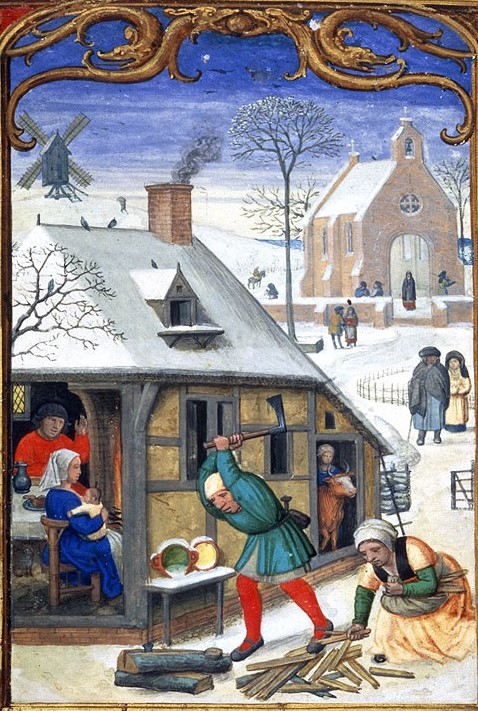
Preparing for the winter and the Christmas season, but the call to worship was never far away in Advent.
Of course, this all seems rather harsh to our modern sensibilities, but there are a couple of points to bear in mind. For one thing, fasting at this time of year meant the meat supplies would go further. But also, after a month of restraint, solemnity and contemplation, everyone was more than ready for the novelty of a huge feast, and a full twelve days of parties and merriment. During the Middle Ages then, the true Christmas period would have been fully appreciated and embraced.
But it wasn’t all prayers and penance, for amid the prescribed sobriety of Advent there were a couple of occasions to look forward to. On 6th December, St Nicholas Day (the patron saint of children) a curious custom called the Ceremony of the Boy Bishop was held. A boy was chosen from the choristers of a large church or cathedral and dressed in full episcopal garb – mitre, crozier and all. With the help of other boys chosen to act as clergy and servants, the young lad then served as bishop for a term lasting until 28th December, Holy Innocents’ Day.

During his term in office, the boy bishop performed most of the duties of a priest.
In what must have been quite a spectacle, the young bishop took all the services apart from the Mass (that was a step too far), gave blessings to the congregation and, to all intents and purposes, was treated as a real bishop. He even sat in the adult seats, while the grown ups had to move elsewhere. Should the lad be unfortunate enough to die in service, he would be buried with full honours, dressed in all his regalia.
Quite how this strange ritual came to be is unclear, but the idea might play into the ancient pagan traditions of role reversal that hung on into the christianised Middle Ages. During the Roman festival of Saturnalia, for example, it was customary for all ranks to swap roles, with masters inviting their slaves to dine with them, and even serving them at table. But however it came about, the ceremony was a popular interlude in Advent, and there are records of services being performed by a boy bishop for King Edward I in 1299, and later for his grandson, King Edward III.

Despite being abolished by Henry VIII and Elizabeth I, the custom of the Boy Bishop is still taking place today, as this image from Salisbury Cathedral shows. (Source)
St Nicholas’s Day could also be an occasion for gift giving, particularly to children, although this varied from place to place. Depending on where or who you were, you may get a present on Christmas Day, or more traditionally on New Year’s Day. Nonetheless, gift giving wasn’t a major part of Christmas, as the main attraction was gathering for the big feast itself, followed by all the fun, games and entertainments. It’s all a far cry from the way we do things today.

After four weeks of restraint and reflection, Christmas arrives and it’s time to celebrate!
So, having studied Advent medieval-style, what can I take from how they prepared for Christmas back then? It’s impossible to avoid the commercial frenzy that pervades the modern season, but in recent years I have to admit I’ve begun to find it all a bit overwhelming. When something becomes massively over-hyped I tend to go off it, but I still love the core festival; the essence of Christmas. So now, as a family, we’ve decided we want to celebrate the midwinter revels in our own, simple but special way.

We’ll be out enjoying the scenery this Advent.
This December, then, we’ll still buy presents, put up decorations and prepare some tasty treats, but other than that, we’re going to slow down. Advent this year will mean less stress, less pre-Christmas indulgence and more peace. I’ll still enjoy a drink and the odd mince pie, but everything in moderation. I’ll sit by the fire and read ghost stories. I’ll walk in nature, observe the coldest season and the fragile light, the wintering wildlife and the setting sun in the afternoon sky. I’ll reflect on the past year and look forward to the twelve months ahead. Then, when Christmas does arrive, we’ll feast, play games and be merry, just as we always do, and as the medieval folk did – in style!

Woodland winter walks are very much on the cards…

…and watching the stunning winter sunsets.
And from this quieter Templeton perspective, I’d like to offer you one of my favourite recordings of a rather beautiful and haunting Advent hymn that has its roots firmly in the Middle Ages. In keeping with the medieval tradition, it’s gentle and delicate, and it reflects the seasonal longing for the coming of the Messiah. So why not switch off the Christmas ads, take a glass of cheer, put your feet up and join me in the peaceful and meditative sound of Advent long ago. With this, I wish all my readers a joyous Christmas to come, and a very Happy New Year.
 medievalwanderings.com
I’m really looking forward to slowing down for advent this year and spending more quality time with you in peace, contemplation and away from all the horrible commercialism and horrendously naff Christmas adverts. Some time reading by the fire sounds wonderful, especially with a small tipple.
Another excellent and entertaining post my love – they really knew how to do things properly in the middle ages!
LikeLiked by 1 person
Glad you approve, and even more glad you agree! 😀 Here’s to actually enjoying Advent for once! 🙂
LikeLiked by 1 person
Cheers! I’ll drink to that!
LikeLiked by 1 person
😀
LikeLike
Lovely, Alli! I’m just keeping my head down this year. 🎄
LikeLiked by 1 person
Thanks, Martha! Don’t blame you for keeping your head down too. Seems we’re both feeling the overload. 🎄 x
LikeLiked by 1 person
I get that feeling, Alli. I just want to walk my dogs, look at the mountains, feel the cold and maybe paint something. 🏔️
LikeLiked by 1 person
Sounds absolutely perfect to me. 🙂
LikeLiked by 1 person
You don’t have to go back as far as Medieval times to remember that Christmas was not always like it is now. Even when I was growing up in the 1950s, it was commercial, but not anything like today brain blasting. I’m sure the “advent” of the internet has hugely increased the pounding we get this time of year and certainly the length of time we have to deal with it. I think they make up occasions to warrant another “sale.”
Capitalism IS colonialism, generally without armed conflict — so far.
LikeLiked by 2 people
Oh yes, it has been far too commercialised for far too long. It just seems that recently it’s gone to another level, and it drives me mad. And yes, without doubt the internet has compounded it. I think you’re spot on when you say they make up occasions to warrant another ‘sale’.
Love the quote at the end!
Did you see the video in my last post? Thought you might like to take a short peek as you’re a fan of the Middle Ages. 🙂
LikeLike
I was planning to look at it but it got buried in all the other endless email from those who want donation to those who want to see me something. It’s bound to show up. I’m down to my final 100 “new” posts — many of which look remarkably like the ones I deleted yesterday.
LikeLiked by 1 person
Goodness, you are a bit swamped at the moment, aren’t you? Sorry to hear that. Hope you can come up for air soon. Take it easy, anyway. 🙂
LikeLike
I found your podcast link. Tomorrow when the TV isn’t on.
LikeLiked by 1 person
No worries, Marilyn. If you do get to see any of it, I hope you enjoy it. 🙂
LikeLiked by 1 person
Like Alli, I love that quote. Funnily enough, I had an intere4sting conversation with friends at my photo group over dinner last night (yes, an Advent excess of eating at our annual group Christmas meal!) Someone made the point that as colonisers we often introduced the concept of capitalism to cultures who until that point had no real grasp of or interest in it, satisfied with what they had rather than aspiring to what they did not.
LikeLiked by 1 person
It’s great, isn’t it? I should think there are quite a few of those sorts of conversations going on around the world at the moment!
LikeLiked by 1 person
Yeah. And look how well it has worked out for most of us? I’m pretty sure we ALL believed that with new knowledge, life for all of us would improve. It was a great dream. Pity it didn’t work.
LikeLiked by 2 people
It’s a shame they bothered to introduce capitalism to those cultures, really. The world would be a better place if we could all just be happy with what we have.
LikeLiked by 2 people
It is way too commercial here. And I hate when they start going on about Christmas in September/October/November. It just means you’re inured to it by the time it finally gets here.
I did used to love the work’s Christmas Parties though – I always had fun – my best one was when me and my best friend took water pistols and blasted everyone. We blasted absolutely all the men (the women tended to make a fuss about ‘their hair’ or suchlike) including the very upper management – executive level. They were the funniest as they couldn’t understand where the water would be coming from and were looking up at the ceiling thinking there must be a leak while we stood not far off having hysterics. When my friend got very drunk later in the evening, it was our turn as she let them get her water pistol so we got soused – all very great fun!
Richard used to make me crackers every Christmas to put under the tree (well, he uses the same cracker wrapping but just refills and reties them) – he used to fill them with so many chocolates they’d last me a few months after Christmas. I loved that. I had to think really hard when he mentioned it this year as I haven’t been eating chocolate at all since spring when I did my ‘no added sugar’. In the end, I decided I wouldn’t feel like it was Christmas without some choccie so I’ve relented and said he can refill them again.
LikeLiked by 1 person
Your work parties sound a riot, especially playing trickster to the upper management! 🙂 Of course, in the middle ages they’d have lots of boisterous fun too, only it was during the twelve days of Christmas rather than in Advent.
I’m glad to hear you’re allowing Richard to fill your crackers with choccies. After missing it for a long time you’ll enjoy it all the more!
I agree entirely about how maddening it is to see Christmas stuff in the shops in September. That and the overhyped commercialism of Advent. It’s gone mad these days, and although I love Christmas I don’t want to be inured to it when it gets here thanks to avaricious retailers relentlessly bashing us with it.
LikeLike
I think, on the choccie front, I’m scared of getting back into a bad habit. I used to have a bar of chocolate every night while I was watching my DVDs just before bed time – not the best time to eat something like that really. Also it does contain cocoa which is good at bed time!
LikeLike
That quote was me. We don’t NEED armies. We can subdue the world by email!
LikeLiked by 1 person
Well done – that’s an excellent quote – I’m impressed! 🙂 You’re so right too. It’s frightening the power the Cyber world has nowadays.
LikeLike
An excellent post as always Alli. You’ve given us the perfect picture of a medieval Christmas, and at the same time, shown us how things have changed over the years. I tend to think of Christmas in different ways: From the early days when I still believed in Father Christmas, to the true meaning of Christmas while singing carols as a chorister and then maxing out on liquid festivities as a teenager, but whatever it was, I always really enjoyed this time of the year. As you quite rightly point out, times have changed, but I think we change as well as we get older, and I often think of the lonely people who have nothing much to celebrate at this time of the year. Whether you believe in the birth of Jesus Christ on Christmas Day or not, it’s definitely a time of year where we have the chance to be nice to each other, but invariably somebody somewhere will do their level best to spoil it. A peaceful Christmas is what I would like too – just not too peaceful. 😊🎄✝️
LikeLiked by 1 person
Thanks Malc, glad you enjoyed my seasonal look at medieval Advent. I think, as it’s got so over-commercialised now, and as we’ve lost track of the original meaning – either the birth of Jesus or the pagan midwinter revels – I can’t help feeling that we overdo it in Advent these days and by Christmas Day itself we’ve had enough. That can’t be right. That’s why I’m easing off during Advent and exercising some of that medieval restraint and reflection, so when Christmas Day arrives, and the following eleven days (or as many of them as we can do before school goes back!) we can do what they did and make the most of the celebrations.
Like you, I feel concern for those who are lonely or have lost loved ones. That’s another reason why I’m not keen on all the hype – it rubs salt in their wounds.
Anyway, I’m glad you liked the post, and I hope you have a lovely Advent and Christmas season. 🙂 🎄
LikeLiked by 1 person
Thanks Alli, and I hope you do too!
LikeLiked by 1 person
🙂
LikeLike
You’re absolutely right about what Advent has become. I confess to liking some aspects – I enjoy getting together for a meal to celebrate with friends for instance, I love decorating the house and wrapping presents. But none of this should start before December!
Thank you for sharing that recording of O Come, O Come … I’ve always loved that hymn, the tune is almost haunting.
LikeLiked by 1 person
I agree, Sarah, there are some aspects I like about Advent too, I just feel it’s all gone too far nowadays and my usual reaction to anything that becomes overhyped is to back away from it. For us, it’s just slowing down and doing things in moderation so as not to spoil our appetite for the real Christmas period.
Glad you enjoyed O Come, O Come. It’s beautiful, isn’t it? And I particularly love this recording. Hope you have a lovely Christmas, Sarah, and all the best for 2025.
LikeLiked by 1 person
And the same to all of you 🎄
LikeLiked by 1 person
🙂
LikeLiked by 1 person
Absolutely fascinating as always/ Hope you have a grand time.
LikeLiked by 1 person
Ahh, thanks John, that’s a lovely thing to say! I hope you have a grand Christmas too, and a happy and prosperous 2025.
LikeLiked by 1 person