For as long as I can remember, York has held a special place in my heart. I usually avoid cities, being the devoted country mouse that I am, but York is different. There’s something unique about the place that I can’t quite put my finger on. But whatever the magic is that infuses the labyrinth of crooked streets, snickelways and age-old buildings, I’ve never sensed the like of it anywhere else.

York has always been a very special place to me…
From the magnificent Minster to the history-soaked castle on the mound and everywhere in between, the never-ending stories that ooze from every cobble and beam within these ancient city walls seem somehow to be still playing out. York is a place where you feel you are truly walking with the ancestors, and that just around the corner you could come face to face with a Viking, a Norman or a Roman. So you can imagine how much I’d been looking forward to our recent Yorkshire holiday, and to some precious time spent in my soul-mate city. And what better way to start our first day than to take a wander around Barley Hall, a charming medieval townhouse tucked away behind one of York’s oldest streets.

Travel back to the time of Richard III at Barley Hall
Tucked away in a quiet courtyard off Stonegate, one of the most historically important and picturesque thoroughfares in York, the visitor attraction that is Barley Hall came into being after being rediscovered in the 1980s hidden beneath a façade of later brick buildings. Saved from the developers’ clutches, it was purchased by York Archaeology (formerly York Archaeological Trust) in 1987 and named after the Trust’s original chairman, Professor Maurice Barley. Following extensive archaeological investigations carried out between 1987 and 1990 the remarkable building was painstakingly restored, opening to the public three years later as a hands-on museum.

The sorry state of Barley Hall as it appeared in 1984, hidden behind modern brick buildings (Source: Barley Hall)…
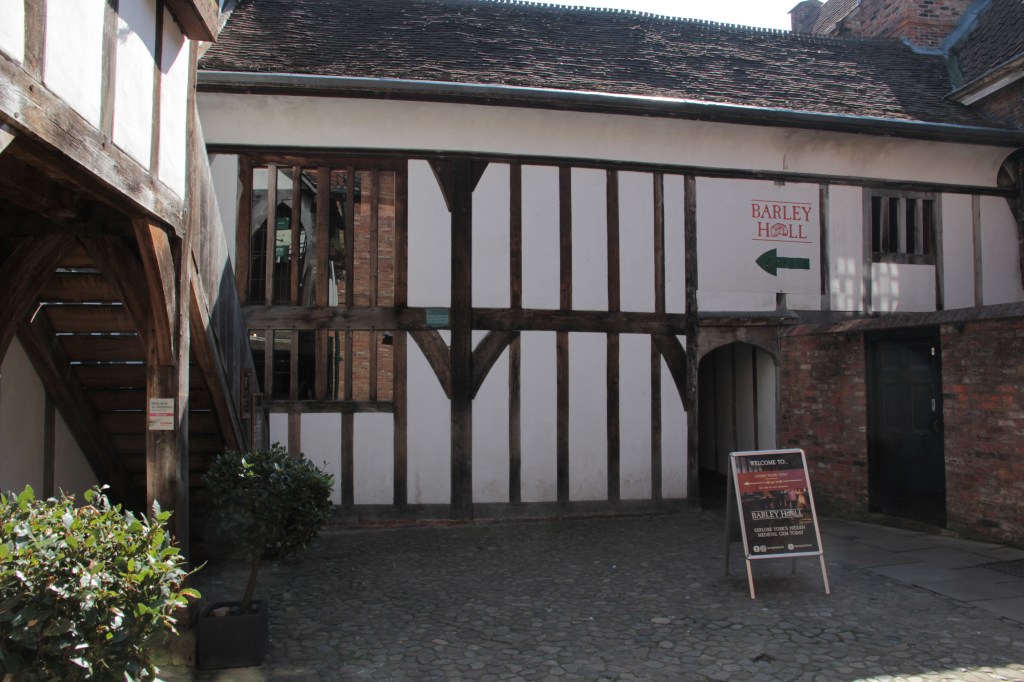
…and how it appears today, looking towards the Great hall range and the alleyway
The hall is furnished with authentically recreated fixtures and fittings that show how it might have looked in 1483, the year that York’s beloved duke of Gloucester was crowned King Richard III, and when the property was occupied by the Lord Mayor of York, William Snawsell. Today’s visitors are encouraged to sit on the seats and handle objects to get a taste of life in late in medieval England. Of course, I couldn’t wait to find out more.
The History
Interestingly, in 1483 Barley Hall was already well over a century old. The earliest record dates to 1361, and refers to the property as ‘the hospicium of the Prior of St Oswald’s’, a well-established and wealthy monastic house located in Nostell, near Wakefield. At this time, York was the capital of the North, boasting both royal and noble residences and a population second only in number to London. York Minster was the heart of Christianity in the North, so visiting clergy needed a base to stay in the city when attending important events and services. Many who served the cathedral lived in nearby Stonegate, so a substantial house was built just off the main street for the use of representatives from Nostell Priory.

Stonegate, one of the oldest and most important streets in York.
The wealth of Nostell Priory that enabled the construction of such a grand house in England’s northern capital was down to its illustrious leader, Prior Dereford. A strict disciplinarian, Prior Dereford was also a gifted administrator with a good head for business, and his acumen brought great financial benefits to the priory. However, after his death Nostell’s fortunes began to decline, and by the 1430s funds were at an all-time low. The priory was forced to give up its mansion in York, renting it out to a secular tenant. It seems that the Great Hall was rebuilt around this time, most likely by the new leaseholder to show off his wealth and status, and it is this impressively reworked hall range that is represented in today’s building.

York Minster was the spiritual centre of the North
By 1466, the splendid townhouse was occupied by our host, William Snawsell. In 1451, as a wealthy goldsmith and tradesman, William had built a shop in Minster Gates, one of the most prized trading sites in the city. Located at the main entrance to the cathedral close, he was ideally placed to ply his lucrative trade, and with the custom of the Minster and membership of one of the wealthiest guilds in York, his business thrived. His position was further raised by an advantageous marriage to Joan Thweng, a lady of noble birth who brought with her political connections to the powerful northern Neville family and to Thomas Wytham, the Chancellor of the King’s Exchequer. In 1468, the distinguished alderman William Snawsell became Lord Mayor of York, and by this time, as befitting his elevated status, he was living in one of the most expensive rented houses in the city.
So now we know it’s story, join me in a wander around William’s grand home…
The Tour
The medieval mansion would originally have formed a U shape, but changes through the centuries have meant that only the chambers and hall range survive. Luckily, what remains is more than enough to tell us about the life of a wealthy merchant in fifteenth century York.
We enter from the courtyard at ground level, through the tradesman’s entrance because we’re not important visitors. If we were, we’d be climbing the exterior timber staircase to gain direct access to William Snawsell’s first floor Great Chamber. Today’s admissions area and shop is known as the Store Room, and would have been packed with various goods for the household’s consumption. The timber beams have been dated to 1360, indicating that this is part of the fabric of the earlier Nostell Priory house.

We’re not important enough to climb the stairs, so we go in through the tradesman’s entrance underneath.
Tickets in hand, we walk through a side door and the modern world falls away. The medieval room in which we find ourselves is the domain of the Steward, the man in charge of domestic matters and the household servants. His workshop is furnished with all kinds of equipment required for daily tasks and maintenance of the hall, as well as a bed to lay his weary head after a busy day’s work. I pick up on the scent of hand worked leather and beaten earth beneath my feet, and looking around it feels as though the Steward has just popped out on some errand and will return at any moment. The room is lit by a window of particular interest, as it’s a rare example of one solution to a perpetual medieval problem: how to ensure you can see what you’re doing and keep warm, whilst blocking out the worst of the weather and all the bugs and rodents. One answer was the fenestral.

The Steward’s Room: he’s just popped out…

A workbench in the Steward’s Room set out for daily tasks, including repairing shoes.
A fenestral was a wooden lattice window covered with a specially prepared sheet of linen. After a good soaking in alum, a chemical compound used to fix dyes, the cloth was stretched over the wooden trellis before being coated in a mixture of tallow and rosin, a substance produced from pine resin. Et voila, you have a translucent and waterproof window! The clever design also meant that the whole thing could be removed when ventilation was required, and you could even take your windows with you when you moved. Simple, but ingenious…

The fenestral was a simple but effective window.
Moving on through an internal vestibule, we turn right to enter the best room in William Snawsell’s mansion: the splendid two-storey Great Hall. This is where the household takes its meals and enjoys elaborate feasts. William, his family and distinguished guests sit at a top table set on a raised dais with an overarching canopy, whilst those of lesser status take their places on simple benches at the lower side tables. Set into the floor in the centre is a square tiled hearth where a fire would blaze, bringing warmth and joy to the proceedings, while the smoke rises up high into the timber rafters and escapes through a smoke hole in the roof.

The stunning Great Hall.

Colourful painted linen wall hangings show the Yorkist white rose, together with William’s initials and the family arms of his well-connected wife, Joan Thweng.
The room is rich in colour and texture, from the floor tiles reproduced from those discovered during excavations to the brightly painted linen wall hangings. The latter may be a step down from the tapestries that adorn the walls of the very rich, but they still announce William’s status and his elevated position in the city.

Diners of lesser status sat on simpler benches on the lower tables.
At the far end of this grand feasting room is a glass panel wall, where a covered public alleyway now divides the service rooms from the Great Hall. In 1483 this would have been a screen’s passage, a wooden screen or curtain that blocked the view of scurrying servants as they crossed between rooms, fetching, carrying and preparing dishes for service. Naturally, I take my seat at the top table, feeling I could comfortably spend the whole day in this room alone…
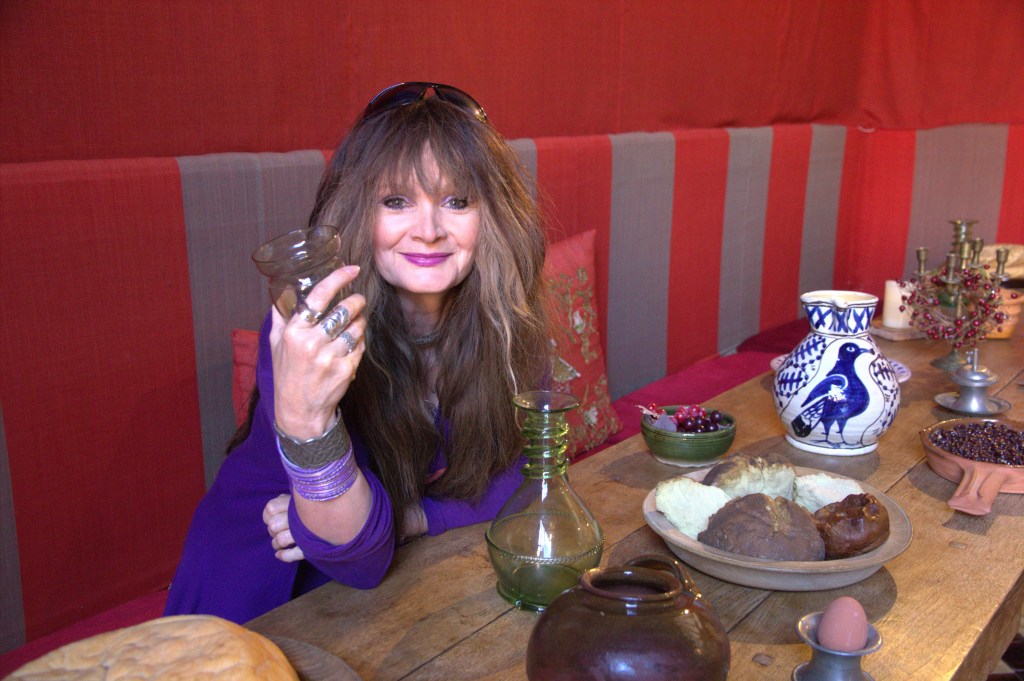
Just leave me here and come back later…
Next we take the stairs to the first floor, emerging in the Gallery, a later addition to the house dating from the late 1500s, but well furnished and featuring several board games popular during the Middle Ages. We take a turn at Fox and Geese, an amusing game of strategy and cunning, and my daughter Maddie wins. In the outer wall we find another type of window common in medieval buildings, this time made from cow horns softened in water then rolled out and cut into strips.

The Gallery, a later addition to the house.

Fox and Geese, a medieval board game.

The horn window.
At one end, through a doorway on the right we enter the Parlour, William’s office where he conducts much of his business. As in the Great Hall, this room is adorned with vibrant wall hangings, while a writing table stands beside a window to make best use of the natural light. Other furniture and objects inspired by contemporary art complete the room, but one item particularly personal to William is the replica of a red chest bequeathed to him by his grandmother.

The Parlour is William’s office where he conducts important business.

Family heirloom: the replica red chest that was bequeathed to William by his grandmother.
Moving back through the Gallery, a door at the opposite end leads to the final upstairs rooms: the private bedchambers. First is the Lesser Chamber, a bright and pleasant space belonging to Lady Joan Thweng. There’s a comfy bed, a crib and seating round a small table, but this room is not just for sleeping in. In fact, it doubles up as a living room, where Joan entertains her friends and relaxes with her children. There’s a real sense of informality to this room, and it’s easy to imagine the family enjoying some private downtime in here.

Lady Joan Thweng’s Lesser Chamber, a private space for relaxation.
On the far side another door leads directly into the grandest private space in Barley Hall, the Great Chamber. Rising through two storeys, this imposing room served as a master bedroom, a study and a private space for William. Today it houses a treasury of medieval artefacts unearthed by York Archaeology from beneath the city’s streets, but in 1483 it would have been designed and decorated specifically to impress. Important guests would be greeted on arrival at the door opening from the top of the external timber staircase, and first impressions mattered.

Now a museum housing a collection of York Archaeology’s treasured medieval artefacts, William’s private Great Chamber was designed to impress his visitors.
Making our way back through the Gallery and Parlour, another flight of stairs leads down to the catering service rooms that lie off a short corridor opposite the Great Hall, situated on the other side of the modern alleyway. Here we find the buttery and pantry, where the drinks and bread are stored, and where dishes prepared in the kitchen – which has sadly never been identified – are plated up prior to serving.
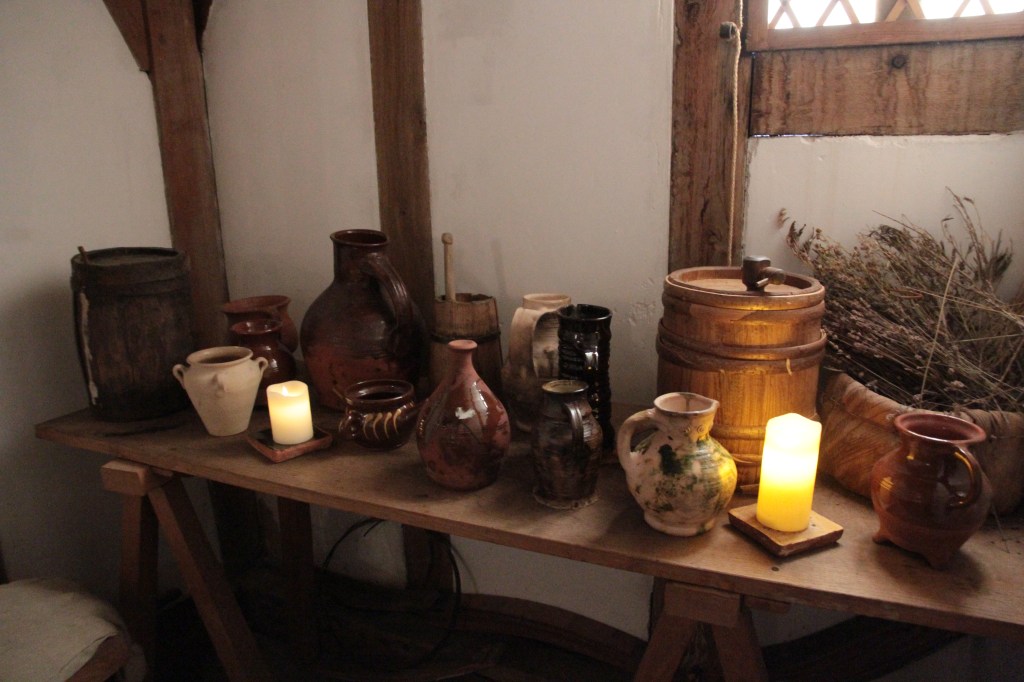
Jugs and bottles in the Buttery.

The Pantry is next door to the Buttery.

Looking back towards the Great Hall from the corridor outside the Buttery and Pantry.
From here I can gaze back at William’s grand feasting hall that was once concealed behind a screen’s passage. Our tour complete, we wander back through the ground floor to the Store Room where we came in, passing one last time through all the rooms as we go. As I cross the threshold to the shop and return to the 21st century, I take a final glance back into the Steward’s Room. For a second I’m sure I catch a glimpse of a figure bent over his workbench, but maybe it’s just a trick of the light from the fenestral.
In the shop we chat briefly with the welcoming chaps at the desk, and before we leave I purchase a copy of Fox and Geese so I can challenge Maddie to a rematch. Then it’s time to step out into the courtyard, and back to reality. It seems strange to feel out of time in your own era, but with all our high technology and the maddening noise, bluster and stresses of today’s insane world, it’s places like Barley Hall where I feel most at home. But at least while I’m in York I can still enjoy that sense of walking alongside the likes of William Snawsell for just a little bit longer…

 medievalwanderings.com
This is wonderful. Thank you. The game looks like fun!
LikeLiked by 2 people
Thanks, Martha! 🙂 Glad you enjoyed Barley Hall. They had some great board games in the Middle Ages, and Fox and Geese is definitely one of them. I just need to get better at it! 😉
LikeLiked by 1 person
Yes the board game looked like it would be great
LikeLiked by 2 people
It is, although I haven’t managed to win yet! 😦
There were quite a few good games in the Middle Ages (that’s when Chess was invented too), and thanks to our bit of gaming fun with Fox and Geese I think I’ve decided what my Christmas post is going to be about this year… 😀
LikeLiked by 1 person
That will make a superb Christmas post – I look forward to learning about more of their board games. Board but never bored!
LikeLiked by 1 person
Thanks Carol, I’ve got the rest of this year to develop my real-world medieval gaming skills, so hopefully it’ll make for a bit of festive fun in December… 🙂
LikeLiked by 1 person
It’s a fabulous place Barley Hall, I could quite happily move in there – I wonder if York Archelogy are open to offers. I could well see us firing up the fire pit and quaffing Mead in the great hall – just so long as I could brick up the snickelway and turn it back into a screens passage.
Another great post my love and what a great trip that was, I love the idea of a soul-city, York is certainly that to us. So many magical memories. Here’s to the flute player.
Cheers!
LikeLiked by 1 person
York is my soul-city, and I reckon it’s always been, I just hadn’t come up with a word for it 🙂 Here’s to making many more special memories in York. I’ll never forget the flute player, although it was actually a penny whistle. 😉 Either way, it sounded like a haunting medieval serenade in the perfect medieval city. 🙂
What a lovely thought of the roaring fire and a good goblet of Mead in Barley’s Great Hall. It’d be a dream come true! 🙂
LikeLiked by 1 person
I’ll definitely drink to more lovely memories in York!
Flute, Penny whistle, it’s almost the same – perhaps we could pay him to come and play for us whilst we’re in the great hall.
LikeLiked by 1 person
Oooh yes, what a lovely thought. Can you imagine that haunting sound echoing around the Great Hall and rising up into the rafters, just like the voices of the Chapter House choir…?! I’d pay good money to experience that. 🙂
LikeLiked by 1 person
That would be fabulous! 😀 With the crackle and roar of the fire for a background!
LikeLiked by 1 person
…and no mobile phones going off! 😉
LikeLiked by 1 person
It’s be fine – in our medieval hall, anyone with a mobile phone going off can be legally shot with a Longbow! 😀
LikeLiked by 1 person
Problem solved then… 😉
LikeLike
Never knew anything about this place Alli, but York has so many places to discover doesn’t it? It reminds me a bit of Greyfriars House in Worcester which was also rescued and restored. You’ve done a great job once again of bringing somewhere to life, and I have to say that you look completely at home in the Great Hall with that glass in your hand. It’s just a shame that it was empty (the glass I mean) – unless of course you knocked back the contents first 😊
LikeLiked by 1 person
Thanks, Malc, glad you liked the look of Barley Hall. It’s a fab place, and so peaceful, especially considering’ it’s in the middle of York. I’ll have to check out Greyfriars next, then. 🙂
I really did feel at home there, and as for the empty glass – well, not for long, that was my third! 😉
We’re hoping to get back up there for another visit early next year, so may even be back in Barley’s Great Hall to enjoy it all again! 🙂
LikeLiked by 1 person
Have we got some more posts to come on York?
LikeLiked by 1 person
I’ve certainly got plans for some, and one on another of our stops in Yorkshire (not the Wensleydale Creamery though; excellent as it is, it’s not very medieval!). 😀
LikeLiked by 1 person
I’ve been to York a couple of times, most recently in 2022, but I never knew about this place. It looks so well restored and furnished etc., really transporting you back in time. And it doesn’t look very busy, judging from your photos?
LikeLiked by 1 person
Thanks Sarah. No it’s not very busy, which is a huge advantage to people like us who hate crowds! They do rent it out for events etc. but it’s lovely and quiet most of the time (the benefits of a hidden gem off the main street!) It’s in Coffee Yard down a snickellway from Stonegate. Well worth a visit if you’re in York. 🙂
LikeLiked by 1 person
Found the different window types very interesting. What a beautifully restored place and looks really interesting to tour around.
I hate cities in general but love York. I also like Edinburgh (as I’m sure most do), Glasgow, Newcastle and Canterbury but those are the ONLY cities I like I think. My brother lived in Malton near York for quite a few years so we often visited it either on the way to see him or with him.
Great and interesting post!
LikeLiked by 1 person
Thanks, Carol, glad you enjoyed Barley Hall.
I’m the same as you, I hate cities and generally avoid them like a spitting frying pay. But a handful of the ancient ones are the exceptions. I grew up in Canterbury, and loved the place. We left when I was 16 and my dad got a promotion which meant a move to Buckinghamshire. I was devastated when I found out we were leaving.
I remember being rather taken with Edinburgh, but I don’t know Newcastle or Glasgow. Where we are in North Wales we’re not far from Chester, and that’s another lovely old, characterful city to spend a day wandering around. But York is in a league of it’s own, and it’ll always be my absolute favourite. By the sounds of it, you see it in a similar way. 🙂
I’m always impressed by medieval innovations, and windows are just one example of how simple but ingenious people could be back then. 🙂
LikeLiked by 1 person
It is an amazing place. There never seems to be enough time to see as much as you want to. I spent a year going back there when I was writing my York-set novel, exploring every snicket and ginnel – and that still wasn’t enough/
LikeLiked by 1 person
That’s exactly how I feel, John. The place gets under your skin and the feeling never leaves you.
LikeLiked by 1 person