Foreword: Before we start, let me briefly explain the title of this post. The sources differ in their dating of the battle in question, with Scottish chroniclers reporting it taking place on 5th August 1388, while the English thought it happened two weeks later, on 19th. However, the general historical consensus, including at the battlefield site itself which we visited in 2023, seems to favour the earlier date of 5th. So for the purposes of this post, I will use this date as the anniversary of what was an interesting and unusual event that etched it’s historical and cultural mark on the northern borderlands forever. Either way, I hope you enjoy the story…
On this day, 5th August in 1388, a nighttime battle took place between Scottish and English forces in Otterburn, Northumberland. It was just one of a series of conflicts and border disputes that plagued the region for centuries, but the events were immortalised not just in contemporary historical records, but also in popular ballads.

The Percy Cross, the monument commemorating the Battle of Otterburn, marks the battlefield site. It can be found 1km west of Otterburn in a wooded copse, just off the north side of the A696. Erected in 1777, the monument incorporates a 14th century cross base.
Ever since Scots secured their victory at the Battle of Bannockburn in 1314 they had been gradually eating away at territories on the Anglo-Scottish border whilst King Edwards II and III were looking the other way, distracted by domestic troubles and continental interests. But by the 1380’s, with a young King Richard II on the throne, the English had turned their military focus north once again, and they didn’t like what they saw. The latest in a line of fragile truces between the two nations was about to expire, and border raids were on the rise.
In 1385, the eighteen-year-old King Richard II, under the wing of his formidable uncle, John of Gaunt, duke of Lancaster and his huge army, marched to Edinburgh to put the Scots firmly back in their place. At that time, the Scots were buoyed by the recent arrival of some long-awaited French support, courtesy of the Auld Alliance struck between Scotland and France in 1295. Lasting nearly three centuries, this theoretical bond between two of England’s greatest enemies ultimately promised far more than it delivered for the Scots, and in the end, this was to be the only occasion that a substantial French force actually set foot on Scottish soil.

King Richard II was only eighteen years old when he marched to Edinburgh with his uncle John.
The French arrival in 1385 brought extra men and money for the cause, but added little to the conflict. Expecting to get stuck into a fight against Richard II and to be treated as the superior militia, they instead stood back, unimpressed by the Scots’ avoidance of pitched battle in favour of scorched earth tactics against the English. Nevertheless, the ruthless burning of crops had the desired effect, and despite inflicting considerable damage on Scottish abbeys and the city of Edinburgh, the forces of Richard and John of Gaunt were driven back across the border just two weeks into their attack. But the great continental alliance took a hit as well. As French disdain for their Scottish hosts increased, acrimony boiled up between the soldiers and fights broke out until the French left for home, leaving a parting curse on the Scots.

John of Gaunt, Richard’s uncle, was one of the wealthiest and most influential nobles in the land.
The failings of the Auld Alliance dented Scottish confidence, so things went quiet for a couple of years. However, in 1388, as the last of the truces with England was nearing its end, Richard was again distracted by threats at home and from the continent. The Scots decided to have another pop at the English, mounting a major three-pronged attack, with one assault in Ireland, and two audacious strikes across the border in the West and East March. The plan was to send the main force, led by the Earl of Fife, down through the English West March while James, earl of Douglas launched a decoy attack in the East March. Douglas and his 6,000 men burned and raided their way as far as Durham, and when news of the invasion reached the earl of Northumberland, he tasked his son, Henry ‘Hotspur’ Percy with intercepting the Scots on their way home.

The Arms of Henry ‘Hotspur’ Percy.
In the resulting confrontation at Newcastle, Douglas captured Hotspur’s silk pennon (the personal heraldic, fork-tailed flag that flew from a knight’s lance), an insulting act seen as a shameful slur on Hotspur’s chivalric pride. According to legend, Percy vowed to get it back, and Douglas, supposedly in true chivalric form, offered to give him the chance. So Hotspur set out after the retreating Scots, accompanied by some 8,000 men, ferociously pursuing them north-west across the county. It’s not clear whether Douglas actually knew that Percy was following him or not, but if he did, his offer of a fair chase may even have been a lure. Douglas was, in fact, riding west to meet with the Scottish army who, having made an unsuccessful attempt to take Otterburn Castle, had set up camp a mile or so to the west. After a council of war, Douglas decided, against the wishes of many of his men, to stay put at Otterburn and wait for Hotspur. He didn’t have to wait long.

Otterburn is a beautiful and peaceful (now!) place to walk.

Otterburn’s modern military use. Covering nearly a quarter of the Northumberland National Park, the Otterburn Ranges are today used as a military training ground, and the area is accessible to the public outside firing times. The remote, wild landscape is a haven for wildlife and offers stunning, uninterrupted views as far as they eye can see.
Henry Percy wasn’t called ‘Hotspur’ for nothing. His swashbuckling nickname was born from his fiery character, his speed and his reckless courage in battle. He had torn across the landscape in pursuit of Douglas, arriving much sooner than the Scots had expected in the early evening of 5th August. Raring to go into battle and unwilling to wait until morning, Hotspur launched his attack on the Scots there and then, as the sun was setting. Many of the unsuspecting Scots had shed their armour and slipped into something more comfortable for the evening, so they were in no condition to fight. Nevertheless, with the help of urgently supplied reinforcements from a higher Scottish camp, and probably the quickest costume change in history, the Scots rallied to meet the challenge.
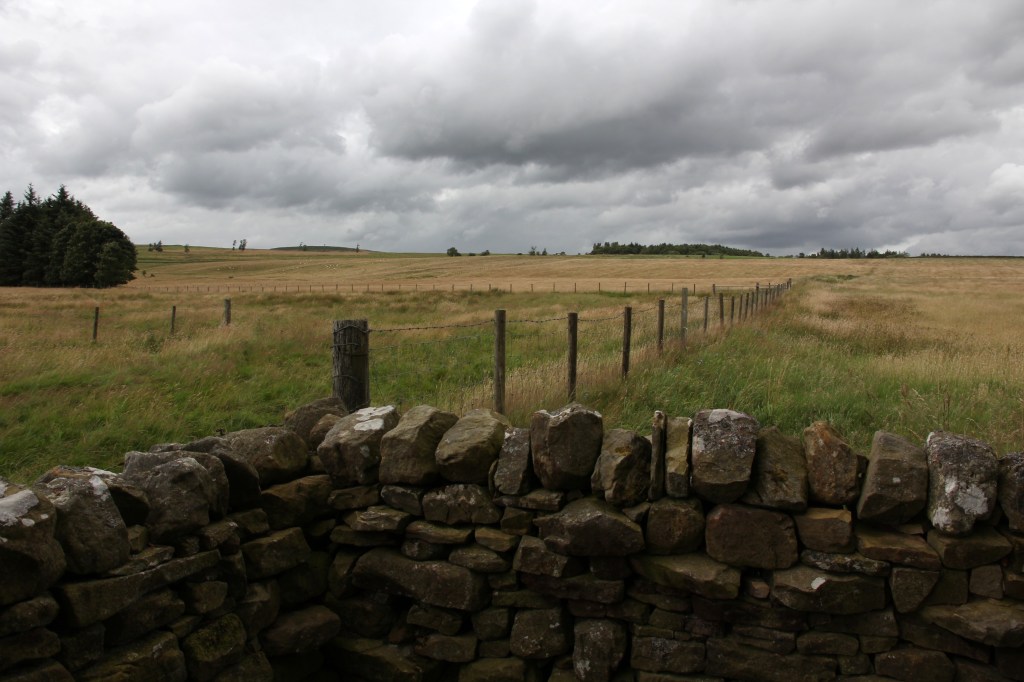
The view across the battlefield from the site of the Percy Cross. Ironically, we were there just as dusk was creeping in!
Darkness fell quickly, and the battle continued into the night under a moonlit Northumbrian sky. The lack of light made archery almost impossible, so fierce hand to hand combat ensued. Meanwhile, Douglas led a clever attack from ‘dead ground’ concealed by woodland, approaching unseen through a shallow gorge, and falling upon Hotspur’s exposed flank. The tactic proved a great success and victory went to the Scots, but it came at a heavy cost. Douglas himself was killed in the fighting, a severe blow to the victors who found his lifeless body the next morning.
Hotspur and his brother Ralph were captured and taken across the border as the Scots marched home. But despite being taken and held by the enemy, Henry ‘Hotspur’ Percy’s enduring reputation as a valiant knight and heroic leader was secured. Clearly highly valued by king and country, his substantial ransom was paid from public funds, with Richard II and parliament chipping in to ensure his safe return to England.

A wooded path leads to the Percy Cross, with the battlefield behind. This is believed to be the the second memorial, as the first, erected in the 14th century, consisted of a battle stone placed in the spot where the most fierce fighting had taken place. The present monument was placed around 150m from its predecessor so it could be seen from the newly constructed Turnpike road to Scotland.
Estimates put the battle’s casualties at around 500 on each side, although the English losses were probably much higher. Numerous hostages were taken by both the English and Scots, and it’s believed that some of the dead were laid to rest in St Cuthbert’s Church in the nearby village of Elsdon. The Battle of Otterburn didn’t put end to the border wars, and it had wider ramifications for the Scottish and English political landscapes, and the relationship between the two nations. But although it wasn’t the biggest or best-known conflict of the border wars, over time its popularised story became woven into the culture of the Marches. Two late medieval ballads were composed based on the events, called The Battle of Otterburn, and The Battle of Chevy Chase. As well as serving as a creative record of the conflict, they celebrated the Scots’ victory and lauded the chivalric virtues attributed to both sides.
Popular both north and south of the border, the rousing ballads preserved the memory in the minds of the people, and created a legend to be handed down through the generations. In The Battle of Otterburn, it’s the reputations of the two leading protagonists, Douglas and Hotspur and their followers that emerge triumphant. Presented as two prominent border families at odds on a more personal level, they are hailed as fine examples of chivalrous valour.
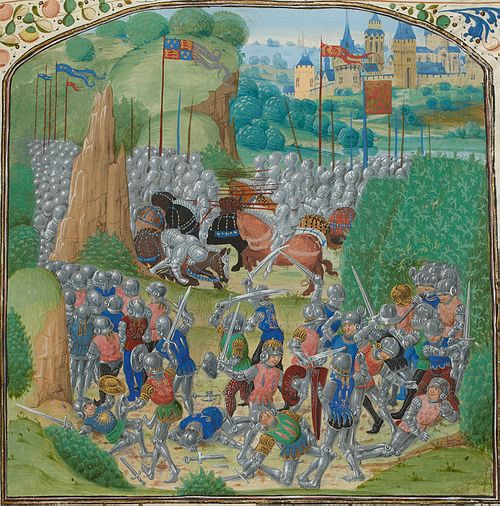
The Battle of Otterburn, depicted in Froissart’s Chronicles, a leading contemporary source for the conflict.
Even beyond the romanticised ballads, the honourable conduct of both sides seem to have been a notable feature in the contemporary historical record. Perhaps we’ll leave the last word to the French chronicler, Jean Froissart (1377-c.1410), who introduces his description of the Battle of Otterburn in terms of the commendable bravery shown on both sides:
“Of all the battles and encounterings that I have made mention … in this history, great or small, this battle that I treat of now was of the sorest and best foughten without cowardice or faint hearts.”
As the legend grew, embedding itself in the psyche of the border societies through historical retelling and popular culture, the Battle of Otterburn, fought on this day in 1388, could almost be defined more by valour than by victory.
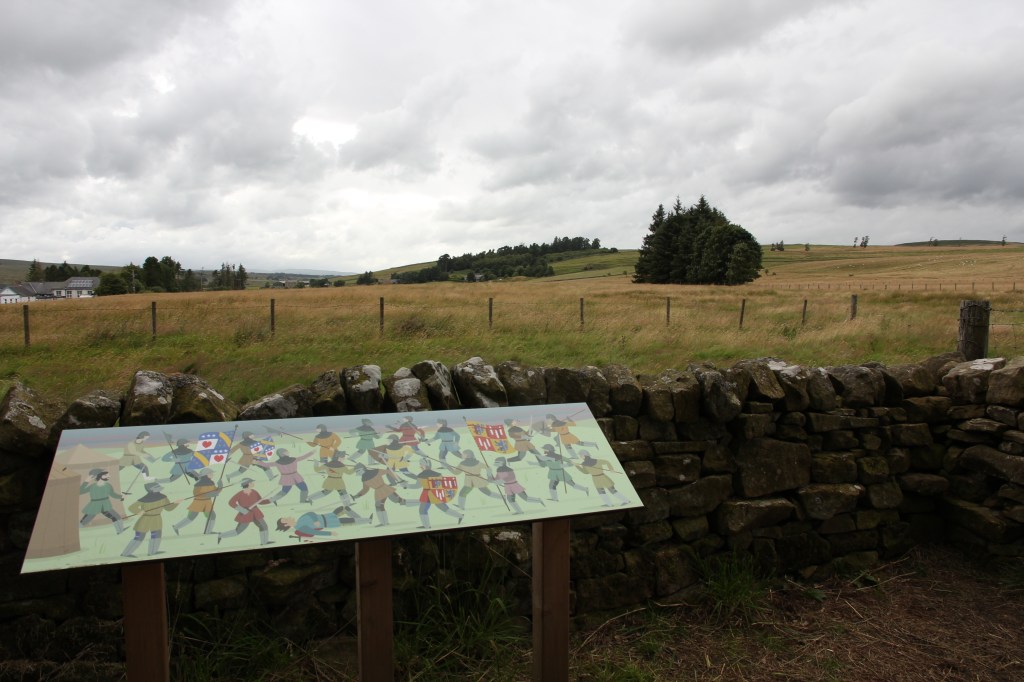
 medievalwanderings.com
I’m not sure really if the Scot’s could claim that as a victory – sounds like a definite draw to me, mind you, the fact that Percy attacked them when they weren’t expecting it and then still manged to fight them off says something about them… Maybe they can claim a victory on penalties! 😀
Another fab post my love. I do love Otterburn, especially the ranges. Seeing the photo’s again reminds me of what a special place it is – I’d really love to go back someday and do more exploring.
LikeLiked by 2 people
Me too. I loved the atmosphere there, strangely peaceful and tranquil – even at dusk! Yes, it was a bit of a hollow victory for the Scots with the loss of Douglas, but credit where it’s due. They rallied and won the day, although I’d have liked to have seen them fighting in their nightgowns!
LikeLiked by 1 person
Tartan nightgowns obviously, sporran optional! 😀
LikeLiked by 1 person
Oooh, a tartan nightgown would be scary, especially if the sporran was fully loaded!
LikeLiked by 1 person
I suppose that depends on the man wearing it 😀
LikeLiked by 1 person
Mad Jack McMad, the winner of that year’s Mr Madman competition! 😉
LikeLiked by 1 person
LOL!!!! That’s excellent 😀 And I bet that was up against some pretty tough competition in Scotland!
LikeLiked by 1 person
It’s all that blue paint… made them look scary. 😉
LikeLiked by 1 person
😀 Or Daft…
LikeLiked by 1 person
😉
LikeLiked by 1 person
Evocative Place. Where we live there was almost constant warfare – small battles as well as big. Some, like Hoff, lost in history/
LikeLiked by 1 person
It really is evocative, John. Northumberland has such a turbulent history it’s hardly surprising the echoes are still around. I suppose we’re quite lucky with Otterburn as it was so well documented – in more than one way!
LikeLiked by 1 person
Love it up there.
LikeLiked by 1 person
Me too. Sadly though, we haven’t been able to bring ourselves to go up there since those morons cut the sycamore down. I was – and still am – heartbroken over its loss as it was our favourite place up there.
LikeLiked by 1 person
Wow. Fascinating! I would like to be there to see the landscape and wander around. Beautiful.
LikeLike
Thanks, Martha! It is a really beautiful place, and you can feel its turbulent history lingering in the land even now. I’m sure you’d love it. 😊💜
LikeLiked by 1 person
I would love that. It’s always interesting to me how the land hold the stories and you CAN feel them. I love that.
LikeLiked by 1 person
You get that a lot over here, especially in places with such strong histories and dramatic events. They all leave their marks. Northumberland and its tumultuous past inspires artists, musicians and writers alike, as the echoes of those stories still radiate from the land, almost like the Schumann resonance. You’d fit in perfectly! 😊
LikeLiked by 1 person
Next life, Alli!!!
LikeLiked by 1 person
I’ll be there with you next time around! 😊💜
LikeLike
Great story. Where did you get that fab photo of the horses running wild on the moors? They look pretty large for wild ponies. The cross looks to be in a lovely situation.
Amusingly, I was having a really superb dream the night before I left Beauly on my Scottish Challenge trip – I was a border reiver (our surname Oliver is apparently a ‘reiver’ name anyway) and was having a great time raiding people’s cattle – and horses – and training a young lad up as well. It was a really long dream and I was quite cross when Richard woke me up to go for breakfast!
LikeLiked by 1 person
Glad you enjoyed the story, Carol, it’s a good ‘un and it’s a beautiful area to explore. 🙂 Glad also you like the photo of the horses – they were beautiful. I can see why you’d think they were wild but they were a group of domesticated ones, but they were behaving in a really interesting way. We took the photo while we were on a walk around Otterburn just before we went to see the Percy Cross. This pack of horses were right over in a far corner of a field we were walking through, when two riders appeared on their horses a way behind us. When the pack saw them they got all excited and were clearly fascinated, as they all dashed straight across to the two newcomers to see who they were. The riders seemed to know them as they weren’t fazed at all, but just waved their hands and told them to go back to their corner again, and after a brief encounter that’s what they did. They turned tail and charged back where they’d come from. They looked gorgeous though, and we found the whole thing quite amusing! 🙂
I’m really intrigued by your dream, especially as it was so powerful and clear, and quite possibly depicting connections to your border reiver ancestors! That’s amazing! And you were even training a young lad too? Wow, it must have been like watching a film, and it sounds almost like a past life dream. I wish I had dreams like that, but most of mine are little more than incoherent garbled nonsense. 😦
LikeLike
my dreams are usually nothing like as interesting or as fun as that one was. I think I know what sparked it off… we were staying at a hotel owned by the ‘Frasers’ and Fraser is an allied clan name to Oliver. I mused on that briefly as I saw their name near reception and that will have caused the dream I think.
That explains the horses – they do act like then when riders on horses come by. Great photo of them though – what a great photo opportunity – well captured!
By the way, my ‘reader’ is down on WordPress so I can’t read anyone’s blogs without typing them in manually. Not sure if it’s a general thing or just my laptop playing up as usual…
LikeLiked by 1 person
Ah that makes sense then. Still a cracking good dream though. 🙂
Glad you like the horses. They were pretty excited, and they looked lovely tearing across the field to see what was going on!
As for the reader, mine seems ok, although I admit I rely mainly on email notifications, but some of the blogs I follow – now also including yours – pop up as notifications of new posts on my dashboard thingy, where the comments show up. That’s useful too. 🙂
LikeLiked by 1 person
Those horses just look like a small, wild herd tearing across the prairies!
Can you remember how you managed to get new post notifications to popup on your dashboard? Mine doesn’t do that, I just get e-mail notifications (which I’m not supposed to get as I told it I only wanted e-mails about new followers and post changes!)
LikeLiked by 1 person
They’re gorgeous, aren’t they, and they were full of personality!
Believe it or not, I’ve no idea at all how I managed to get post notifications on my pop up dashboard, although it is indeed useful. Remember when I wasn’t getting notifications from your site? I got so frustrated that in the end I unsubscribed and resubscribed in an effort to rectify whatever was going wrong. Ever since I did that I’ve had your posts arrive in my dashboard as well as email, so something’s changed. I’m sure I didn’t do anything different to last time, but now yours and a couple of other people I follow (but by no means all) do come up. It just sort of happened. The only thing I can think is that WordPress may have changed something in how it notifies followers since the first time round when I subscribed to your site in 2019 (wow, has it really been that long?!). But how it happened I honestly can’t say, so sorry to be so unhelpful, but if I do find out I’ll be sure to let you know. 🙂
LikeLiked by 1 person
Sounds a bit like it – I looked all through my admin options and couldn’t see a way to do it. I’m a bit loath to unsubscribe and resubscribe to everyone though in case it goes wrong!
LikeLiked by 1 person
Don’t blame you for that. I only did it with yours as a last resort! You may find, though, that if you subscribe to anyone new they may appear in your dashboard. Fingers crossed anyway! 🙂
LikeLiked by 1 person
I’ll keep my eye out for that…
LikeLiked by 1 person
Hi Alli, great post and fun comments too – this place does look amazing and the whispers of a very serious past!
LikeLiked by 1 person
Hi Yvette, great to hear from you again! 🙂 Hope all’s well with you. Glad you enjoyed the battle, and yes it is a lovely place, and so peaceful, which is rather ironic considering it’s past! 😉
LikeLiked by 1 person
☀️☀️☀️☀️
LikeLiked by 1 person
My apologies by the way, WordPress seems to have unsubscribed me from your blog, which I hadn’t asked for, so I assumed you had stopped blogging. However, I’ve re-subscribed now, and it’s great to be back in touch. 🙂
LikeLike
Hi alli
I did stop blogging for a while and found my way back last spring
But I have come to accept that the blog has to have pauses and time aaay
Oh and glad to connect again xxxx
LikeLiked by 1 person
That makes sense, Yvette. I’m very in and out of the blogsphere these days as well, depending on what’s going on in life, but it is lovely to be back in touch with you. 🙂 xxx
LikeLiked by 1 person
🙂🙂
LikeLiked by 1 person