When I need a breather from the madness of the modern world, which these days seems to be rapidly intensifying, I will often take a short drive to the enchanting medieval town of Conwy. Not only is the awe-inspiring castle a special haven for some quality time out, the town itself was shaped by King Edward I’s (r.1272-1307) unwavering determination to subjugate the Welsh. For in the thirteenth century Conwy, as with the king’s other builds at Flint, Rhuddlan and Caernarfon, was more than just a castle; it was a whole new colonial town.
I wrote about Conwy Castle as part of my 2019 Castle Quest, in which I told the full story of Edward’s Welsh wars and the events that led up to them. So if you’d like to read the saga, or be reminded of it, you can find the first post here. This time, however, I warmly invite you to join me in a scenic wander around the town walls, with all the sights and diversions they have to offer.

Conwy Castle, still dominates the area, while the walls hug the bustling heart of the town.
The idea for planned and fortified towns, was imported from Edward’s territory of Gascony in the south west of France. Known as ‘bastides’, these plantations were enclosed by high walls and laid out on a grid system. In North Wales, the king’s new, heavily fortified townships were designed to generate income through goods and taxes, but would be inhabited exclusively, and entirely, by English incomers. Inside the walls the Welsh were barred, with only limited access granted under strictly controlled conditions.

The magnificent town walls can be seen here extending from the castle, which overlooks the Conwy River. The whole construction was originally whitewashed for maximum impact.
Conwy was designed and constructed by the king’s master mason, James of St George, a highly skilled man who knew how to make a statement in stone, and do it efficiently. Just as well really, because in 1283, having defeated Llywelyn ap Gruffudd, the last native prince of Wales, Edward urgently needed some new secure fortresses to assert his authority over the land. For Conwy he’d made a controversial choice of building site, as it meant displacing the existing Abbey of Aberconwy, the burial place of a succession of Llywelyn’s predecessors, the princes of Gwynedd, and planting his new fortress in its place. In so doing, Edward was effectively wiping his old rival dynasty off the face of the Earth. It was an audacious and antagonistic move, and he must have felt a pressing need for some sturdy defences against the indignant Welsh. True to form, James of St George rose to the challenge, swiftly delivering the desired result.

Edward I, Britain’s greatest castle building king.
The entire Conwy project was completed in only four years between 1283 and 1287, an astonishing speed for such an ambitious development in the thirteenth century. Enclosing an area of around 22 acres (10 ha), the robustly defensive walls reached around 1.3 km in length, with an outer ditch, 21 evenly spaced towers and three formidable gateways, creating a huge, intimidating edifice that would make the Welsh think twice about attempting any attack on the castle or the town within. Even today, when approaching Conwy, it’s easy to imagine the impression this striking, almost Camelot-like fortress would have made on the wider Welsh populace. And once you’re on the town walls, that sense of scale and dominance is even more evident.

The first section of the walls adjoining the castle. As soon as you’re up here you get a real sense of strength and security.

Inside one of the wall towers, well supplied with arrow loops looking in every direction.
Today, Conwy’s walls run in an almost unbroken circuit around the old medieval streets, making this one of the best and most complete examples in Europe. There are several entry and exit points, but we usually start by climbing a set of steps just outside the castle at Tower 21. The walkway at the top leads to the two-towered Mill Gate, which gave access to the royal watermill on the nearby stream. Here, thanks to the Victorians ploughing through the walls to create the Chester to Holyhead railway and it’s attending bridge, we have to take a break, leaving through one of the gateway’s towers, past some nice-looking shops and rejoining the wall just off Platform 2.

The first stretch of wall leads to the Mill Gate, and the views are already impressive.
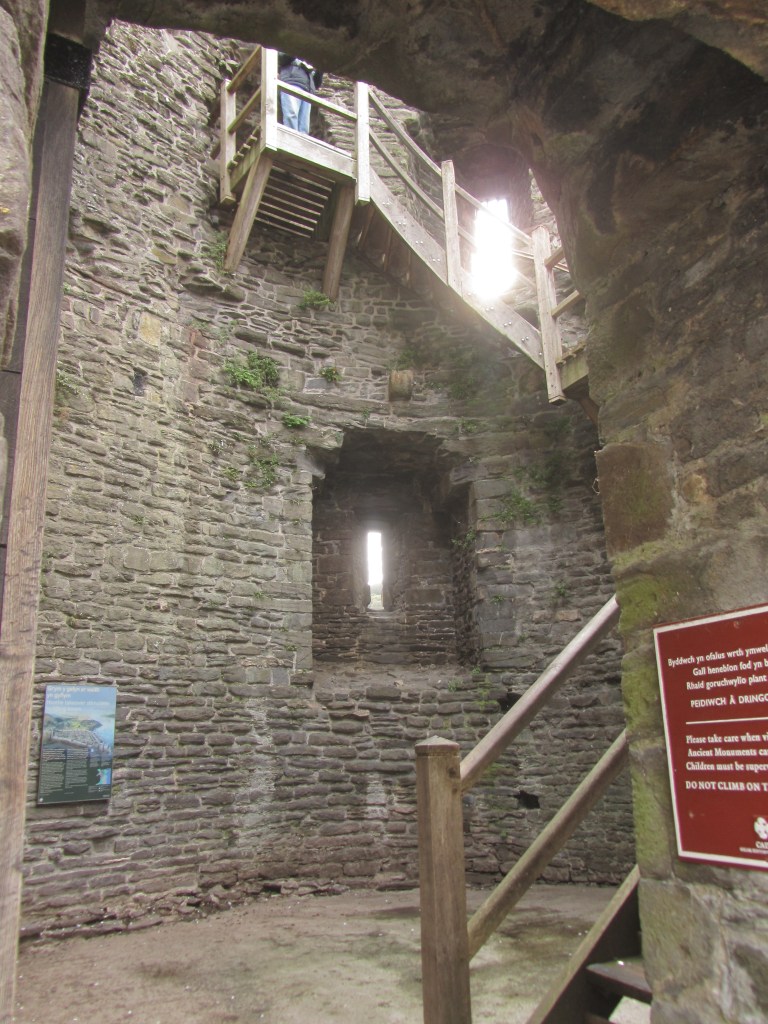
At the end of the first section, we leave the wall for a short break through this tower in the Mill Gate.

Viewed from outside the walls, the Mill Gate gave access to the watermill on the stream below.
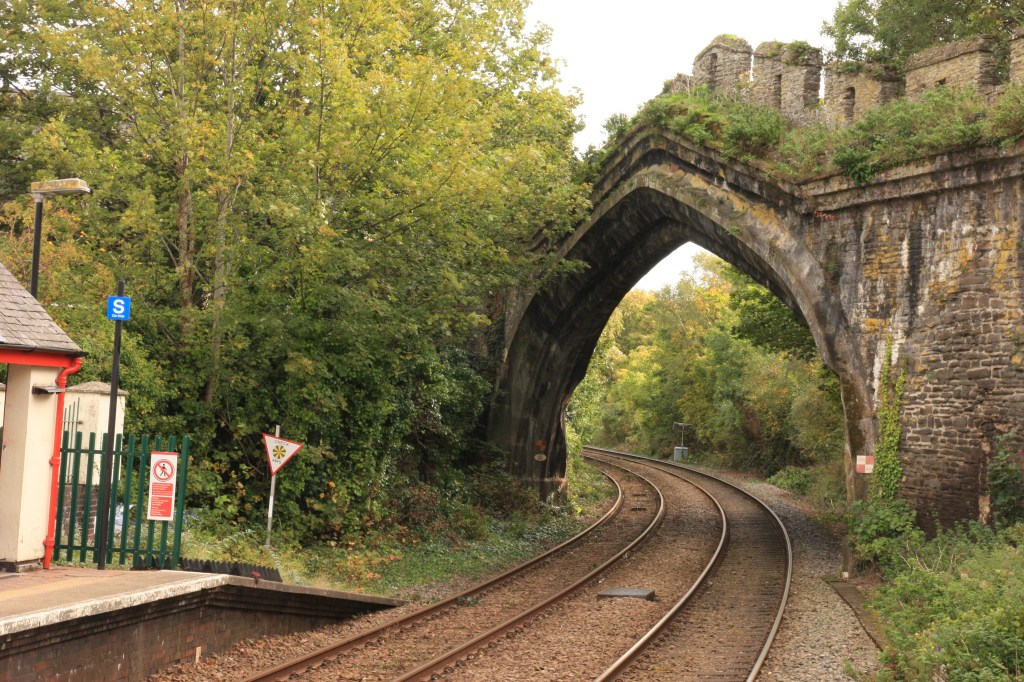
The Victorian railway bridge that tore a hole in the town walls to make way for the Chester to Holyhead line.
The next section takes us past a spot known as Llewlyn’s Hall. It’s here that we can look down on the only traces that remain of a previous Welsh royal court believed to have belonged to Llywelyn ap Gruffudd. The town wall was built up to the side of the hall, and may even have incorporated it, but exactly how the two fit together and whether the original building was knocked down and rebuilt is not clear. Either way, the English continued to call it Llywelyn’s Hall, and it’s probable that Edward and his son, Edward II (r.1307-1327), used it for brief periods until 1316, when it was finally dismantled and taken to Caernarfon to be used as a storehouse. The only surviving remnants are a line of corbels and window seats below the walkway that once supported the hall’s tall roof beams. Still, it’s a tantalising glimpse into the historical evolution of Conwy, although perhaps don’t stare for too long because the land beneath is now somebody’s garden!

The next section takes us past the site of Llywelyn’s Hall.

Beneath the walkway can be seen the corbels and window seats that were once part of Llywelyn’s Hall.

After this stretch, the path begins an assent.
Onwards and upwards, and after the next tower, numbered 15 we go into an ascent towards the Upper Gate, the landward entrance to the town. Made up of two drum towers, this main gateway was heavily defended with a stone barbican, a portcullis and wooden gates, and a drawbridge that spanned the original town ditch.
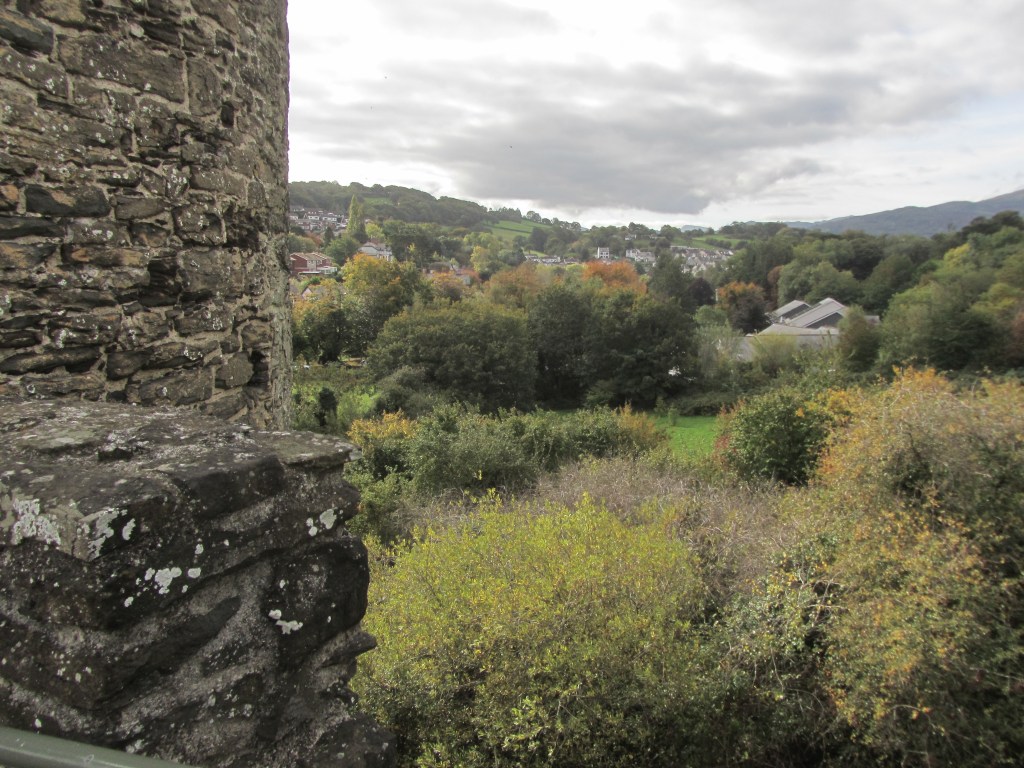
Lovely views on the ascent.
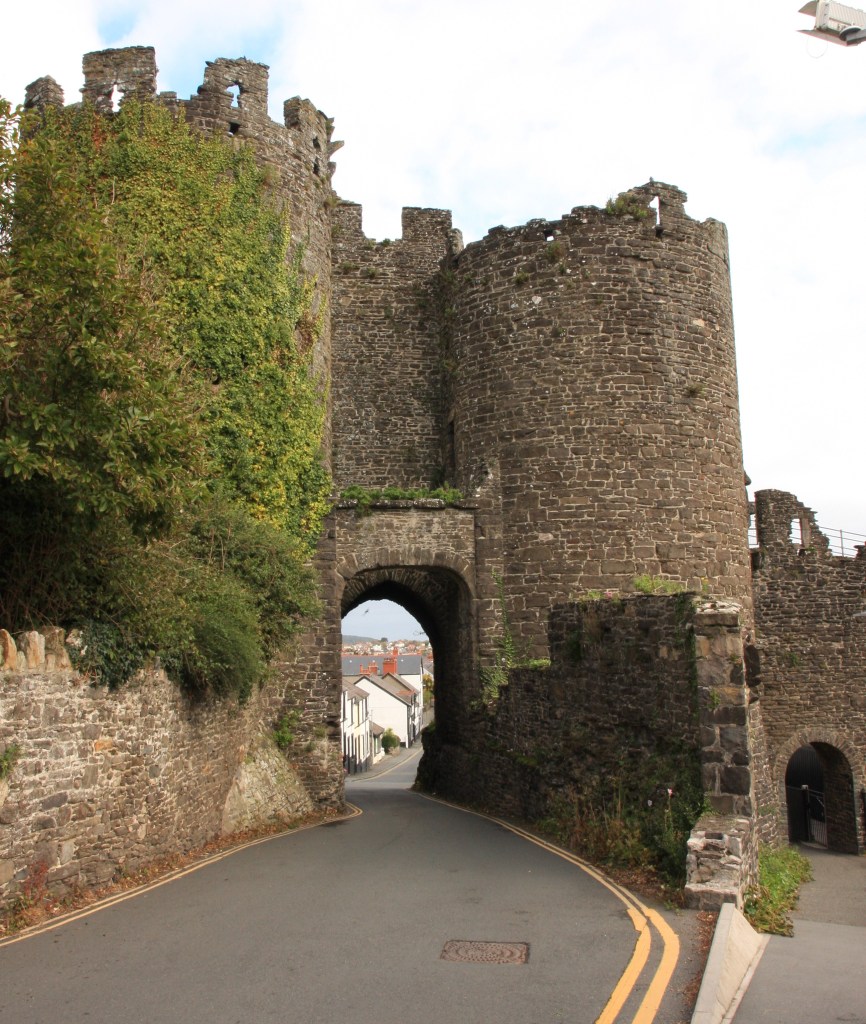
The Upper Gate from outside the walls…
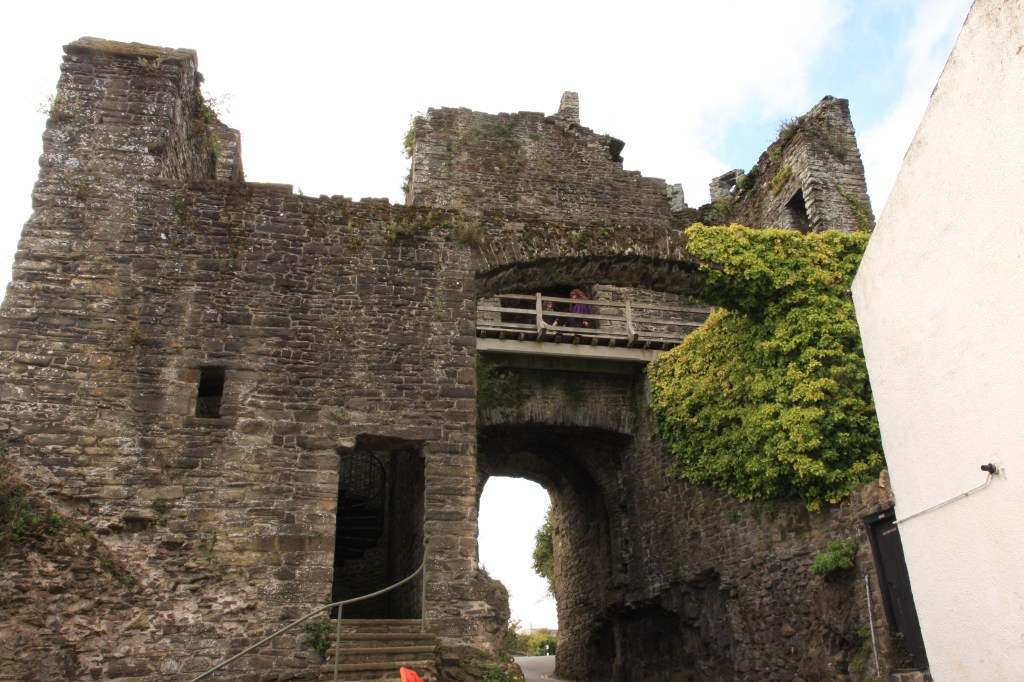
…and inside the Upper Gate, the walkway passes over the arched entrance, where you can see the old recess for the gateway’s portcullis.
After this prepare to shed a layer or two, as a steep climb takes us to the highest point, Tower 13, or the Watchtower. Named for obvious purposes, today this lofty spot offers spectacular views down the Conwy Valley, and across the town to the castle and beyond, so it’s well worth the effort!
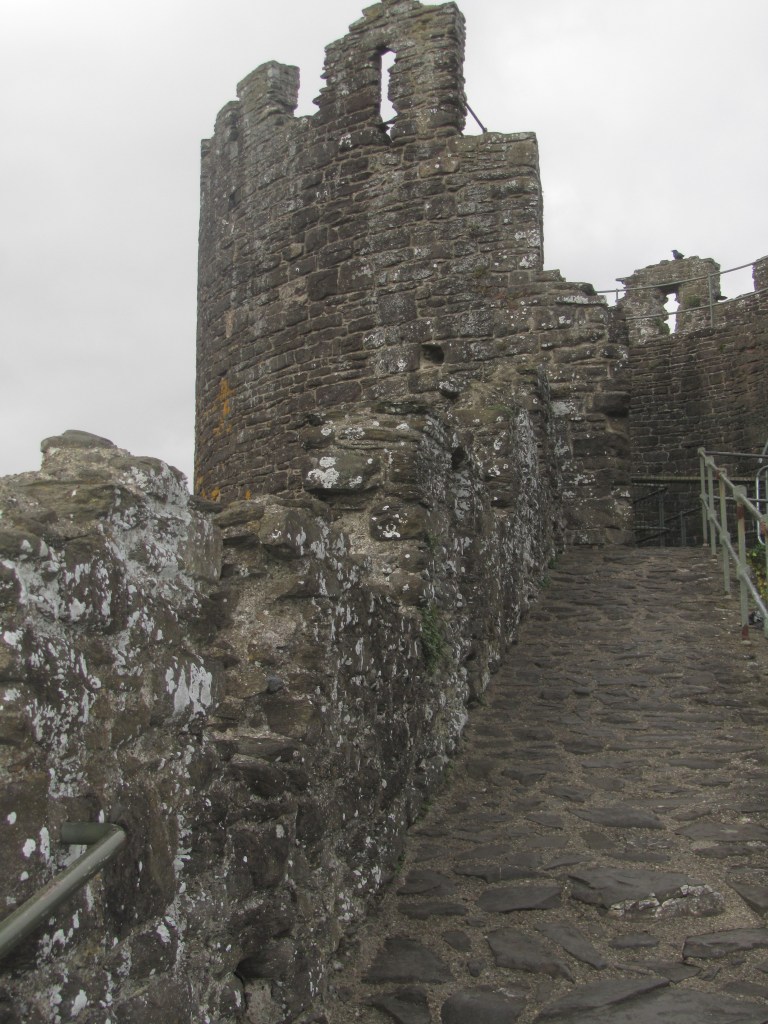
On the climb to the Watchtower…

Nearly at the top of the steepest climb!

Spectacular views down the Conwy Valley from the highest point...
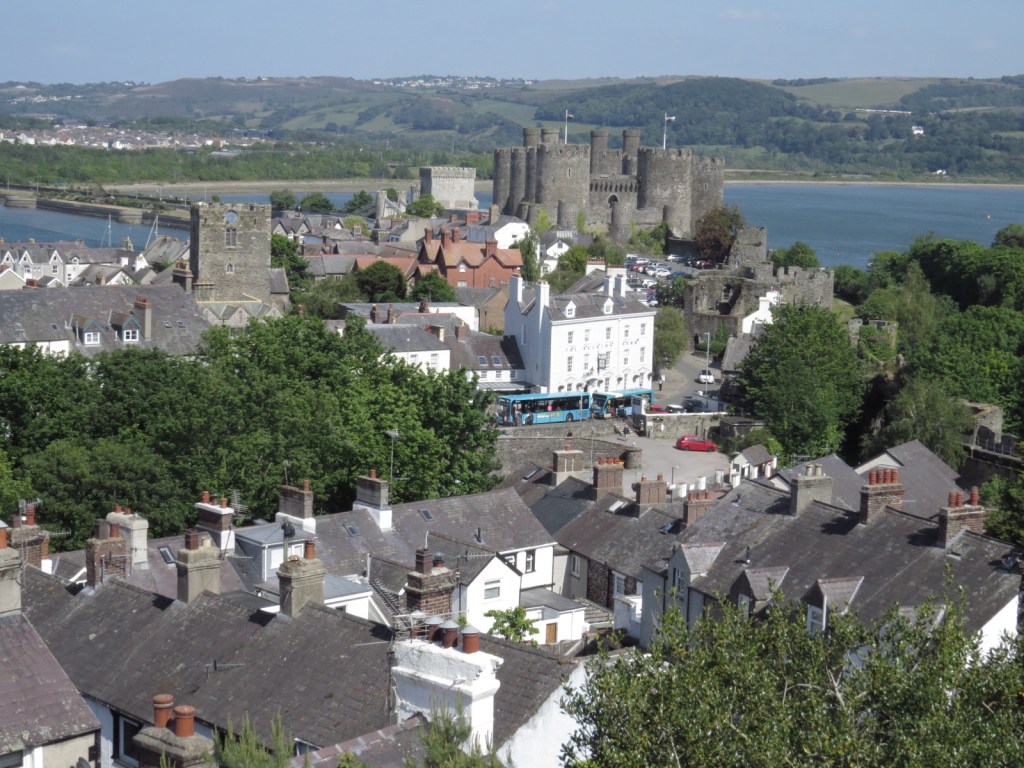
…and back across the town to the castle, and beyond.
From here, thankfully it’s all downhill while we look across Conwy’s ancient grid of busy streets. The walkway follows a straight line down towards the quayside with its spur wall stretching out into the sea, designed to act as both an extra defensive feature and a breakwater. From here, although the wall turns back towards the castle the walkway does not, so we drop down another flight of steps to stroll along the quayside with its various attractions, (including the smallest house in Great Britain, which is well worth a look, and it won’t take long!) and the twin-towered Lower Gate, through which various goods were once taken into the town from ships docking in the harbour.

From the Watchtower, it’s downhill in a straight line to the quayside.
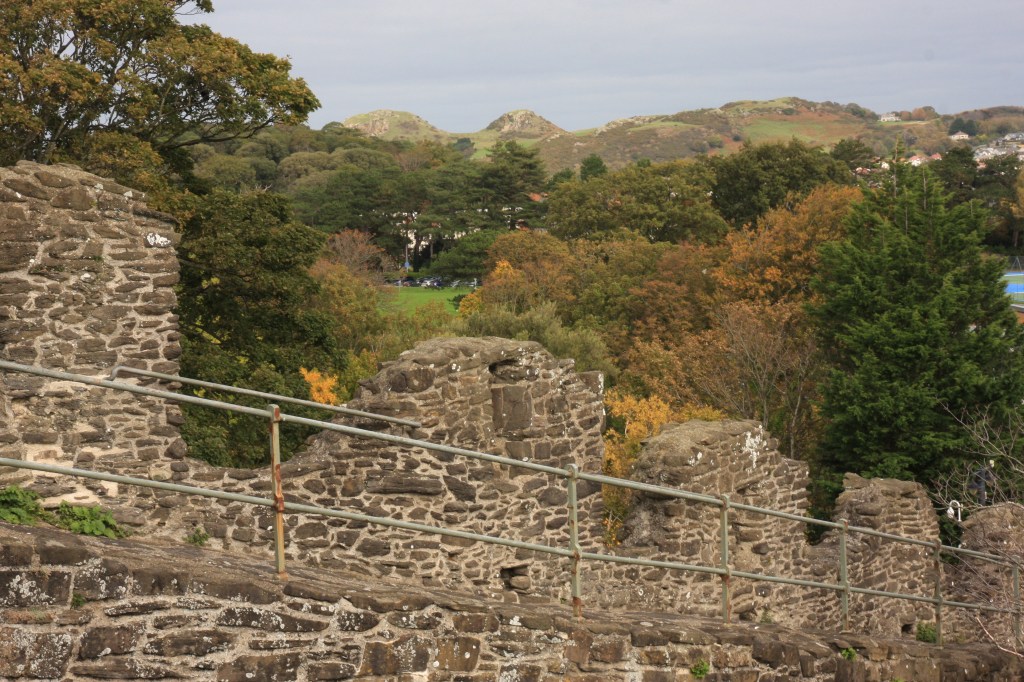
The impressive views continue on the descent.

The quayside from the spur breakwater.
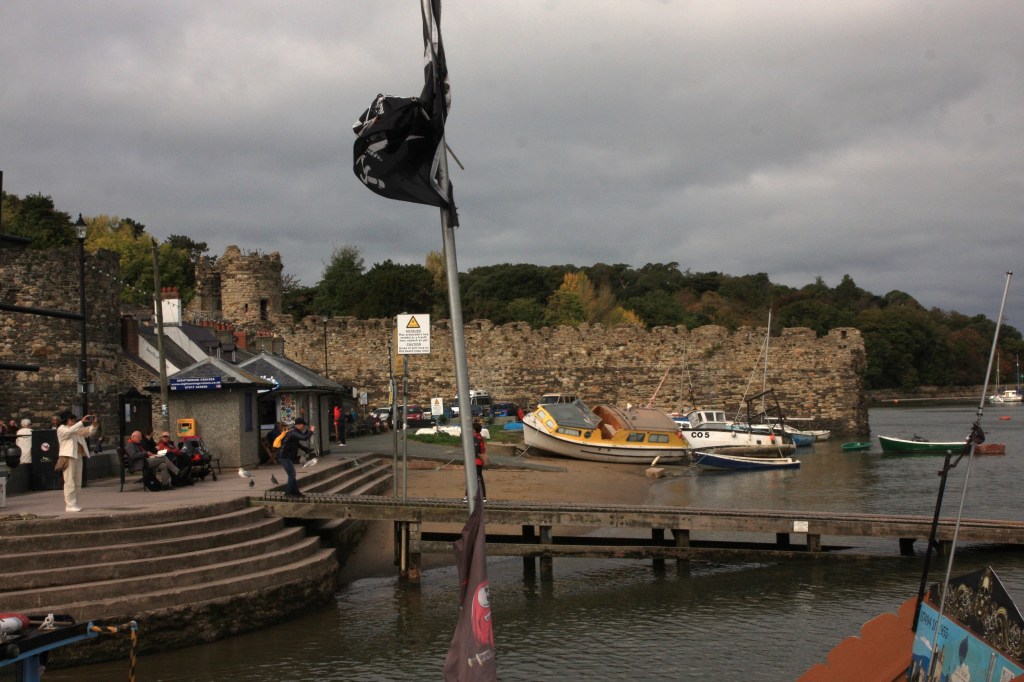
The extra defensive spur/breakwater stretching into the harbour.

Built against one of the wall’s towers at the end of a quayside terrace, Britain’s smallest house, with it’s red frontage, makes a fun and interesting little attraction!

The Lower Gate on the quayside, through which goods were taken into the town from ships docked in the harbour.
Finally, we turn back into the heart of the town through a postern gate (Tower 1), which itself houses our final destination, and something we always look forward to. Trotting up the steps leading to the first floor, we reach our favourite café, The Jester’s Tower Coffee House. Here we can relax in evocative medieval surroundings and enjoy a delightful cup of coffee or their wonderful ‘Snowdon Mist’ tea, the best cheese and chutney toastie I’ve ever tasted, and a well-earned slice of delicious cake. The perfect end to a time-slipping wander.
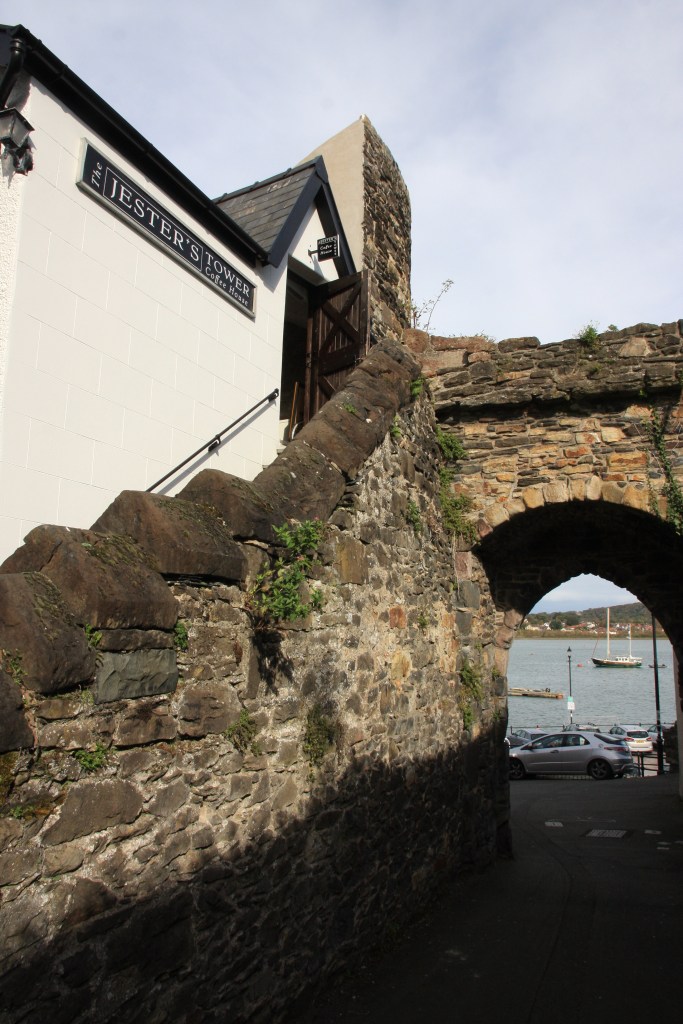
The Jester’s Tower, our final and very welcome destination!

Relaxing with a knightly friend…

…and a scrumptious Jester’s lunch!
In this age of turmoil and uncertainty, we all need a place of sanctuary. Here in North Wales, we’re fortunate to have access to peaceful and wild landscapes that help to restore our sanity, while medieval bolt holes like Conwy Castle and its stoic town walls are on hand for a more immediate escape. But lately I’ve been wondering how other folk cope with the ever-increasing chaos. So where do you go to decompress, and what helps you unravel the vexing knots of news-induced stress?
Whatever you do, and wherever you go, I wish you joy and the same sense of solace and contentment that we find wandering around the medieval walls of Conwy.
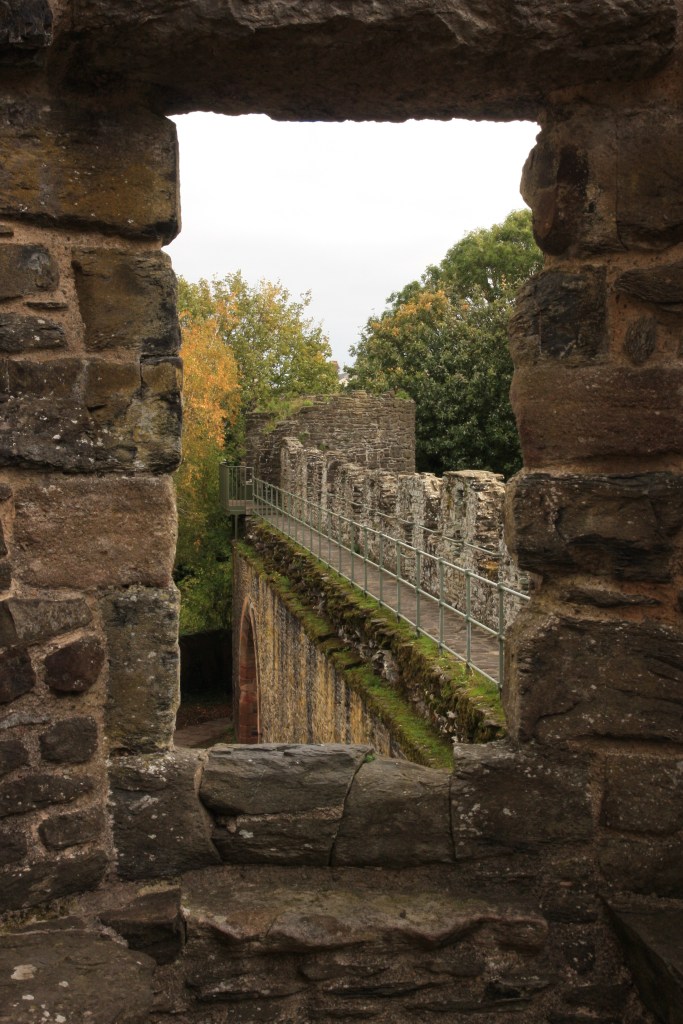
P.S. As I write, in November 2025, a section of the walls from the Watchtower to the quayside is undergoing some much-needed conservation work, so that part is currently closed off. However, you can still reach the all-important Watchtower at the highest point and enjoy those incredible views. It’s expected that the full route will re-open for Easter 2026.
 medievalwanderings.com
Another wonderful wandering into the past my love. Conwy is such a magical place to visit, it really does feel like Camelot when you’re crossing over the bridge towards it.
Being up on the walls, high above the modern hustle and bustle, really is a refuge I agree – it’s easy to imagine how it must have looked all those years ago, minus all the rubbish we have now.
Great photos too – it really does look like a place you only used to visit on holiday; it’s hard to believe it’s just down the road.
I look forward to our next visit, perhaps we can squeeze a visit to the castle… and another absolutely fabulous sandwich!
LikeLiked by 1 person
It’s great to have Conwy close by, isn’t it? I still find it ironic that we did used to visit it on holiday, and now it’s on the doorstep! I love the combination of a superb medieval site and the beautiful views – it’s the best of both worlds. We’re lucky to be able to get to some wonderful places to escape and unwind, and we need to do that a bit more often, I reckon.
Either way, next time we should definitely do the castle too, and make it a longer break from the madness. As long as we can still end up in Jester’s Tower! 😀
LikeLiked by 1 person
I’ll drink a Snowdon Mist to that!
We do indeed need to do it a bit more often, and absolutely the Castle needs to feature next time, and that’s a wonderful place to get lost in too – I sense a day out coming 😀
LikeLiked by 1 person
I really hope so. We badly need some more time out at the moment. 🙂
LikeLiked by 1 person
We do indeed – we’ll have to get out in the next few weeks!
LikeLiked by 1 person
That’s a date. Or several. 🙂
LikeLiked by 1 person
Thank you!!!! Since I can’t be there in the flesh, this was a wonderful armchair journey. And I’m with you 100%; that these are times when — in order to maintain some scrap of sanity — we need to “travel”. The dogs and I spend part of nearly every day in “the big empty” being reminded by sky, mountains, and an ancient lake bed that there’s more to all of this than the gratuitous shit-show. This is a very amazing castle!!!
LikeLiked by 3 people
Thanks so much, Martha! I’m so glad you enjoyed our wander around Conwy’s town walls, and that you could feel part of it. I was hoping folk would feel that way with all the photos. It really is an amazing castle, and I guess it is rather photogenic!
I admit I do envy you your wild location, and your time spent in ‘the big empty’ with the dogs. It must be a great antidote to the gratuitous shit-show (love it!). There certainly is more to all the madness. In fact these days I tend to feel more at home in the wild and in the past. Thanks so much for the lovely comments, and enjoy today’s escape to the big empty! 🙂
LikeLiked by 2 people
Decades since I’ve been that way, so grand to see your splendid pictures. We are spending a lot of time in the Scottish Borders, that place of great abbeys and such mixed countryside. A real stepping back into the past.
LikeLiked by 1 person
Glad you enjoyed the pictures, John. The castle and walls are a great link with Edward’s time because they’re so well preserved. Little wonder they’re part of the ‘iron ring’ World Heritage Site.
The Scottish Borders seem another excellent place to get away from it all, especially with the combination of lovely countryside and history. And I should imagine it would be fairly quiet too, which also helps.
LikeLiked by 1 person
The roads are so quiet and most of the car parks are free. Rarely see other walkers.
LikeLiked by 1 person
Sounds idyllic. I must get up there for a break again.
LikeLiked by 1 person
It’s very many years since I’ve been in Conwy and even more since I was up on the walls so I thoroughly enjoyed this virtual visit! The views are lovely and for a moment I envied the owner of that garden, to have such a backdrop, but then I realised that with the backdrop would come all the town’s tourists peering down at you 😀
LikeLiked by 2 people
Hope the virtual visit brought back some good memories for you Sarah. 🙂 We’re lucky to have Conwy so close by.
You’re so right about the garden though. When we first saw it, I reckon the present owners had just moved in, as it was really unkempt and neglected. From then on, every time we went past it was in another stage of development and now it looks lovely, as you can see from the photos. But as you say, no privacy at all, as it’s totally overlooked from every angle. You have tourists looking down on you all the time from the wall, and on the other side there’s an public footpath leading into town that runs alongside the garden, screened only by a chest-height open metal railing! I love the walkway, for sure, but I couldn’t live there. 😉
LikeLiked by 2 people
It was too long ago that I was there for me to remember much at all, so this felt all new to me!
LikeLiked by 1 person
Then it’s a pleasure to have you virtually along with me, Sarah! 🙂
LikeLiked by 1 person
Great post and photos! I’ve been to Conwy a couple of times on the railway, once to do Conwy Hill and once to the Youth Hostel but I’ve never walked the walls or realised they were so extensive. I’d be worried on those steep sections in wet weather that the stone would be slippery – have you been there in the wet?
Always good to finish with a tea room!
LikeLiked by 1 person
Thanks Carol. I remember you saying you’d been to Conwy, and that you were amused by the dancing seagulls (they’re still doing that a lot!). Excellent point about the steep sections on the wall though. Yes we’ve done the walls in pouring rain before, but surprisingly we were OK. I don’t know whether it’s down to the footwear we had on, which was walking boots and wellies with good tread, or whether it’s the path itself being quite knobbly in texture, which may help to prevent it getting slippery. Good point though, and something I’ll reconsider next time we’re there.
I thought of you when I was writing about Jester’s cafe, as I know you like a good tea room too, and this is a lovely, quirky one! 🙂
LikeLiked by 1 person
if I do the walls walk, I’ll be in walking shoes so it sounds like it will be fine. Could well be the knobbliness of the stone…
LikeLiked by 1 person
I guess a few good knobbles can make a big difference! 😀
LikeLiked by 1 person
it also depends on the rock type – slate, for instance, and limestone are horrifically slippery in the wet. So is gneiss (Hebrides and so on). Not sure what the rock type is around Conwy…
LikeLiked by 1 person
oh yes, forgot – the bridge built by the Victorians over the railway is really beautiful!
LikeLike