For the past few weeks much of the UK has been subjected to some truly dismal weather. Although technically we’re heading into spring it feels as though we’re still floundering in the bleak midwinter. Here in North Wales, after two weeks of freezing rain, cutting winds and sleety showers we’ve taken to donning our warmest woollies and socks and nesting by the fire in true wintering style. While the elements have been relentlessly pounding at our windows, a wonderful song has come to mind. But this isn’t just any old tune: it’s the earliest known secular song in the English language, and it’s all about rotten winter weather.

We’ve spent a lot of time wintering by the fire lately!
Dating from the first half of the 13th century, ‘Mirie it is while sumer ilast’ has a curious story, as it owes its very survival to a stroke of good fortune. The parchment on which the song was written had been torn from its original (now lost) book and added as a flyleaf into a completely unrelated manuscript. Its new home was a 12th century Book of Psalms, which today resides, albeit in incomplete form, within the Bodleian Library in Oxford as part of the collection of an 18th century antiquarian named Richard Rawlinson (d.1755).
The musical page, which also included two French songs, was discovered in the Book of Psalms and was brought to the attention of scholars at the start of the 20th century. The surviving fragment of ‘Mirie it is’ had clearly weathered some damage, looking somewhat worn and torn, and what remains consists of the music, a few vague notations and a single verse. Luckily, however, it was just enough for the experts to work with, and after much analysis and study the song was painstakingly recreated and arranged for us to enjoy for all time.
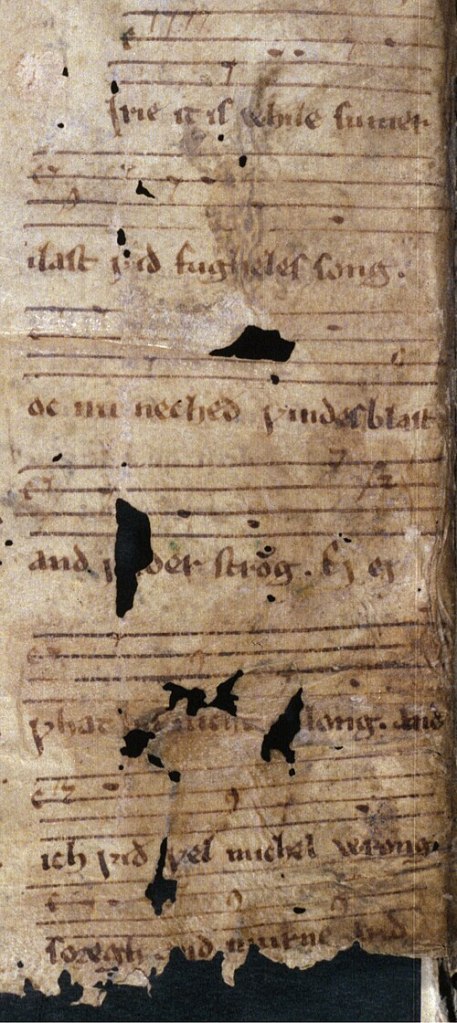
The single manuscript source for ‘Mirie it is’, looking a little battered and bruised, but it survived to tell it’s melodic tale.
The song begins with memories of summer when the birds sang, conjuring images of long warm and joyous days of abundance, before going on to lament the encroaching dreaded winter with its harsh weather and short days. Many of us will identify with that, but it seems rather poignant when you consider that during the Middle Ages the darkest months could mean exposure to freezing temperatures, deadly illness and severe hunger through a lack of fresh food and dwindling stores. In short, winter could decide whether you lived or died, and this little ditty gives us an evocative snapshot of the medieval struggle to get through nature’s most cruel season.

Mirie it isn’t… Winters were hard in the Middle Ages.
The single verse is written in Middle English, which you can read below alongside a modern translation. The recording is from my favourite medieval music album, so you can listen along and let your mind wander back to winters long ago. As you’ll discover, despite the seasonal threats of those precarious times, this chirpy song still manages to cheer the soul. Who knows, maybe medieval folk danced along to its tune to keep warm as the nights drew in!
Mirie it is while sumer y-last Merry it is while summer lasts
With fugheles son With birds’ song;
Oc nu neheth windes blast But now draws near the wind’s blast
And weder strong. And weather strong.
Ei, ei, what this nicht is long! Ei, ei, what, this night is long!
And ich with wel michel wrong And I with very great wrong [illness?]
Soregh and murne and fast. Sorrow and mourn and fast.
For Christmas I was given a rather beautiful soprano recorder, crafted in plumwood, from the Early Music shop in Bristol. One of my goals this year is to learn to play some medieval music, perhaps even to wander in the greenwood and serenade the wildlife with tunes from centuries ago (that’s if I don’t scare them all away!). And this, the earliest known English secular song, written way back in the early 1200’s, is one of the first pieces I want to learn.

Recorders were a key medieval woodwind instrument, as depicted in this detail from a Spanish altarpiece, La Virgen con el Niño, dated to c.1385.
[Source]
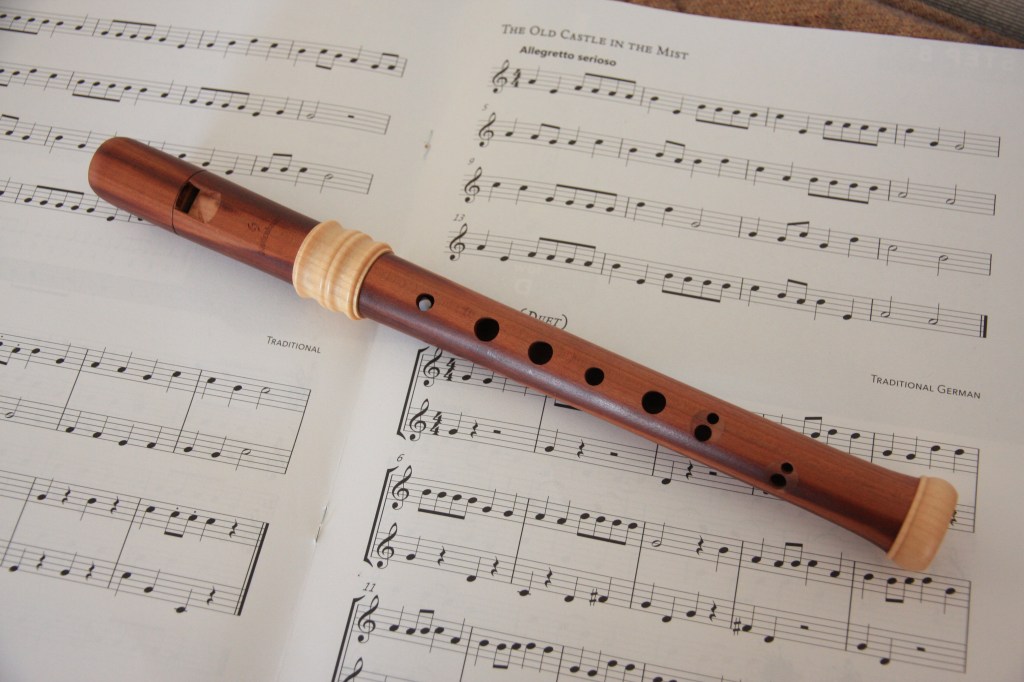
My beautiful new plumwood recorder gives an authentic medieval sound – if you play it properly! I’m working on it…
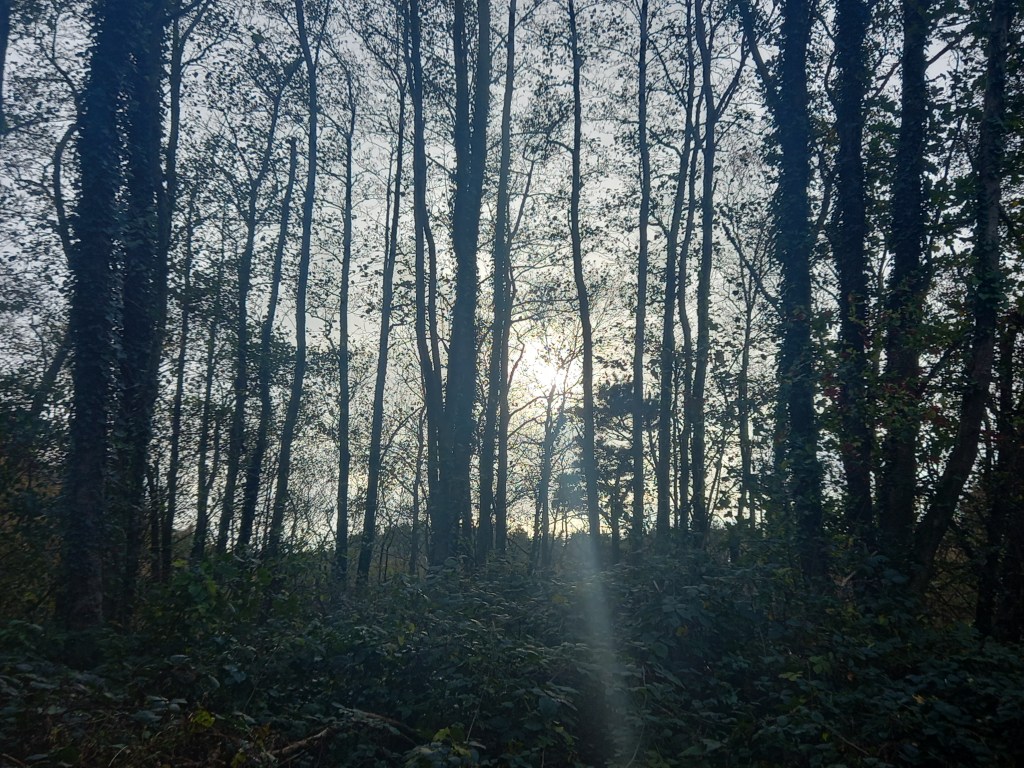
Today, in the middle of February 2026, it’s still cold outside. We’re told to expect snow tomorrow and even more rain over the coming week. However, when I looked out this morning, for the first time in what seems a very long while the sky was a bright, yawning expanse of blue. For a precious few hours, the landscape was bathed in sunshine, the fragile rays of hope. Before the afternoon clouds rolled in, our brief wander in the not-so-greenwood was blessed with golden light, a hint of solar warmth and the promise of brighter days to come. So I’ll take that, for now. Mirie it is…
 medievalwanderings.com
That song was excellent, I was transported to the 1200s! this is so fascinating for me, I have often wondered what life was like during those centuries. In elementary school in the early 1970s, we were given recorders and had to play them in class.
LikeLiked by 3 people
Thanks John! Glad you enjoyed the song and its story. The medieval era is the most fascinating of all for me and it’s given us some of the most wonderful stories and artefacts to treasure.
I remember those dreaded school recorder lessons too, and I can happily say the true medieval sound is much nicer, so haunting and evocative. I’m doing my best to emulate the special sound, but in the meantime my family have been amply supplied with earplugs! 😉
LikeLiked by 2 people
Earplugs… I’d love to hear you learning! I’m sorry you too suffered the Recorder thing! 😂 Imagine being able to transport to that era instantly to experience it. Wow…
LikeLiked by 1 person
Wouldn’t that be amazing? I’ve often said if I could travel in time I’d be straight back to the Middle Ages. The music would be one thing I’d love to experience first hand. 🙂
LikeLiked by 1 person
She’s talking Twaddle John – we don’t need earplugs at all – she’s actually very good considering how long she’s been playing.
Mind you… when I start singing along – Earplugs are a must then! 😀
LikeLiked by 1 person
I actually enjoyed my recorder lessons and was glad to learn an instrument. I was a bit miffed it wasn’t something exciting like the violin though – my friend played that and I always wanted to.
LikeLiked by 2 people
You can still learn the violin if you set your mind to it. 👍🏻
LikeLiked by 1 person
I know – I’ll have to bear it in mind if I have to stop going up the hills. But as I go hillwalking every day, I have that much to do when I get back and am generally fairly tired so not up to much apart from some crossword puzzles and suchlike.
LikeLiked by 2 people
I have enjoyed your walks!
LikeLike
I hope I keep on being able to enjoy them!
LikeLiked by 1 person
I hope ya do!
LikeLiked by 1 person
Another wonderful little post my Love. All I can say about the weather recently is Yuck… Mirie it isn’t indeed. I’m very happy to be wintering in front of the fire and I hope those in the Medieval period had a chance to do the same – with a glass of Mead in the hand.
Having heard your progress on the Recorder, I’m 100% certain that when you do serenade the woodland wildlife, they’ll have nothing to worry about.
XXX
LikeLiked by 1 person
I knew you’d love this one. Such a great song, and so appropriate for our current seasonal weather! There’ll be more wintering by the fire over the coming weeks, I think, but I can’t say I mind at all as I’ve got so much reading and crafting to do. Throw in a glass of mead and I’ll be perfectly content!
As for the recorder progress, well I’m getting there, but do keep the earplugs for now! 😉
LikeLiked by 1 person
😀 Earplugs are not necessary – I love listening to you play ‘Castle in the Mist’ and everything else!
You know me – I’m always ready to be on hand with a glass of mead 😀 I’ll certainly drink to more wintering. I find myself wanted to do that more and more at the moment. XXX
LikeLike
I found the language comparison interesting – the ‘Middle English’ looks to have a few languages thrown in – it looked like some German, some Gaelic or Welsh and some Scots. I find that kind of thing fascinating – maybe I should do some language study in the evenings or something – time I took up studying again.
Great post as usual! The guy in the picture sat by the fire looks like he’s also drying and warming his soaked feet! I can certainly empathise with him there!
We had sun and snowy hills yesterday and I had a nice walk in it but there were thousands of tourists everywhere so, in a way, I preferred today when it was miserable, the snow had all washed away (which was a shame) but it was really, really quiet!
LikeLiked by 1 person
Many thanks, Carol! 🙂 Glad you enjoyed the song and its quirky story. I love Middle English, it is indeed fascinating. It evolved from Old English which was very Germanic, and although I’m not an expert on it’s evolution, English is a mix of all the languages of the peoples who have invaded and settled in these isles over the millennia! There’s Latin, French, Norse, Celtic and Germanic influences, all in the mix. So you were right to pick up on so many other tongues.
Glad you got out this weekend. It was crazily busy here too – half term I suppose. I’m with you in preferring places when they’re quieter, even if it means bad weather. As it is, we tend to find the mountains (and castles) much more atmospheric in bad weather. And quiet is always better! 🙂
LikeLiked by 1 person
Oh yes – the recorder – I’ve got two recorders with various drawbacks and virtues. My descant (soprano) recorder which I’ve had since my primary school days is great as it’s a wooden body with a plastic mouthpiece – my ideal combination as I find the all wood ones a bit too mellow for me. My parents both had all wood recorders and I used to play those too. But then they bought me an all-plastic Aulos treble recorder. I love the tone and pitch of it but it doesn’t half suffer from condensation – I’m always having to blow it through backwards to clear it as it just won’t play when condensation forms. I believe it’s a common problem with the plastic ones.
LikeLiked by 1 person
Wow, I hadn’t realised you were a recorder fan too! Fantastic, Carol! I’m sure you could teach me a thing or two. It’s a lovely sound when it’s played properly!
LikeLike
I didn’t say I was a good player! 😉
LikeLiked by 1 person
You’ll be way ahead of me! 😀
LikeLike
it’s good for my lungs anyway – I should really play more often to keep them in good fettle as well as doing the hills.
LikeLiked by 1 person
That’s true, it’d do you a lot of good. Playing musical instruments is also one of the best things there is for your brain. Apparently, playing an instrument is the one activity that uses all your brain at the same time. So I’d highly recommend knocking out some tunes on a regular basis. And it’s fun. 🙂
LikeLiked by 1 person
That’s interesting how good it is for your brain. At the moment my primary thing for brainwork is doing the various ‘Puzzler magazines’. It’s quite convenient – Richard subscribes to two of them and he and I like completely the opposite puzzles to each other so he does half the book and I do the rest afterwards – for free! 😉
LikeLike
I love this so much and I really needed it today, actually RIGHT NOW not because our winter has been bleak and cold, but because it’s been a lousy day in a challenging week. Hearing this? I love this language. It’s true transportation. Your recorder is beautiful — Thank you.
LikeLiked by 2 people
Oh bless you, Martha. So sorry you’re having such a bad time right now. I’ll catch up with you very soon, and if I can offer any support do get in touch. xx 💜💜 In the meantime, I’m so glad the song and its story gave you some comfort and joy in such dark times. Glad too that you like the look of my recorder, although I’ll spare you my early efforts at playing for now! 😉
LikeLiked by 1 person
I fell in love with the hurdy-gurdy from a CD I bought ages ago. What a cool sound. And I’m good with hearing your early attempts. Everyone has to start somewhere!!! As for my “dark times” — not all that bad. I just did something stupid online and am now doing triage. It’s OK, not existential or physical just administrative and annoying.
LikeLiked by 1 person
Oh yes, the hurdy-gurdy is incredibly haunting and atmospheric.
Sorry you’re having a rough time though. A lot of people seem to be having problems of one kind or another at the moment. Hope it all sorts itself out very soon. xx 💜💜💜
LikeLiked by 1 person
Thank you, Alli. 💙
LikeLiked by 1 person
As a carver, I have loved plum wood whenever I can get it here in the States. It has lovely grain, carves well, and is an underappreciated tone wood, and I wish you joy playing your very lovely recorder.
I was amazed at how much of the English in Mirie I could understand!
LikeLiked by 1 person
Thank you, Lou! That’s so interesting, as I adore wood but know little about plumwood. I can’t imagine why it’s underappreciated as I think it’s stunning. All I can say is how beautiful and tactile my recorder feels in my hands, and I only hope that in time I can do it justice and play it well.
And top marks for your understanding of the English in the song! Thank you so much for reading and for the lovely comments. 🙂
LikeLiked by 1 person
Wonderful post; this is new to me. Reading it immediately after some travelling, I realized that when your ear is tuned to German and Swedish, it is not hard to puzzle out the drift of medieval English.
LikeLiked by 2 people
Thank you! So glad you enjoyed winding down after your travels with this special medieval song. True, it’s possible to find lots of different languages that have contributed to the development of the English language. This is in no small part owing to the number of times we’ve been successfully invaded and colonised over the centuries! 😀
LikeLiked by 1 person
Also, English shares an origin with some of them
LikeLiked by 1 person
Absolutely, it does. English is a real soup of a language, with many and complex ingredients!
LikeLiked by 1 person
I’m reading this in tropical Sri Lanka while anticipating a return to the icy cold of the UK in a few days time, so it couldn’t be more apposite! The story of the song’s survival is as inspiring as its reminder of the joys of summer to look forward to even in the coldest part of winter. I wonder what more the songwriter had to say??
LikeLiked by 1 person
Hi Sarah, hope you’re enjoying tropical Sri Lanka – your weather couldn’t be more different from us back here in the UK! 🙂 Many thanks for your great comments, as always, and I’m glad you liked the story of Mirie it is. I’ve had the same thought as you, and wondered what else the writer may have said in his lyrics. I do know that despite their awful winter conditions, medieval people did get a bit more time off at this time of year because of the lack of farming activity, so he may have gone on to mitigate the misery. But sadly, as the rest of the original book it was written in was lost, I guess we’ll never know. If only that little bit more had survived, eh?
Have a great time in Sri Lanka, and thanks again! 🙂
LikeLiked by 1 person
Thanks Ali – we are having a great time although we had a dramatic storm this evening so it’s not all sunshine!
LikeLiked by 1 person
Wow, so you could say you’ve had ‘weder strong’ after all! Still, I’m glad you’re having such a great time despite the storm, and I’ll look forward to seeing your photos. 🙂
LikeLiked by 1 person