My last post came from our recent holiday in Northumberland, and the first image shows a place with which we have deep connection: the Sycamore Gap on Hadrian’s Wall. Just a couple of months ago we spent many cherished hours here, but now we are grieving. We’re all struggling to process this week’s devastating news that the noble tree we loved so much has been cruelly felled. The senseless destruction of this national icon and beacon of natural beauty has plunged the county into mourning. Its untimely and violent end sent a shock wave across Northumberland, the UK and around the globe, affecting everyone who knew and loved the most photographed tree in Europe.
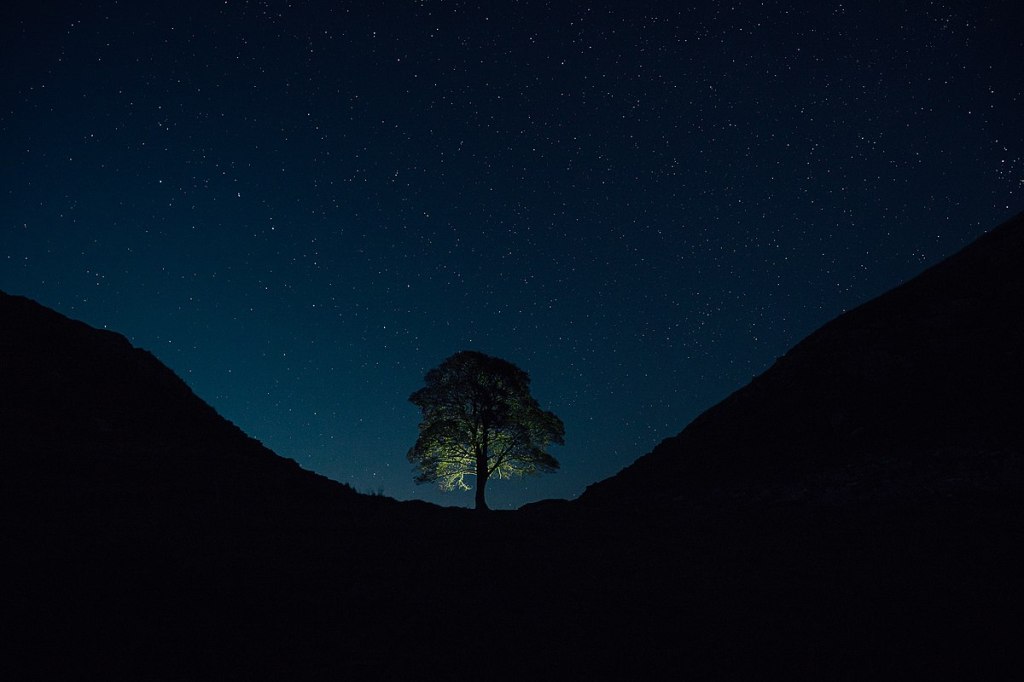
The celebrity tree occupied a prime spot on the Whin Sill, a natural system of dykes and raised ledges of dolerite rock formed around 295 million years ago, and spanning some 4,500km2 of Northumberland, Teesdale and Weardale. Little wonder then, that in the year AD 122 the Roman Emperor Hadrian chose this ready-made barrier on which to build a wall securing the Empire’s northern border in the province of Britain. The Sycamore was planted in its scenic position around 150 years ago, and as it matured and thrived the location became a focal point where history, geology and nature met to showcase Britain at its glorious best. The exquisite view of the tree framed within a dramatic dip in the wall inspired artists, writers, photographers and film makers, and it’s impossible to go into any gift shop in Northumberland without seeing its striking image.
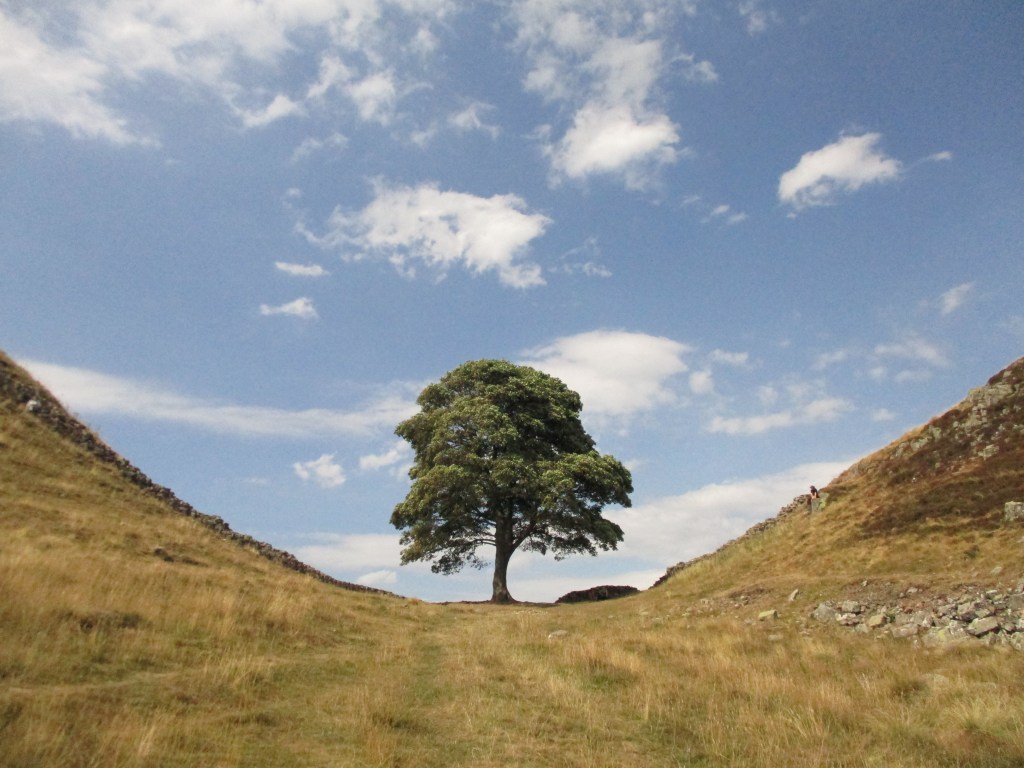
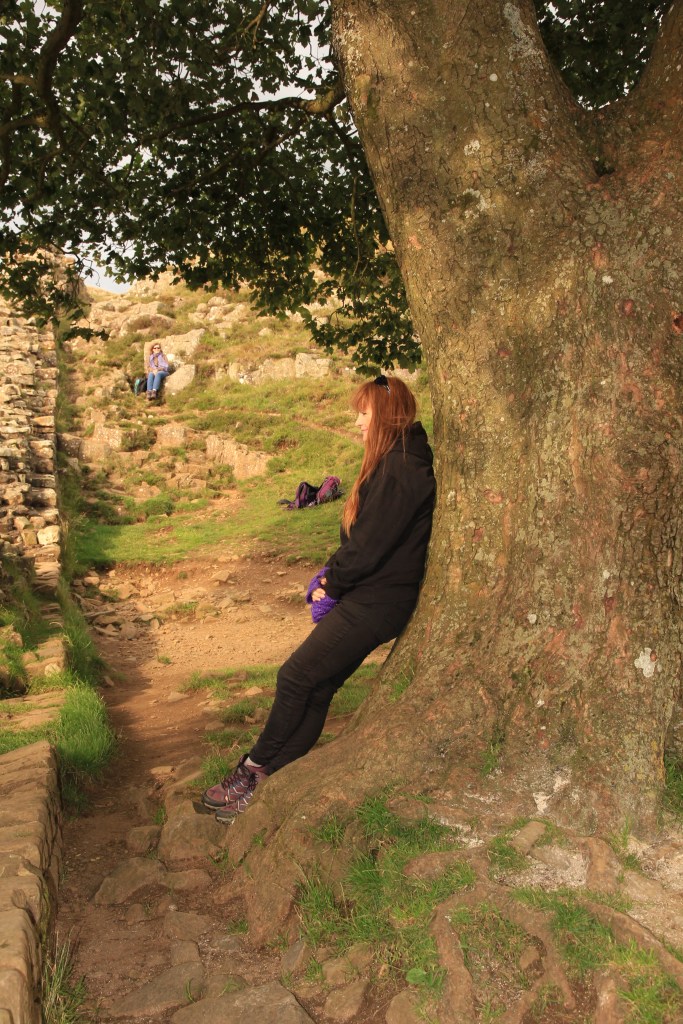
The unique beauty and tranquility of the Sycamore Gap drew visitors from all over the world and from all walks of life. Walkers trekking across the Wall would pause there to rest and record the famous stop on their journey, friends would wander along the hills to the shade of the tree on a summer’s evening, and couples embraced as proposals were made under its vibrant branches. Some people chose this idyllic spot as their final resting place, where their ashes, along with their memories, would suffuse the unsullied ground and find eternal peace in this little paradise. People would meet there, talk there, sit and chill there, reflect and remember, and always photograph the famous tree. But whatever was going on and whoever was around, the Sycamore Gap was always a place of peace and respect.


Our time at the Sycamore Gap was always treasured. It was a place of solace and celebration. When my degree award came through while we were in Northumberland in 2021, we chose this spot to mark my success with an evening picnic and a bottle of wine. A group of walkers passed us as we raised a glass, and they smiled in greeting while one of them said to her party ‘why didn’t we think of that?’. We visited the tree in all weathers, taking refuge under its verdant, shimmering canopy from both heat and rain. We explored the wall beside it, and collected fallen twigs from the ground around its roots as natural souvenirs, each one encapsulating its own cherished memory.

We collected fallen twigs from the Sycamore; now they’re even more precious keepsakes

For those who sadly never made it to the Sycamore Gap, it’s hard to describe the feelings the place evoked. Even though more than fifteen hundred years has passed since the Romans left, there remains a palpable sense of a frontier land. I would sit on the tree’s muscular roots with my feet up on Hadrian’s Wall and stare out at the wilderness beyond, to a land the great Empire failed to bring to heel, to a place, and its people, that were ‘other’. But it’s much more than that. The Sycamore Gap wasn’t just a site where two earthly realms collided. The tree by the wall seemed to bridge a barrier between this world and the next. It was almost a sacred space, a point at the thinnest edge of the physical world where the spirits were only a whisper away. And while the tree lived, they were.

The Sycamore touched so many lives, and resonated with so many people. And now it’s gone, brutally ripped from the heart of the Whin Sill, and we’re all reeling in shock and disgust. News reports show its noble form lying pitifully across the wall like a murder victim, the cherished spot now a taped-off crime scene. In recent years there has been a great deal of research into the lives of trees, and it seems there is a vast amount more to them than we had realised. In fact, they may not be all that different from us. The leading forest ecologist and scientist, Professor Suzanne Simard, has discovered many human-like traits in trees, and her findings make for intriguing, even poignant, reading. Although trees don’t have brains as such, Simard has learned that ‘the network in the soil is a neural network and the chemicals that move through it are the same as our neural transmitters’. It’s now widely believed that trees can experience pain, that they are social creatures, that they have memories, and that they may even be capable of distinguishing us as humans. Think of that…
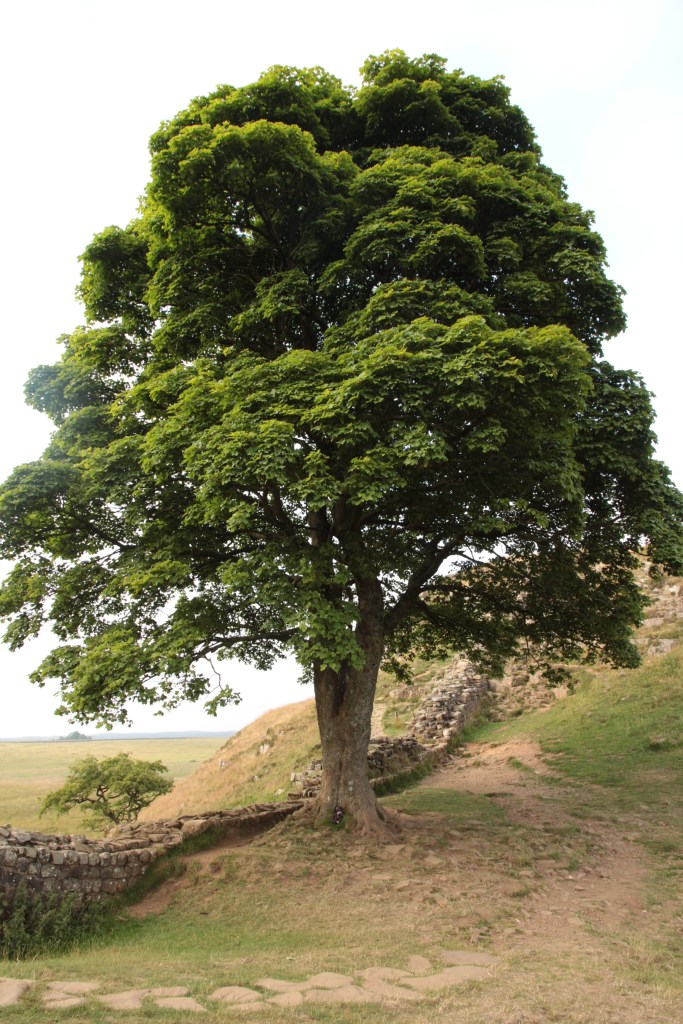
Our beloved place is no longer the Sycamore Gap. The dramatic dip in Hadirans Wall remains but, for us, it’s now a soulless gap, a void where there was once magic and life. There are plans to make this spot special again, to recreate a unique location where memories can be made and shared once more. But for many, and particularly for us, it will always be the sycamore void, the scene of happiness past before the heinous act of destruction.
As for the monsters who perpetrated this vile act, these inhuman beings, I hope the horror of what they have done haunts them for the rest of their miserable days. Not only have they killed the stunning Sycamore in the prime of its life, they have desecrated the precious memories of countless people, and robbed us – and thousands of others – of all the future joys that would have been experienced at this unique place.

I’d like to finish with a tribute to the Sycamore, an elegy in the form of a song. The lyrics were written by Rob Macfarlane, adapted from his poem written to accompany the enchanting illustrations of Jackie Morris, my daughter, Maddie’s favourite artist. Together, Macfarlane and Morris have produced two masterpiece books, The Lost Words and The Lost Spells, the latter of which we bought for Maddie, ironically, when we were in Northumberland this summer. Macfarlane’s poem, Heartwood, was set to music, along with several others from The Lost Words, to accompany a touring exhibition that, again ironically, began with an 11-month stay at The Sill, the discovery centre of the Northumberland National Park, located just a mile away from The Sycamore Gap.
Heartwood
Would you hew me to the heartwood, cutter?
Would you lay me low beneath your feet?
Listen to my sap mutter
Hear my heartwood beat.
Would you throw me on the log pile, cutter?
Would you toss me to the steel saw blade?
Listen to my leaves flutter
Hear my heartwood break.
Would you lean your back against me, cutter?
Would you rest your axe a while and sleep?
Listen to this song I utter
Hear my heartwood weep.
Hear my heartwood, heartwood
Hear my heartwood.
I drink the rain
I eat the sun
I gift the breath that fills your lungs
I hear the roaring engine thrum
But I cannot run…
Would you hew me to the heartwood, cutter?
Would you lay me low beneath your feet?
Listen to my sap mutter
Hear my heartwood beat.

Rest in peace, dear friend
Heartwood from ‘Spell Songs’: vocals by Karine Polwart, Lyrics by Rob Macfarlane, artwork by Jackie Morris.

