Last week we spent a welcome few days in North Wales, during which I paid a return visit to some of the castles I wrote about during my great Welsh Castle Quest of 2019. Amid the current stresses and distractions surrounding our house move, I found respite within the walls of some of the great thirteenth century fortresses that secured Edward I’s hold over Wales, and unwound amidst the mountainous majesty of Snowdonia once more. But this time I had an extra treat, an escape into a wild and natural landscape of a different kind, for we went for a walk in one of the most peaceful and captivating woodlands I’ve ever seen. Not only was this leafy haven truly magical to wander around, it’s a rare and ancient habitat, and it’s even mentioned in a famous Welsh medieval story as the last resting place of a revered and heroic king.

A magical woodland hides in Snowdonia…
Hiding in the heart of Snowdonia in the village of Maentwrog in the Vale of Ffestiniog, Coed Felenrhyd and Llennyrch is one of the few remaining examples of a Celtic, or ‘Atlantic’ temperate rainforest that once extended from the north of Scotland all the way down to Portugal. Largely untouched for over 10,000 years, and thanks to it’s sheltered gorge setting where rain falls around 200 days a year, the woodland is home to a unique and complex ecosystem where an abundance of plants and animals thrive.

A river runs along the valley beside the quiet entrance
Rare species of lichens, mosses and liverworts enrobe the twisted and gnarled oaks, ash, birch and hazel. Examples include the globally scarce lichen Pyrenula hibernica, or ‘blackberries in custard’ as it’s more popularly known, and the rare oceanic Sematophyllum demissum, or ‘prostrate signal-moss’ that clings to boulders by the wood’s many rocky gullies and streams. The diverse habitat makes the woodland a paradise for the wildlife-watcher, as an abundance of native and migrant birds find refuge and sustenance among the trees, while foxes and badgers thrive on the ground, otters play in the flowing waters and ravens nest on the gorge’s craggy cliffs.

One of the many species of mosses (if that’s what it is!) that thrive in Coed Felenrhyd. This one caught my eye because of it’s unusual pinkish hue.
Its easy to see why this green oasis is one of Wales’s best kept secrets. There’s no signage directing the visitor from the roads, no car park, no sweeping entrance or attention-grabbing welcome signs. In fact, the ‘main’ entrance is an easily missed and very unassuming double gate next to a hydro-electric power station on the A496 to Harlech. But once inside, another realm unfolds before you, and the 765-acre site can be explored through a network of paths and tracks including a waymarked trail.
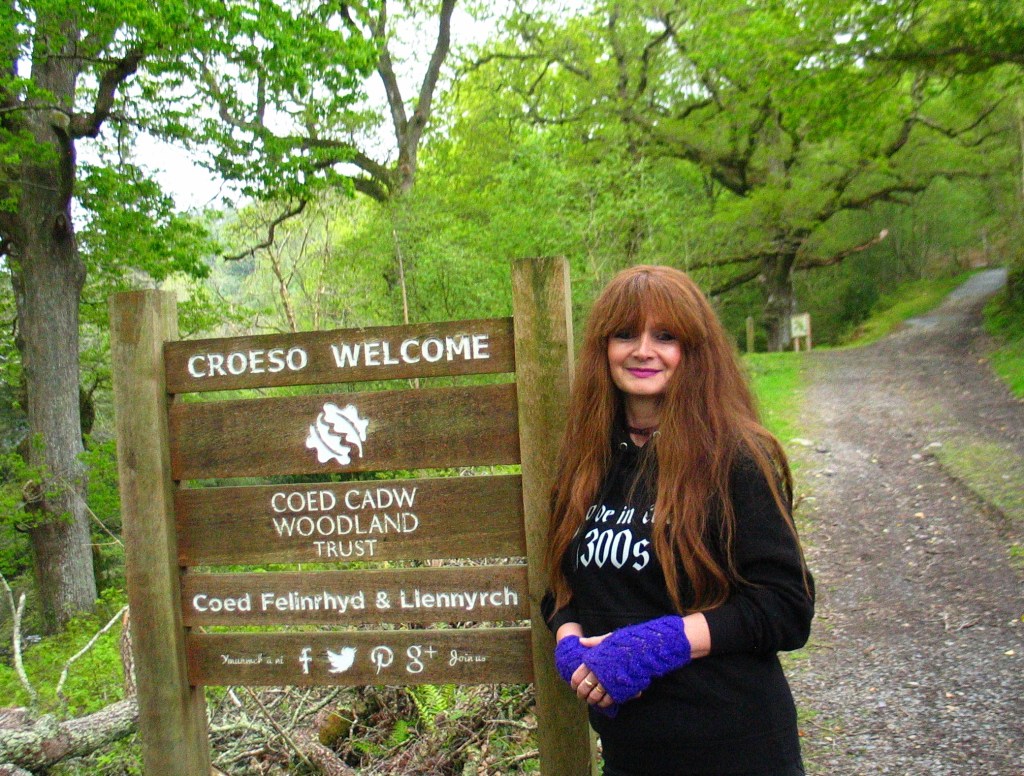
The modest sign marking the entrance. Notice the alternative spelling of ‘Felenrhyd’, which I haven’t seen anywhere else.

Another realm lies beyond the almost hidden entrance.
We took the trail that follows the Ceunant Llennyrch valley, beginning fairly flat and wide before meandering upwards on a narrowing and sometimes steep path to a hidden waterfall at the eastern end. As we climbed ever upwards, pausing to catch our breath and take in the verdant views, we savoured the serenity of our surroundings, losing all trace of the modern world. With only the sounds of our feet crunching over the forest floor, echoing birdsong and gently trickling streams to break the silence, all my stresses fell away as a rare but enchanting feeling came over me, a sense that at this precise moment, in this beguiling place, we really could be ‘anywhen’. Of course, during perfect moments like this, my mind will always transport me to the Middle Ages, and this is particularly appropriate in Coed Felenrhyd, as the woodland’s age and distinction earned it a place in a famous medieval prose tale.
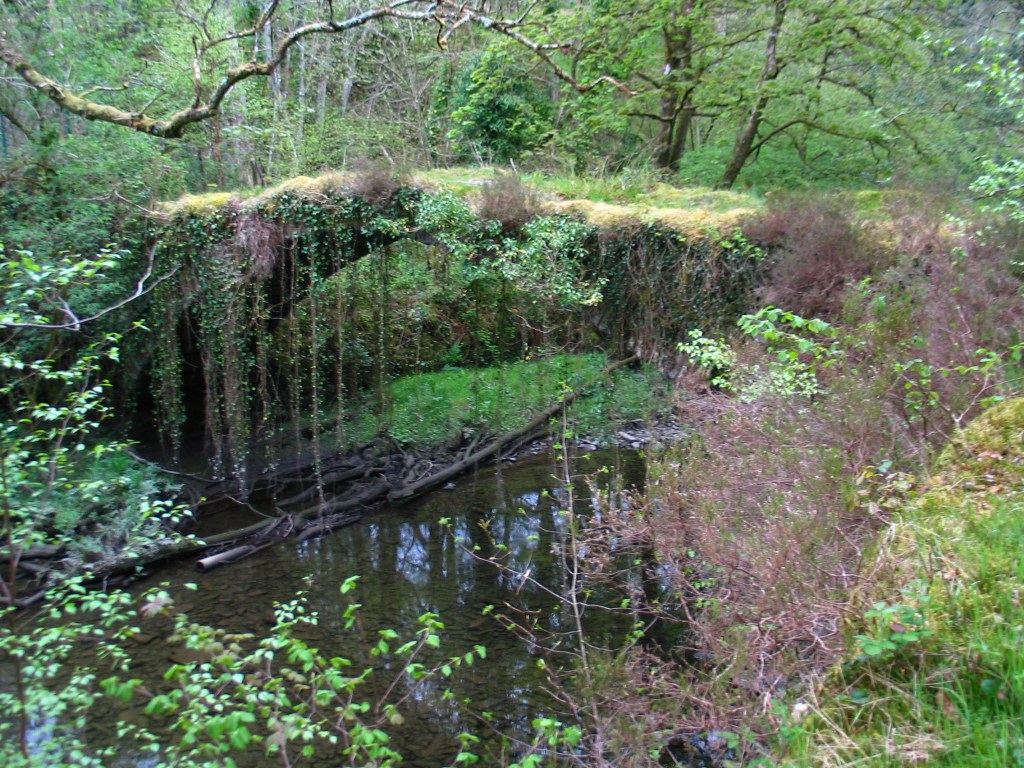
A hauntingly overgrown bridge on the lower path of the trail.

A pathway to paradise…

Views on the ascent: green as far as the eye can see…

Taking a break on the way up…
The Mabinogion is a collection of eleven medieval Welsh tales written down in the late eleventh century but with roots in the oral tradition. With a range of themes including Celtic mythology and Arthurian romance, the fanciful stories tell of dragons, witches, shape-shifting magicians and heroic warriors. Four of the tales, referred to as ‘branches’, form a loosely connected but distinct group and they have one recurring hero, namely Pryderi, the son of Pwyll, Prince of Dyfed and the beautiful and mysterious horsewoman Rhiannon. Pryderi is born in the first branch and dies as the King of Dyfed in the fourth, and it’s his tragic end that has left its mythical imprint in the lush landscape of Coed Felenrhyd.

The path winds ever on…

A glimpse of the Snowdonian mountains from the top.

Veiled in trees and vibrant foliage, a waterfall marks the high point at the eastern edge of the woods.
In a complex web of desire and deceit, Pryderi is goaded into battle by Gwydion, the magician and trickster and nephew of Math, King of Gwynedd. According to the tale, Math is in the curious position of only being able to exist if his feet rest in the lap of a virgin (perhaps she was good at reflexology), so he’s ‘unable to circuit the land’, although he is allowed out to go to war. The problem is, Gwydion’s brother is deeply in love with the maiden carer, Goewin, but as she is permanently looking after the king’s feet, he can only get to her if Math is out of the way. So Gwydion cooks up a plot to provoke a battle with Pryderi’s forces, and travels to his land disguised as a poet, where by illusion and magic he steals a load of special pigs (of all things) that were a gift to Pryderi by the king of the ‘Otherworld’. When Pryderi discovers he’s been cheated out of his precious swines he is furious, and the conflict escalates into war when his and Math’s armies march to battle, converging on Felenrhyd. However, Pryderi has second thoughts and ‘as soon as they reached Y Felenrhyd … Pryderi sent messengers requesting that both armies be called off, and that the matter be left to him and Gwydion’. Single combat ensues, but Gwydion triumphs by using magic and Pryderi is finally killed. The author tells us that ‘he was buried in Maentwrog, above Y Felenrhyd, and his grave is there’.*

Moss-clad boulders and trees. Could this quiet sanctuary be where Pryderi is resting?

A small footbridge crosses one of the woodland’s many streams…

A view on the way down.
We didn’t find Pryderi’s grave, but if he is lying somewhere in this unique woodland he couldn’t wish for a finer and more tranquil final resting place. We certainly found it a perfect sanctuary, and we’re looking forward to returning to Coed Felenrhyd and Llennyrch to explore some more. And our return here is indeed a certainty, for the reason for our Welsh trip was, in fact, to do some house hunting, as it is to North Wales we are moving. There’s no denying that fate works in mysterious ways, because following my great Castle Quest here back in 2019 that proved to be such an exciting and wonderful adventure, this place is soon to become our home.


