Which buildings qualify for the title of ‘Castle’ and which don’t is another subject constantly debated by historians. However, it’s universally accepted that a real castle had to fulfil two major functions: it had to be a splendid home for the lord or the king, and it had to have defences to withstand an attack and protect a garrison in times of war. If it only served as a posh home for the lord and his family it was just a manor, and if it was only a military bastion with no room for fun, it was merely a fort. In order to be a castle, it had to be both.
For me, that rules out anything much after the medieval era, because by the early modern period castles were becoming redundant as weapons of war, giving way to stately homes and lightly fortified manors as methods of warfare evolved and tastes and fashions changed. Take Hampton Court, for example, it’s without doubt a fabulous palace, but if it came under siege with a few trebuchets hurling huge stone balls at it, it’s walls would crumble instantly.
Another point to take into consideration when identifying a castle – and probably an obvious one – is that it has to look the part. It has to have certain features you’d expect to see, such as crenellations, towers, some arrow slits and/or gun loops, a gatehouse with a portcullis, perhaps a drawbridge, and possibly a moat from the outside, while on the inside you’d expect to see a great hall for the lord to entertain his guests, administer justice and meet with his tenants, a kitchen to feed the large household, a chapel and some luxurious accommodation with fireplaces and en suite facilities. Historians debate the validity of some castles, such as Bodiam in East Sussex, built towards the end of the castle era in 1385, because they say its defences are more for show than for true fortification purposes. But I disagree. Bodiam was not built by an earl or a king, but a knight called Sir Edward Dallingridge. But he managed to obtain a Licence to Crenellate from the king in order to build it, so Richard II must have had faith in his knight’s new castle. As long as it fits the criteria, who are we to judge what they saw back then as adequate defences to qualify Bodiam as a castle, at a time when warfare and threats of attack were constantly changing? It’s a luxury home, it has defences, including a giant moat, crenellated towers and a gatehouse with a portcullis, and it was built in the Middle Ages. And it most certainly looks the part. Ergo, for me, it’s a castle.
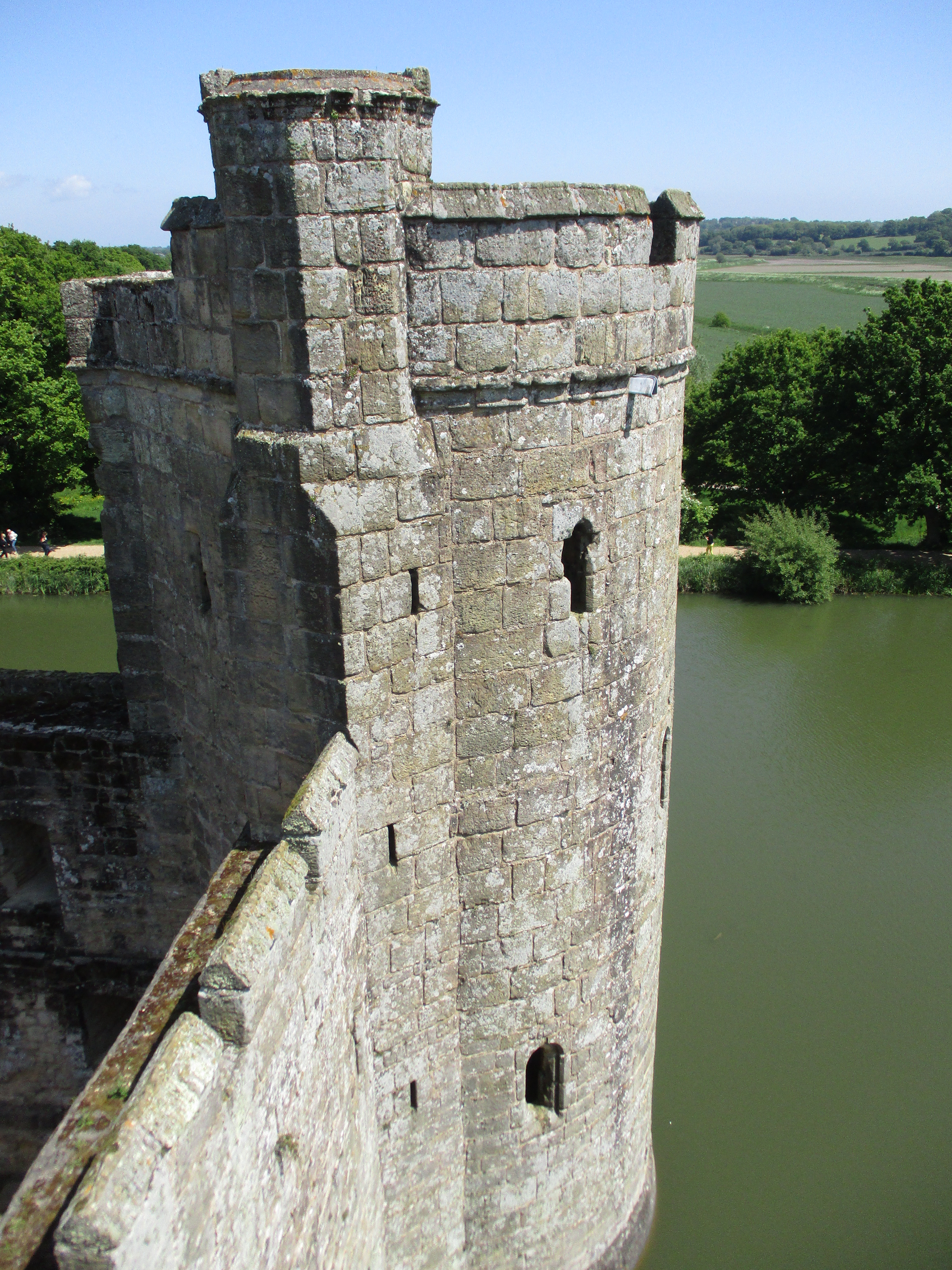
The view from the top of Bodiam Castle looking out over one of it’s beautiful towers and it’s massive moat. It’s a castle alright…
Contrary to many people’s impressions of castles in their ruined states that we see them today, during peacetime they were great places to live, with sumptuous furnishings, comfortable day to day living and lavish feasts and entertainments. But in times of conflict, all the fine living was shelved in favour of defence and basic survival.
So then, a castle had to be a posh home for the lord or king, and an instrument of war. On the one hand, it was a place for fine living, a grand display of the owner’s power and status and the centre of life for the people who lived on and worked his lands. But on the other it was a defensive stronghold when the need arose. Two opposing functions under one glorious title. And it’s those two, irresistibly incongruous purposes that make just one of the reasons why I love them so much.
 medievalwanderings.com