Writing about Easter in the Middle Ages has got me thinking about village life back then. It’s harder to pin down the lives of ordinary medieval people because they left little of themselves behind. I’ve walked over a fair few settlement earthworks in my time, those spectral lumps and bumps in the land, but the other day I got to wander around a very special place: a living medieval village. So come with me on a wander around the enchanting homes and buildings of a real community from the Middle Ages.

Cosmeston Medieval Village
Welcome to Cosmeston Medieval Village in South Wales, the remains of which were discovered in the late 1970s during the construction of the country park in which it now stands. Named after the Costentin family from northern France, this was part of the Anglo-Welsh border lands partitioned out after the Norman Conquest to keep the unruly Welsh in check. During the 1980s a thorough archaeological investigation was undertaken, revealing an entire lost community. Buildings emerged and everyday artefacts surfaced such as a fishhook, a jug and a penny from the reign of Edward 1st. So it was decided to reconstruct the buildings, keeping each on its original site, with future excavations aiming to explore the manor house, the dovecot and the field systems around the settlement. In the meantime it’s open to visitors, and occasionally the buildings are used by costumed re-enactors for their original purposes. So now it’s time to turn off your mobile phone, leave your modern day worries behind, and imagine walking along with me as we go through the gates to Cosmeston and begin our journey back in time.
In the doorway of the Reeve’s House – better wipe our feet, this is a posh one…
Our first stop is the Reeve’s house, a good start because it’s the poshest home on site. The Reeve is a fairly wealthy freeman, and his job is to manage the farming of the manor. He assigns work to the peasants who are bound to the lord and his land, and he keeps an eye on the all-important boundary markers. He pays the highest rent to the lord for both his house and a barn for his farming tools and ploughs, and for storing wood, an extensively used material in medieval life. His comfortable and well-appointed house consists of a whole, entire room, divided into distinct areas of work and rest. And you can see how wealthy he is by the fixtures and furnishings. The walls are lime-washed and brightly painted, the windows shuttered, and he has an array of colourful pottery and a comfy mattress on his bed. Another sign of wealth is the wooden floor, whereas more commonly this would be beaten earth scattered, if anything, with rushes. So wood is luxury, indeed. But in truth, I do think the Reeve’s house has a comfortable and homely feel. I’m sure I could make do.

Inside the Reeve’s house: wooden floors, comfortable furnishings, brightly coloured walls and shuttered windows – what more could you want?
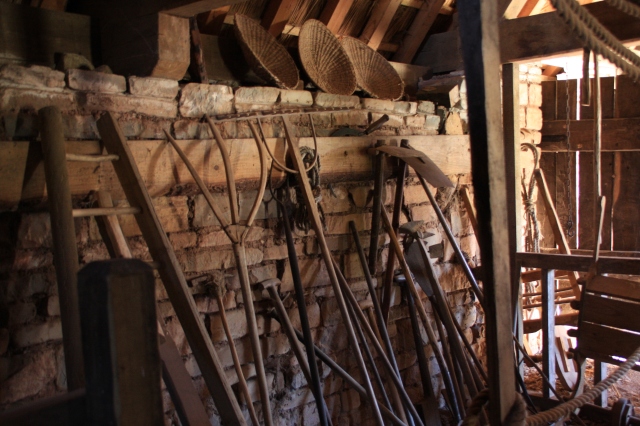
Farming tools in the Reeve’s barn
Next we come to the peasant’s cottage, a typical farmer’s home rented by the villager from the lord. This is a dinky little dwelling, doubling up as an animal shelter during the cold months for the sheep kept by many villagers for their wool. There’s a meagre bed, a coracle for fishing, and not a lot in the way of comfort. And the floor smells of damp earth. So living like this in such cramped conditions with few washing facilities must make for a thoroughly aromatic place to live. Still, I’m sure the sheep get used to it. Any spare space could be sublet for a little extra income, and outside there’s a small yard where the animals live in better weather, while some peasants also rent a small piece of extra land on which to grow vegetables.
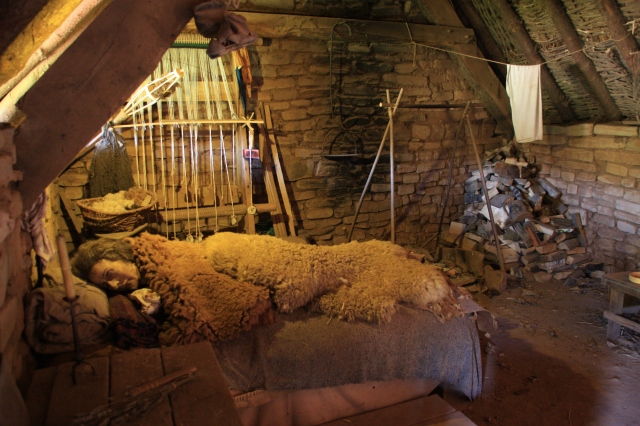
Inside the peasant’s cottage: bare earth floor and cold comfort

In the back yard of the peasant’s cottage: some had a little patch for cultivating vegetables

The peasant’s cottage from the main street, with the bakers next door
Adjoining the peasant’s cottage is the busy bakers – with added extras. The baker only works here as he lives off site, and in many places he’s the only person allowed to make bread and use the village ovens. Should a villager dare to bake their own bread, they’re rewarded by being branded on the hand with a hot iron in the shape of a cross. The baker prepares and sells six types of bread from his premises, ranging from the expensive loaves made from sifted white flour to the lowly version for peasants made from a mixture of wheat, rye and flour. The very poorest have to make do with plain rye, sometimes enriched with ground acorns or even stone dust.
But I promised you extras, and the bakery doubles up as the village tavern. As the scent of freshly baked bread fills the air, in here we can meet our fellow locals and have a chat, play games and drink beer. But the most common drink these days is mead, so I think I’ll just hang around here for a while…
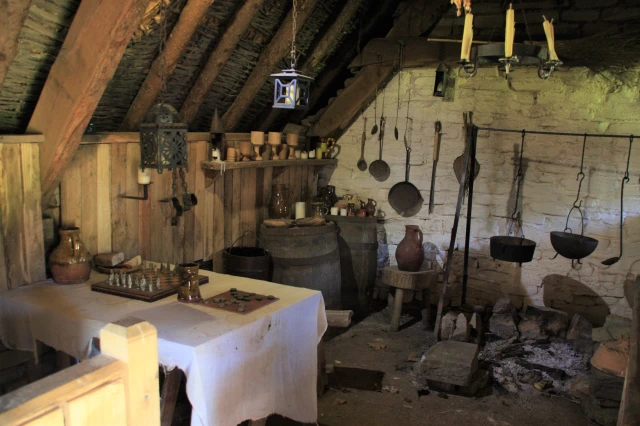
The other half of the bakery – the village tavern

The bar in the tavern – is that a jug of mead?
Next to the pub/bakery is the village oven where the bread is baked. This small building houses two ovens either side of a passageway. The baker lights the bread oven and his apprentice tends it with wood and a bellows until it’s ready to receive the dough. The first bread of the day goes to the lord of the manor, but because it has sat on a bed of ash and the bottom often burns, this is sliced off and the ‘upper crust’ is presented to the lord – hence the saying. The other oven is used for a variety of purposes, including smoking and drying meat and fish, drying damp grain after harvesting and roasting barley for ale.

The back of the bakery, with the village ovens behind
Wandering back down along the other side of the lane, we come across two more buildings, one big and one more modest. The first, a cottage, is that of the swineherd, who looks after the village pigs. Divided into three sections, the swineherd’s home also has to be shared with the animals, as well as serving as his living and working space. Apparently, lords love their pigs, apart from when they eat them, but the animals do have comfortable and positively pampered lives first. At Cosmeston, the lord has built a palatial pigsty behind the swineherd’s cottage, to where the pigs can retreat after their regular forays into the woods to forage for fallen acorns and fruit. Nothing is wasted in these Middle Ages, so aside from the meat, candles are made from the ‘tallow’ fat, which is the most common form of medieval lighting.
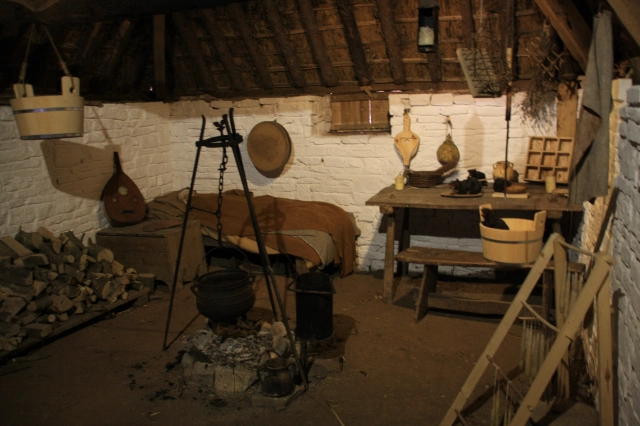
Inside Swineherd Cottage, with tallow candles drying on the right
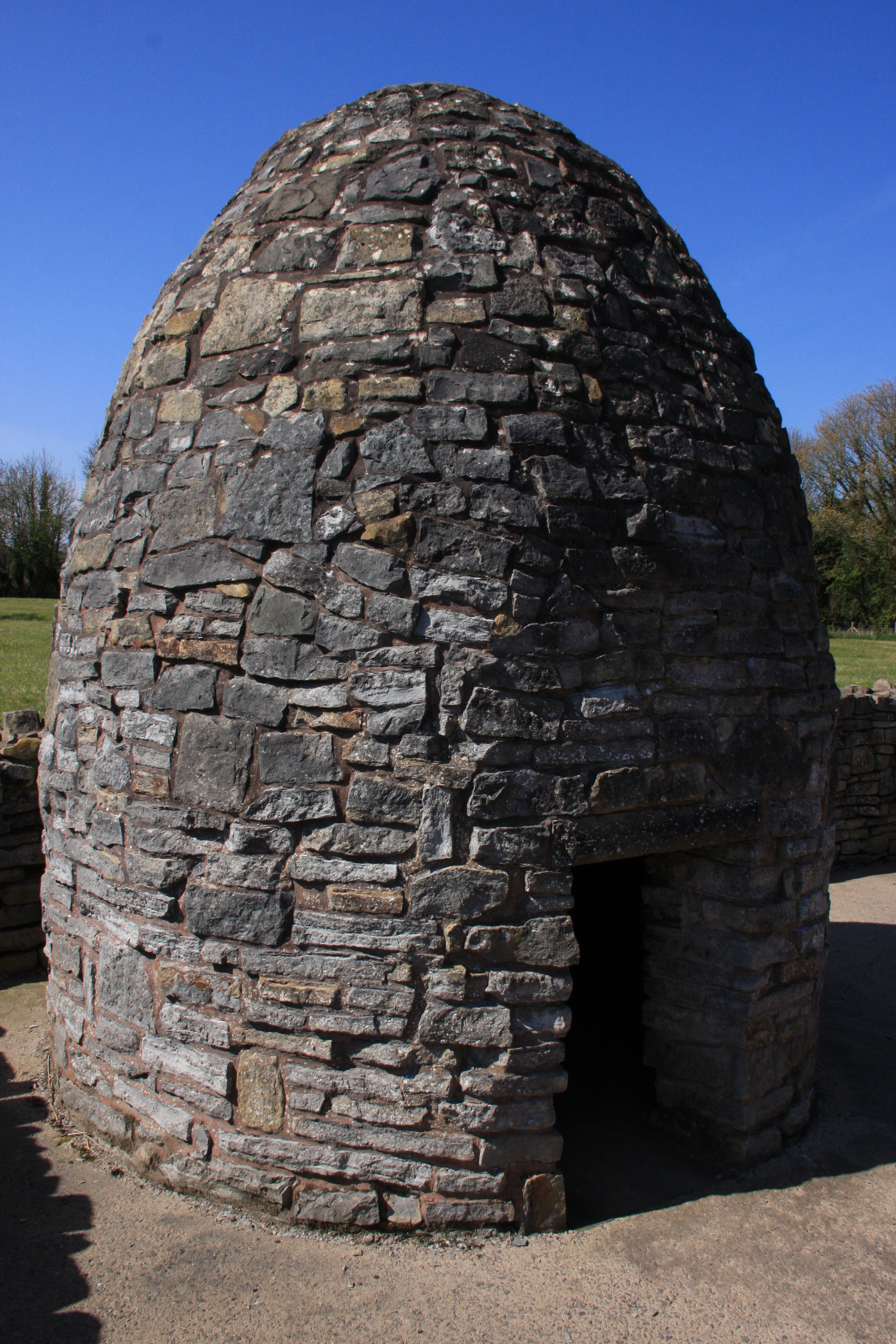
The posh pigsty: the lord is said to have spent more on this than he did on the village houses!
The final stop on our tour is probably the grandest. The Tithe Barn is the only building that doesn’t belong to either the lord or the villagers, but is owned by the church. Divided into two sections and brightly decorated, one side houses the village priest who’s responsible for checking and storing all tithes paid by the villagers and recording them in the ‘scriptorium’. The church taxes everything grown, produced or earned at 10 per cent, ‘tithe’ meaning one tenth. The other section of the barn produces further income for the church by being hired out to travelling traders or surgeons.

The side entrance to the Tythe Barn, and the village stocks – so be good!
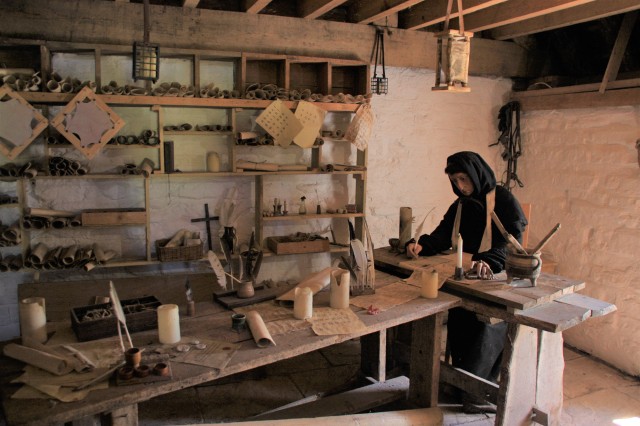
The tax man commeth – the village priest in his scriptorium

A small altar in the Tythe Barn
Leaving through the wide double doors of the Tithe Barn, we have now only to wander through the gardens of the village apothecary, where herbs for medicines are grown and gathered, and past a small hovel of unknown purpose, which it’s thought may be used to store plants during the winter.
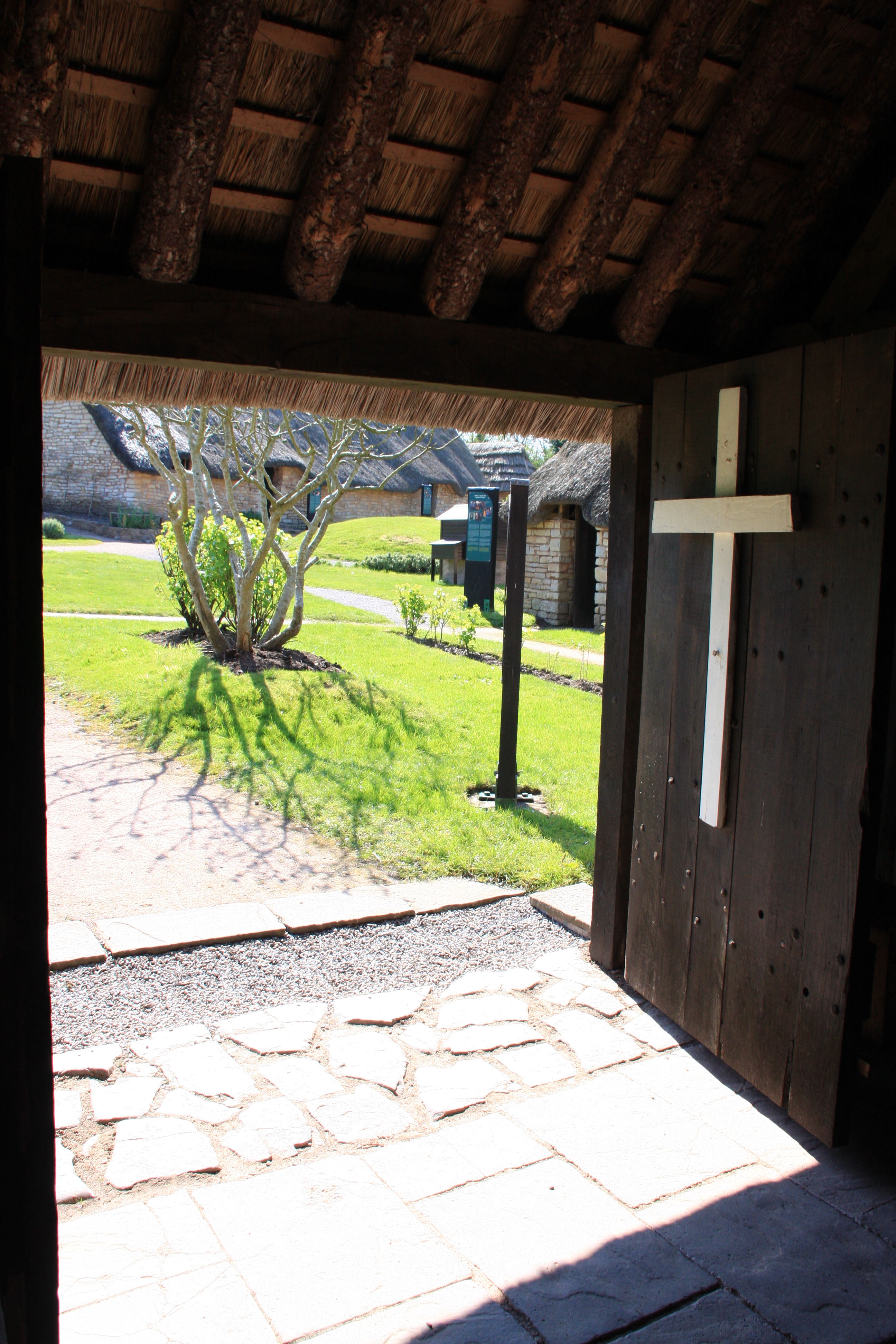
Leaving the Tythe Barn through it’s large double doors…
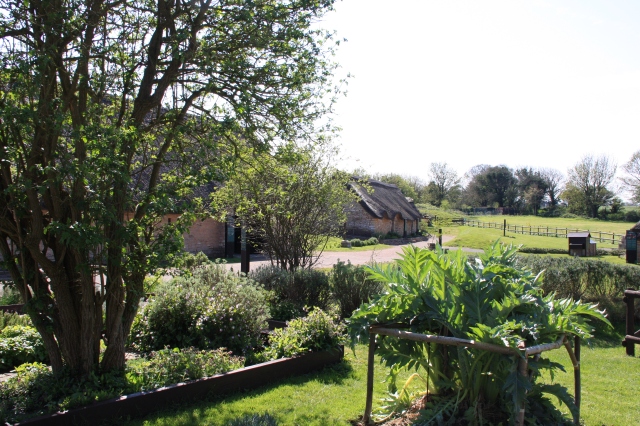
Looking out into the village from the herb garden
And so we arrive back at the village gates. I hope you’ve enjoyed our wander through a medieval village, and poking around the residents’ homes and workplaces. But right now, I think I’ll just pop back to the tavern for a goblet of mead and a chat before buying a loaf of white (of course!) bread, and nipping back home – to the Reeve’s house, or maybe the manor, or better still the place I really belong – a castle…

