While young Sticky Rogers sleepily transforms into something magical all tucked up in his comfy nest in the pantry, I’ve been learning all about the worlds’ oldest alcoholic beverage. The story of mead stretches back for millennia, and it’s as rich and complex – and sometimes as dark – as the drink itself. It shared the stage with some of our most ancient peoples as well as our medieval forebears, and aside from its appearance in historical sources, it’s been a feature of our mythology and literature throughout time. But, of course, this is Medieval Wanderings (although at times this Quest may well be more of a Medieval Wobbling), and my main interest is bound to centre around my beloved era. So, where to start..?

Sleeping Sticky Rogers: he may be quiet, but he’s dreaming a lot…
Mead has been around far longer than people have been writing about it. And it’s a drink with global appeal. Archaeological evidence from Chinese pottery jars has shown traces of a fermented drink containing honey and fruit from as long as 9000 years ago. It’s referenced in ancient Greece and Egypt, with early sources suggesting it was imbibed in India some 2000 years BC. Mead also cast its mellifluous spell over the Romans and the Vikings, as well as the Russians and even the Ethiopians. The Greeks believed mead to be a gift from the gods, a divine nectar appearing as dew and collected by bees. Little wonder then that the ancients thought it held sacred and magical properties, and that its health benefits increased everything from virility, life expectancy and strength to creative and literary endeavours such as poetry. But it wasn’t all good news. There are also stories from long ago showing that mead could get you into quite a bit of trouble, and one I came across comes from the early Saxon period, and it happened right here on British soil.
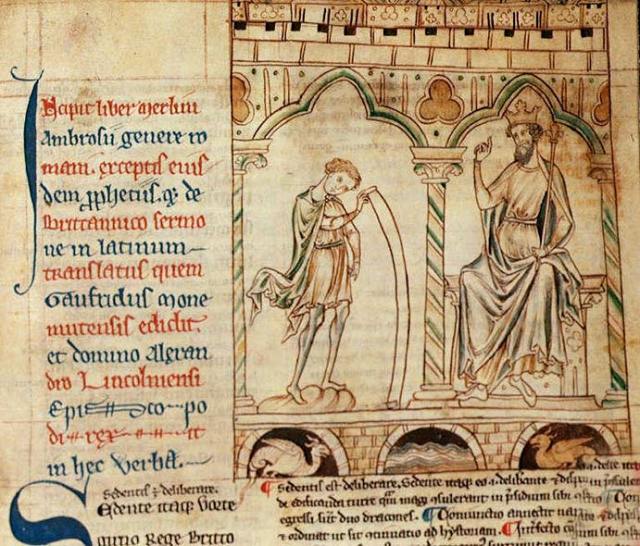
This 13th Century manuscript shows a rare picture of Vortigern. The figure to the left isn’t pouring a fountain of mead, it’s Merlin reading him his long list of prophecies…
For this, we have to travel all the way back to the 6th Century and an account written by one of the first British historians, a monk named Gildas. According to Gildas, the early 5th Century leader of the Britons, whom we know as Vortigern, invited the Saxons to enter his service and defend his land against Pictish and Irish attacks. The leaders of this Saxon army were two brothers called Hengest and Horsa, and Vortigern’s plan worked for a while until the Saxons became greedy and started demanding land as reward. But when another Roman Briton, Ambrosius, also rebelled, Vortigern called again on the help of Hengest, who, spotting a good opportunity to secure the desired land, came up with a plan of his own. He sent for reinforcements from home, more warriors who arrived in many ships, along with an ace to keep up his sleeve: his beautiful daughter, Rowena.
Hengest invited Vortigern and his nobles to a banquet, during which copious amounts of mead, ale and wine flowed before his daughter appeared to help serve the drinks. The now inebriated ruler of the Britons instantly forgot the recent territorial tussles and fell in love with the girl, demanding her hand in marriage. He was so besotted he promised: “I will give anything you want in return – even half my kingdom!” He ended up giving his new father-in-law the province of Kent, which didn’t technically belong to him. But that didn’t bother Hengest. He’d got what he wanted, for now…

Vortigern at the banquet, falling under the spell of Rowena – and the mead…
When everyone had sobered up, Hengest’s lofty ambitions caused more wars and the death of Horsa and Vortigern’s son, Vortemir, until five years later when peace was finally negotiated. To ratify the treaty, Hengest again invited his son-in-law and his nobles to a huge feast, and again it was mead that oiled the cogs of their newfound amity. When the unarmed Britons were sufficiently drunk, Hengest gave the signal for assassination, and his men drew knives concealed in their boots and slayed hundreds of the unsuspecting guests. Vortigern himself managed to dodge a grisly death by ransoming his provinces, but, according to Gildas, he: “wandered from place to place till his heart broke and he died without honour”. This poor old leader of 5th Century Britons ended up being universally hated, all because of his poor judgement and too much mead.

Beware the Saxon banquet…
Nowadays, many scholars dispute the ferocity of the Saxon rebellion, and Gildas’ writings undoubtedly display a hatred of the Saxons and an angry despair of Vortigern and his council: “What utter blindness of their wits. What raw, hopeless stupidity!” But whatever the truth, the story does show how potent a libation mead was, and the havoc it could wreak when it’s intoxicating properties blunt the senses of even top-ranking leaders.
Still, it’ll do for me, and it is a great story. So I think I’ll go and drink a toast the hapless Vortigern with the first batch of honey wines I have lined up to try out…
 medievalwanderings.com