Last week I realised that it was exactly a year ago that I completed my Welsh Castle Quest, and I’ve been looking back through that epic journey and all the adventure and discovery it entailed. After the Quest, we stayed on in Wales for a week’s break and, inevitably in this ‘land of castles’, we found a few more. But those we visited during our wind-down week were no great English fortresses born of Edward I’s Welsh Wars, but more modest castles built by the earlier, native princes of Wales. One in particular jumped out from my trawl through the photos for several reasons: it’s in a spectacular setting, it had a walk-on part in the Welsh Wars and it was built by one of greatest Welsh rulers of the middle ages.

The castle keeps vigil from its high rocky ridge
This was the first day of our post-Quest holiday, and we’d actually set out to explore the magnificent mountains. But as we drove through Snowdonia on the A470, I caught sight of a handsome tower in such a commanding position I just had to investigate. Pulling into a car park, we realised that we’d stumbled across Dolwyddelan, one of the most impressive Welsh castles built by the native princes. The castle sits proudly in its rock-cut ditch atop a high ridge, and access to it entails a climb up the hill on foot, so realising that we’d already spent two weeks on a castle quest I gallantly offered to forego a visit and press on into the mountains. Luckily though, everyone felt this intriguing edifice was too good an opportunity to miss, so we set off.

The castle’s Snowdonian setting
The early Welsh rulers weren’t natural castle builders like the Normans. Instead, a prince would travel around his lands, staying at each place in an undefended hall within a court, called a llys, which formed the administrative base of the surrounding estate. But after the Norman invasion, William the Conqueror’s chums built their wooden motte-and-bailey, and later stone castles, as terrifying instruments of their Welsh invasions and and border occupations. In time the idea rubbed off, and by the 13th century the native rulers had begun building their own stone strongholds to defend their territories, and this is where Dolwyddelan and its creator come in.

The hilly approach to Dolwyddelan
It was in this elevated position overlooking the Lledr valley in Gwynedd that the most famous of the native Welsh princes, Llywelyn ab Iorweth, or Llywelyn the Great, chose to build his castle soon after 1210. The location amid Snowdonia’s rugged natural defences was an obvious choice, but it’s also believed that the prince was born (c1173) at Tomen Castell, an earlier stronghold just across the road. Little is known about Llywelyn’s early life, but a popular theory is that after the early death of his father, his mother took him to Powys where he was educated and trained. But the life of a Welsh noble was never easy. The rules of partible inheritance meant that when a landowner died, his estates would be divided equally between all his sons – legitimate or otherwise – and this led to violent clashes and even murderous family feuds. Young Llywelyn, however, was fiercely ambitious. He was out to win as much of Wales as he could get his hands on, and that meant seizing power by fire and sword.

This craggy mound, lying across the road from the castle, is all that remains of the supposed birthplace of Llywelyn the Great

The man himself: Llywelyn ab Iorweth, ‘the Great’
According to a contemporary poet at Llywelyn’s court, the prince was no more than 12 years old when he embarked on his first military campaign; a civil war for control of the whole of Gwynedd. By deception and in battle he managed to defeat his two uncles, and in 1198 he moved on to tackle his cousins until he became the undisputed ruler by 1201. With the whole of north Wales in the bag, soon it was time to make sure everyone knew he was the true master of all he surveyed. And what better place to build a lasting assertion of his greatness than the place where he was born? So Llywelyn returned to Dolwyddelan and built a stone keep and a courtyard surrounded by a low curtain wall high up on a strategic spot guarding a main route through the mountains. This formidable prince had earned his place as ruler of the north, and now he’d come home to prove it.

The great tower is entered at first floor level

Inside the keep, the main chamber has a cosy feel. I can just imagine the warming flames in that fireplace!
Following his success in Gwynedd, Llywelyn the Great looked to the rest of Wales and beyond, nurturing a friendship with King John of England that earned him the hand of John’s illegitimate daughter, Joan. Through a mixture of conquest, guile and alliances, Llywelyn extended his authority across much of Wales, becoming the premier native ruler by 1218. To reflect his rise to the top, in around 1230 he upgraded his regal accommodation, building a bigger castle at Criccieth that became his new power base until his death in 1240. Sadly, however, the legacy of Llywelyn’s hard-won success was not to last. His grandson’s wars with Edward I of England ended the long line of native princes, and many Welsh castles, including Dolwyddelan and Criccieth, were taken and enhanced by the English king for his own purposes of crushing the Welsh. In 1283, Edward heightened the keep at Dolwyddelan, added a new tower, installed a siege engine with stone missiles and he even equipped his garrison with white tunics as camouflage for winter warfare. Llywelyn’s Welsh badges of honour had become English badges of conquest.

The remains of the tower attributed to Edward I faces the keep
Compared to Edward’s ‘iron ring’ of English fortresses, Dolwyddelan is tiny, but I loved it nonetheless. The tower, which was restored in the 19th century, has a curiously homely feel, so much so that I could quite happily move in. The principal accommodation is on the first floor, reached via a set of external steps to what was once a small defensible forebuilding. But it’s when you get out onto the battlements that you can see exactly why Llywelyn chose to build on this spot. It feels as though he could have seen his entire rugged realm from up here, and I could have spent hours just taking in the spectacular views. But those wild mountains were calling, and all too soon it was time to make our way back down the hill and drive on.

Feeling at home in the keep: a room with a stunning view

The view from the battlements
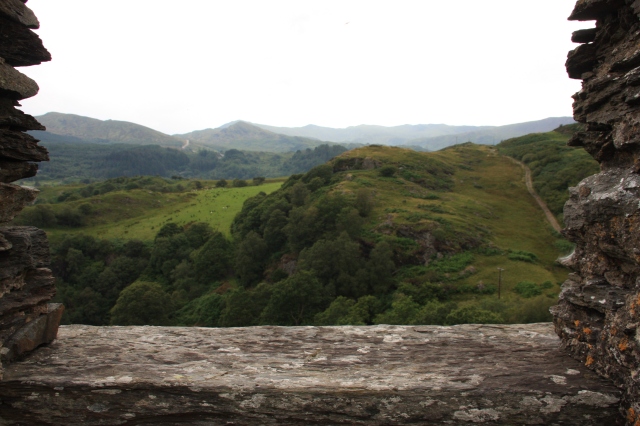
Master of all he surveyed: Llywelyn’s Snowdonian territory
My experience at Llywelyn’s little castle stayed with me as we wended our way through the untamed landscape of his Snowdonian dominion, and in many ways the mountains still carry his presence, along with the echoes of his grandson’s ill-fated resistance to English subjection. From that day, having explored his homeland and touched the fabric of his world, I felt as though somewhere between our worlds I’d crossed paths with Llywelyn the Great, and got to know him and his spellbinding story.


